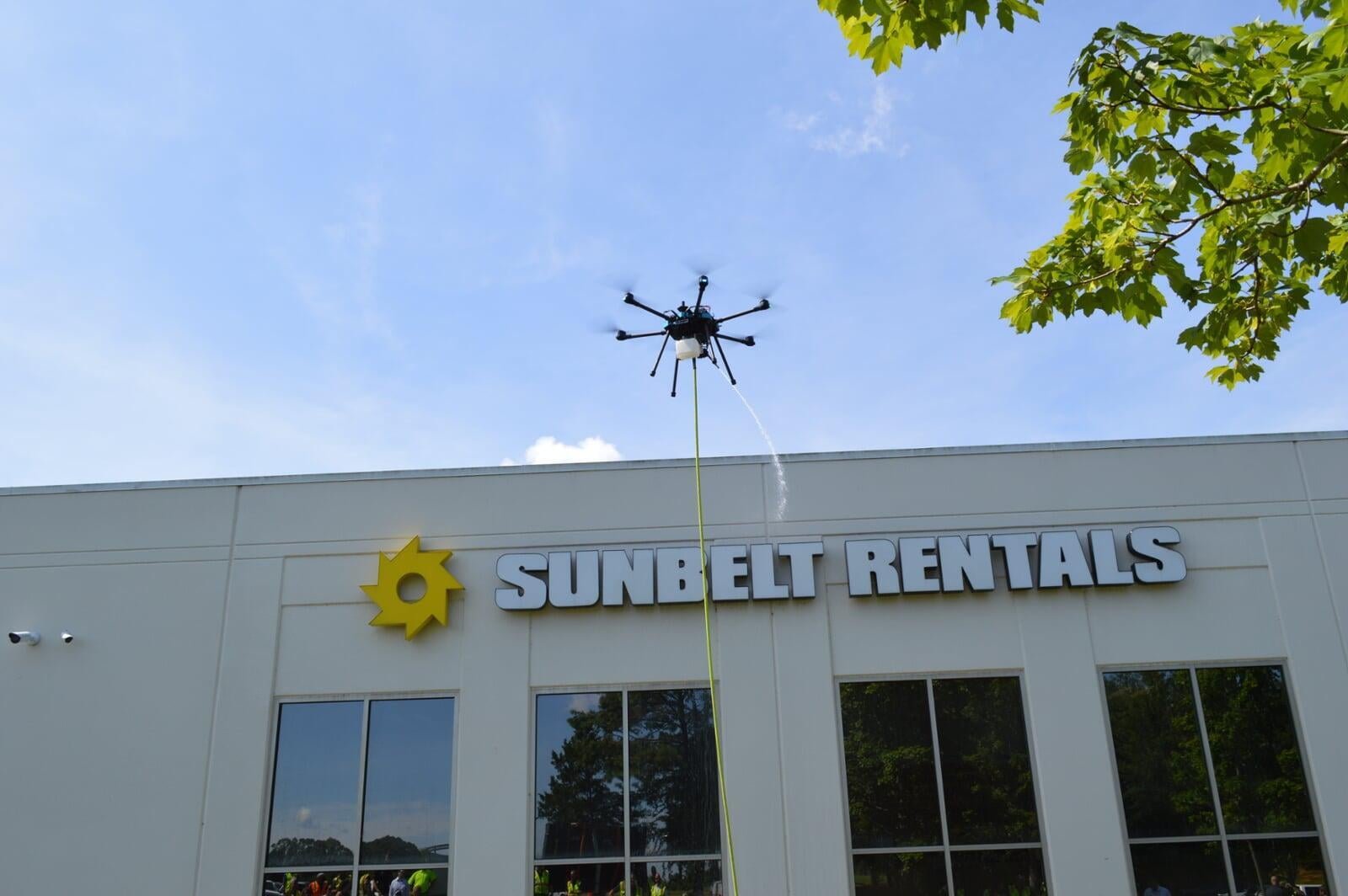
Sunbelt Teams With Lucid Bots
Sunbelt Rentals has entered into a strategic partnership with Lucid Bots
Sunbelt Rentals has entered into a strategic partnership with Lucid Bots.
The agreement calls for Sunbelt to make Lucid Bots cleaning drones available to the company’s rental customers nationwide. The two organizations will collaborate on an approved solution program for their clients, and the drones will be backed by Sunbelt’s support and service to maintain the equipment for optimal use.
“Partnerships like the one with Lucid Bots are what has enabled us to bring innovative solutions to our customers,” said Adam Camhi, Sunbelt vice president of flooring solutions. “With the Lucid Bots cleaning drone, our customers will have safer operations, reduce their environmental impact, and increase overall operator efficiency, while still completing tough exterior cleaning jobs.”
About Sunbelt
Fort Mill, South Carolina-based Sunbelt Rentals supplies a wide variety of rentals for the facility services market. For more information, visit www.sunbeltrentals.com.
What This Partnership Means for Operators
The Sunbelt Rentals partnership gives cleaning contractors and facility managers a low-risk way to test drone cleaning before purchasing equipment outright. Instead of committing to a full system, operators can rent a Sherpa Drone through any Sunbelt location and deploy it on real jobs, proving ROI before signing a purchase order.
For building service contractors handling exterior work on commercial properties, hotels, universities, and warehouses, the rental model solves one of the biggest adoption barriers: upfront capital. A single weekend rental can demonstrate the labor savings and speed improvements that justify long-term investment.
Key Benefits of the Rental Program
Whether you are an established exterior cleaning business or a contractor exploring drone services for the first time, the Sunbelt Rentals program removes the friction between interest and action. Talk to the Lucid Bots team to learn more about rental availability in your area.
Related Articles
.jpg)
Best Commercial Drones for Building Cleaning in 2026
175 deals, $9.7M in operator revenue in 2025. The complete guide to commercial drone cleaning: how it works, what it costs, and how to get started.
If you're evaluating commercial drones for building cleaning, you're not shopping for a hobby quadcopter. You're making a capital equipment decision — one that affects your crew's safety, your job capacity, and how you bid work going forward.
This comparison covers the drones actually being used for commercial exterior cleaning today, what they cost, what they do well, and where they fall short. No filler, no speculation.
Quick Comparison
| System | Type | Reach | Pressure | Flight Time | Price |
|---|---|---|---|---|---|
| Lucid Bots Sherpa | Aerial pressure washer | Up to 150 ft | 4,500 PSI | ~19 min | $75,000 or $2,950/mo |
| Apellix W1 | Tethered aerial sprayer | Variable (tethered) | Lower pressure | Continuous (tethered) | Custom quote |
1. Lucid Bots Sherpa — Best for Commercial Facade and Window Cleaning
The Sherpa is the only purpose-built aerial pressure washing drone with commercial contractor-grade specs. It's designed for the same operators who currently budget scaffolding, swing stages, or rope access to clean mid-rise facades, curtain walls, and large commercial windows.
Key specs:
- Cleaning rate: 300+ sq ft per minute
- Pressure: 4,500 PSI
- Flight time: ~19 minutes per battery cycle
- Vertical reach: up to 150 ft
- Water supply: ground-based, fed through a lightweight hose
What it replaces:
A scaffolding setup for a 10-story facade can run $15,000–$40,000 in equipment rental and labor before a single gallon of water hits the building. The Sherpa lets a two-person crew do the same job from the ground — one operator flies the drone, one manages the ground rig. No swing stage permits. No OSHA fall protection coordination. No half-day setup.
ROI:
Most operators recover the equipment cost within two jobs when they're replacing scaffolding or lift rentals. On a $2,950/month Lucid Refresh subscription, the monthly payment typically runs well under the cost of a single aerial lift rental — which means the subscription pays for itself before the month is out on an active schedule.
Best use cases:
- Mid-rise and high-rise facade washing
- Commercial window cleaning (exterior)
- Curtain wall and glass panel cleaning
- Concrete and brick pressure washing at height
- Solar panel cleaning on commercial arrays
- Coating and sealant application on tall structures
Pricing:
The Sherpa is available outright at $75,000, or through the Lucid Refresh subscription at $2,950/month. The subscription includes maintenance, software updates, and technical support.
Honest limitations:
The Sherpa runs on battery cycles, so large jobs require either multiple batteries or scheduled charging windows. It's not a continuous-operation system the way a tethered unit is. For very high-volume, all-day industrial coating work on massive structures, that cycle management is a real operational consideration.
2. Apellix W1 — Best for Continuous Industrial Application
Apellix makes a tethered aerial system designed primarily for industrial painting and coating on large structures — think oil tanks, marine vessels, and infrastructure assets. It's a different tool for a different buyer.
What makes it different:
Because it's tethered, the Apellix W1 isn't limited by battery life. It can operate continuously as long as the ground power source runs. That's a meaningful advantage for all-day industrial coating projects where crew downtime between battery swaps would compound across a long job.
Where it fits:
If your work is primarily large-scale industrial coating — refineries, port infrastructure, storage tanks — Apellix is worth evaluating. It's built for that environment.
Where it doesn't fit:
For commercial building cleaning, facade washing, or window cleaning, Apellix is not the right tool. The tethered design limits maneuverability around complex building geometry. It's also priced and configured for industrial buyers, not commercial cleaning contractors. The two systems serve different markets.
What to Know Before You Buy
A drone is only part of the system. Operators consistently flag three things that determine whether aerial cleaning actually works in their business:
1. Ground crew requirements
The Sherpa needs a two-person crew at minimum. One flies, one manages the water supply and ground equipment. If your current jobs already run two-person crews, this is a direct substitution. If you're trying to run solo, aerial cleaning adds a headcount requirement.
2. Water source logistics
The Sherpa pulls water from a ground-based supply. On most commercial jobs, that means a water tank truck or a building-side hookup. Contractors who already operate pressure washing trucks have the infrastructure.
3. FAA Part 107
Flying commercially requires a Part 107 Remote Pilot Certificate. It's a written exam — most operators pass within a few weeks of study. Lucid Bots' onboarding process walks new customers through it.
The Case for Autonomous Ground Cleaning
Not every cleaning challenge is at height. For ground-level pressure washing — parking garages, warehouse floors, large hardscape surfaces — the Lavo Bot is worth knowing about. It's an autonomous ground pressure washing unit that runs independently while your crew handles other tasks. Contractors who run both aerial and ground work are increasingly pairing the Sherpa and Lavo Bot to cover a full site without dedicating a human to every surface.
Frequently Asked Questions
How much does a commercial cleaning drone cost?
The Lucid Bots Sherpa is priced at $75,000 purchased outright, or available through the Lucid Refresh subscription at $2,950 per month. The subscription includes maintenance and support. Apellix does not publish pricing publicly — their systems are priced for industrial buyers rather than commercial cleaning contractors.
Do I need a license to fly a commercial cleaning drone?
Yes. Any commercial drone operation in the U.S. requires a Part 107 Remote Pilot Certificate from the FAA. This is a written knowledge test. The process typically takes two to four weeks of preparation. It's a one-time certification, not a per-job permit.
Can a drone actually clean a building effectively?
At 4,500 PSI and 300+ sq ft per minute, the Sherpa cleans at commercial pressure washing standards. The limiting factor is usually water supply logistics and job planning, not the drone's cleaning capacity.
How does drone cleaning compare to scaffolding or swing stage costs?
Scaffolding and swing stage rentals for a 10-story building typically run $15,000 to $40,000 or more, depending on building complexity and duration. On jobs where the Sherpa replaces a lift rental, operators often recover the monthly subscription cost within a single project.
What buildings is the Sherpa suited for?
The Sherpa's 150-foot vertical reach covers most mid-rise commercial buildings — office towers, hotels, mixed-use buildings, and institutional facilities in the four- to twelve-story range.
The Bottom Line
For commercial building cleaning in 2026, the Lucid Bots Sherpa is the only purpose-built aerial pressure washing system designed for the commercial contractor market. The specs are real, the pricing is transparent, and the use case is specific: it's for operators who are currently spending significant money on scaffolding, lifts, or rope access to get water to the side of a building.
Apellix fills a different niche — industrial coating on large infrastructure assets — and is worth knowing about if that's your work.
If your business runs facade washing, exterior window cleaning, or high-rise pressure washing, the Sherpa is the closest thing to a direct answer.
Talk to our team to see whether the Sherpa fits your current job mix, or get a demo and put a number to what you'd save on your next scaffold job.
.avif)
1 Hour, 53 Seconds of Continuous Drone Cleaning
Sherpa Drone just completed 1 hour and 53 seconds of continuous exterior cleaning using Lucid Bots’ new power tether—unlocking effectively unlimited flight time.
Lucid Bots builds U.S-made robots for dirty, dangerous cleaning work.
On a recent exterior cleaning job, Sherpa Drone stayed in the air for 1 hour and 53 seconds of continuous cleaning at 3,500 PSI and 8 GPM.
No battery swaps.
No landing every few passes.
Just steady exterior cleaning at height while the crew stayed on the ground.
Our CEO, Andrew Ashur, put it simply: this was the longest commercial drone cleaning flight we've ever seen – and a big step toward making drones a true all-day tool on real jobsites.
Why this flight matters
Until now, drone cleaning has been limited by batteries.
A typical day with Sherpa Drone looks like:
- Clean for 10–20 minutes
- Land
- Swap batteries
- Take off, line up again
- Repeat
It works, but you lose time and rhythm on every swap. Jobs get planned around chargers and packs instead of just buildings, water, and crew.
With our new power tether, that equation changes.
By feeding power from the ground, it gives Sherpa Drone effectively unlimited flight time: the practical limit on a job is no longer at the fault of the drone batteries. Limitations become things like crew endurance, site scheduling, generator fuel, etc. rather than remaining battery capacity. We're not removing constraints entirely, but we are moving them off the drone's batteries.
On this record flight, the drone didn't come down because the battery was dead. It came down because the section of work was done.
That's the shift we care about.
What actually happened on the job
This wasn't a lab test or a parking-lot demo. It was a live exterior cleaning job with all the usual constraints.
On this flight:
- Mode: High-pressure exterior cleaning at height
- Runtime: 1 hour, 53 seconds of effectively continuous work
- Pressure / flow: 3,500 PSI, 8 GPM
- Crew: Operators stayed safely on the ground
Sherpa Drone handled every pass on the wall. The crew focused on:
- Managing hoses and water supply
- Watching for quality of clean
- Keeping eyes on the site, not on battery timers
Under the hood, we paired the power tether with updated onboard power electronics designed for long flights. From the operator's point of view, though, it felt simple:
"It just stayed up and kept cleaning."
That's the experience we're building toward.
What this unlocks for operators
For contractors, facility managers, and building service companies, this milestone shows up in a few concrete ways.
1. More work per crew per day
With no battery swaps, more of the day is actual cleaning. Sherpa Drone becomes an all-day workhorse for glass, facades, and other exterior surfaces at height.
2. Less time in lifts
Sherpa Drone does the work at height so crews can stay safely on the ground. That means:
- Fewer lifts to rent, move, and maintain
- Fewer people working on edges, roofs, or swing stages
3. Simpler planning
Instead of planning around chargers and packs, you plan around:
- Water
- Generator fuel
- Crew schedules
In other words, the things you already think about on a pressure washing job.
What's next
This was Lucid's first and longest exterior cleaning jobsite flight with the power tether. It's a milestone, not the finish line.
From here, our team is focused on:
- Repeating long-duration flights on more buildings and surfaces
- Gathering real-world feedback from operators
- Making the power tether available to more Sherpa Drone customers
We automate the ordinary, so humans can do the extraordinary.
If you want fewer people in lifts and more work done from the ground, talk with our team about using Sherpa Drone with the power tether on your next job.
Lucid Bots and NVIDIA: Riding the Next Industrial Revolution
NVIDIA is laying the foundation for the next industrial revolution with over 2 million developers building robotics on its platforms. From Isaac Sim for digital twins and testing, to Isaac ROS GEMs for advanced autonomy, and Jetson for real-time edge AI — NVIDIA is the backbone of embodied intelligence. At Lucid Bots, we’re harnessing this ecosystem to build robotic systems that take on the world’s dirtiest, most dangerous jobs — transforming industries with safer, faster, and smarter automation.
NVIDIA just announced a milestone that signals more than progress — it signals a shift in history. Over 2 million robotics developers are now building on its platforms, from Isaac Sim for simulation to Jetson for edge AI computing. This isn’t just a developer count; it’s the early scaffolding of the next industrial revolution.
The first industrial revolution mechanized human labor. The second scaled it with electricity and assembly lines. The third digitized it with computing and the internet. Now, the fourth industrial revolution is physical again — driven by embodied AI and robotics that can perceive, decide, and act in the real world.
At Lucid Bots, we are building for this moment. Our focus is on developing robotic systems that take on dangerous, dirty, and time-intensive jobs and preserve human value. We’re pushing forward technologies that protect people while scaling efficiency — transforming how work gets done in the built world.
NVIDIA as the Backbone of the Revolution
For Lucid Bots, NVIDIA’s ecosystem is more than validation — it’s infrastructure.
- Isaac Sim provides photorealistic simulation environments where we maintain digital twins of our Lavo Bot robots and Sherpa Drones. We run software-in-the-loop (SITL) and hardware-in-the-loop (HIL) regression tests with stereo, RGB-D, LiDAR, and IMU sensor models. This tightens the sim-to-real loop and reduces risky, expensive field iterations.
- Isaac ROS GEMs are core to our autonomy stack. With Visual SLAM, our drones and ground robots gain a strong sense of position in real time even when GPS is weak or unavailable. For recurring missions, Map Localization enables a robot to recognize a site and align to a saved map within seconds. Together, these capabilities shorten deployment times, reduce operator workload, and ensure consistent, repeatable performance in tasks like high-precision surface cleaning, data capture, and inspection.
- Jetson edge compute powers real-time autonomy, enabling perception, obstacle avoidance, and sensor fusion directly onboard our robots.
Combined with a global community of 2M+ developers, this infrastructure accelerates R&D, de-risks deployment, and ensures Lucid Bots can move faster than the market.
The Market in Transition
We believe this revolution is already underway. Just as factories a century ago transformed productivity with machines, industries today will transform safety and efficiency with intelligent robots.
- Property and facilities management is a $1T+ global market, facing rising costs, labor shortages, and regulatory pressure.
- Legacy approaches — scaffolding, diesel light towers, and manual cleaning — are relics of the last era.
- Robotics doesn’t just replace these methods; it leapfrogs them, delivering safer, cleaner, and more cost-effective outcomes at scale.
Why Lucid Bots, Why Now
The industrial revolutions of the past favored companies that seized the moment when the right infrastructure converged with unmet demand. That’s exactly where we are today. NVIDIA’s milestone proves the infrastructure is here. The demand for safer, more efficient operations is only accelerating.
Lucid Bots is positioned at this intersection. Our systems are not science projects — they are field-tested, revenue-generating platforms, designed for immediate deployment at scale.
For investors and pioneers, the story is clear: the fourth industrial revolution is no longer on the horizon. We’re building it — and delivering it — now.


.avif)


.avif)