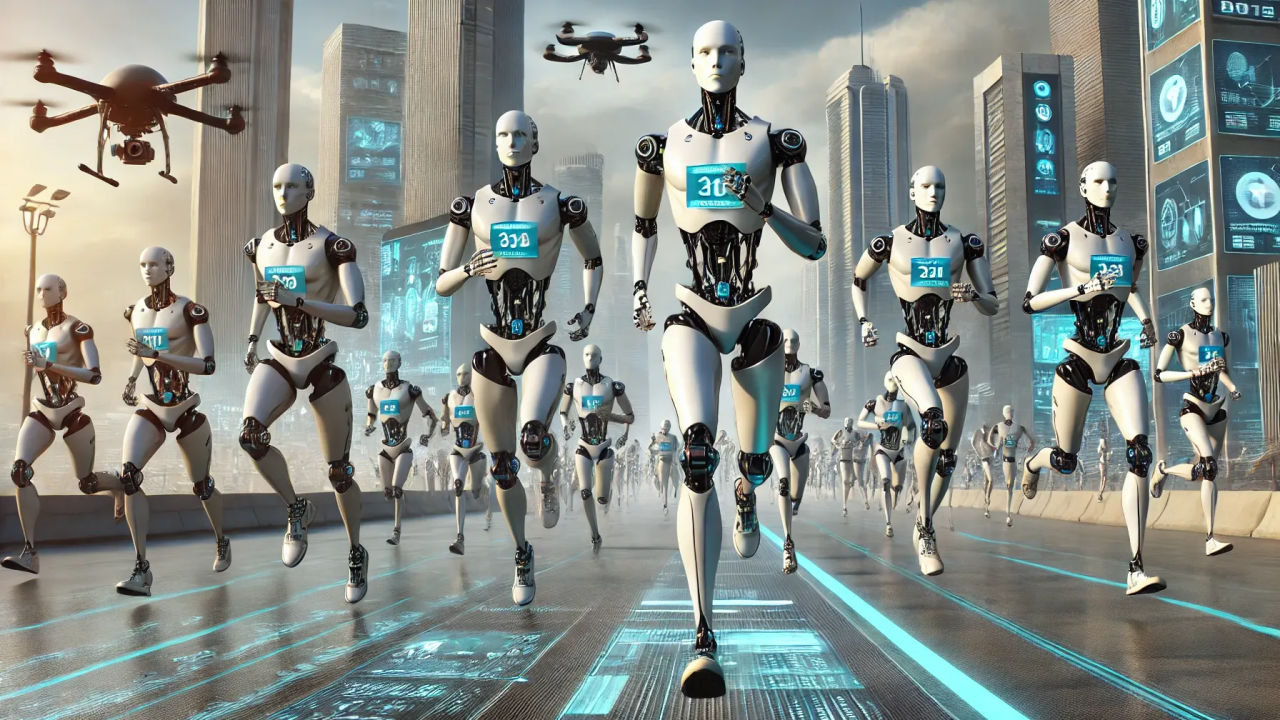
The Future of Human-Robot Synergy
Discover breakthroughs in brain interfaces, robot races, and new U.S. drone laws shaping future innovations.
1. Brain Chips Restore Movement in Paralyzed Patients
A groundbreaking brain-computer interface (BCI) has enabled a paralyzed man to move his arm using thought alone. Researchers implanted electrodes in his brain, which decoded his neural signals and transmitted them to electrodes on his arm, bypassing the damaged spinal cord. While still in early stages, this technology signals a future where BCIs could help millions regain mobility.
Major takeaway: Brain chips are making science fiction a reality, offering hope for restoring movement in people with paralysis. Read more.
2. Humanoid Robots to Compete in Half-Marathon Against Humans
Japan is set to host the first-ever half-marathon featuring humanoid robots racing against human runners. These robots will need to run, balance, and conserve energy over 13.1 miles, pushing the limits of bipedal robotics. While Boston Dynamics' Atlas and Agility Robotics’ Digit have made headlines, endurance remains a major challenge.
Major takeaway: This race isn’t just for fun—it’s a serious test of robotic endurance that could drive innovation in real-world applications like disaster response and logistics. Read more.
3. Congress Revisits Drone Legislation
U.S. lawmakers are once again debating new drone regulations, focusing on issues like airspace safety, security threats, and domestic drone manufacturing. The push comes amid concerns over Chinese-made drones and efforts to boost American drone companies. Striking a balance between security and innovation remains a challenge.
Major takeaway: New drone laws could shape the future of UAV operations in the U.S., with big implications for businesses, security, and air traffic management. Read more.
About Lucid Bots:
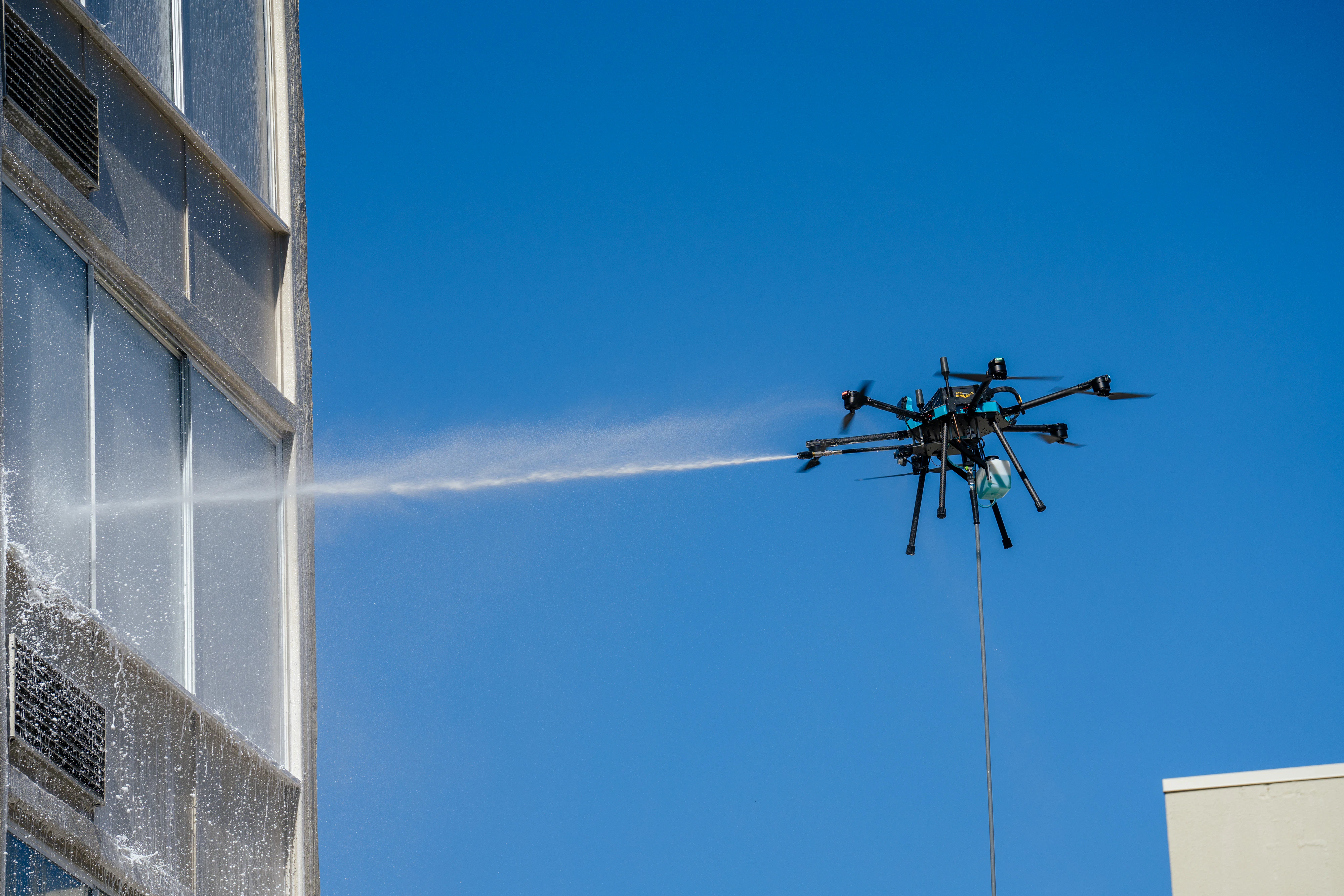
Founded in 2018, Lucid Bots is an AI robotics company that is committed to uplifting humanity by building the world's most productive and responsible robots that can do dangerous and demanding tasks. Headquartered in Charlotte, the company engineers, manufactures, and supports its products domestically, which include the Sherpa, a cleaning drone, and the Lavo Bot, a pressure-washing robot. Lucid Bots' products are elevating safety and efficiency for a growing number of customers around the world. Lucid is a Y Combinator-backed company, with investments from Cubit Capital, Idea Fund Partners, Danu Ventures, and others. Lucid Bots was recently recognized as the 4th fastest growing manufacturing company in the United States.
Related Articles
.png)
Congress Races China as Nvidia Signals Robotics Era
This week, Congress heard urgent calls to ban Chinese-made robots from federal networks and build a national robotics strategy as China accounts for 54% of global robot installations versus just 9% for the U.S., Nvidia declared the physical AI era open at GTC with new foundation models and simulation tools, and global experts at Davos confirmed that robotics' foundational technical breakthroughs are complete and the industry is now entering the era of deployment.
U.S. Robotics Companies Want Federal Help to Keep Chinese Robots Out of America's Networks
Top U.S. robotics executives testified before the House Homeland Security cyber subcommittee this week, pressing lawmakers for federal dollars, new legislation, and a unified regulatory strategy to compete with state-funded Chinese rivals in a sector valued at an estimated $50 billion, as China accounted for 54% of global robot installations between 2020 and 2024 compared to just 9% for the United States. Matthew Malchano, vice president of software at Boston Dynamics, warned that Chinese company Unitree is capturing market share with U.S. police departments and universities despite contracting ties to the Chinese military and a wormable exploit discovered in 2025 that could allow attackers to take over entire robot fleets. Max Fenkell of Scale AI told lawmakers the U.S. is winning on AI model quality but losing on data and implementation, pointing to China's industrialized strategy of funding mile-long warehouse facilities dedicated to gathering and labeling robot training data, with no U.S. equivalent in place. Executives unanimously called on Congress to block federal agencies from purchasing Chinese-made robots, establish a single federal regulatory standard, and direct CISA to conduct a security review of foreign-made robots. Malchano also pressed for the National Commission on Robotics Act, sponsored by Rep. Jay Olbernolte, which would create a bipartisan commission to develop a national robotics strategy. The hearing comes as federal robotics spending accelerates, with the Coast Guard investing $350 million in autonomous systems by 2028, DHS finalizing a $1 billion AI analytics contract with Palantir, and ICE spending $78,000 last year on a robot capable of deploying smoke bombs.
Major Takeaway: The congressional hearing signals a shift from ad hoc procurement decisions to a broader policy reckoning over foreign robotics hardware, as lawmakers and industry leaders increasingly treat robot supply chains as a national security issue rather than a commercial one. Read More
Nvidia Declares the Rise of ‘Physical AI’ — and a World Run by Robots
At its GTC conference, Nvidia announced a sweeping push into "physical AI," with Jensen Huang declaring "Physical AI has arrived. Every industrial company will become a robotics company," backed by new foundation models, simulation frameworks, and a broad set of industry partnerships. New tools include Cosmos 3, a world foundation model combining synthetic world generation, vision reasoning, and action simulation; Isaac Lab 3.0 for large-scale robot learning on Nvidia DGX infrastructure; and GR00T N1.7, a robot foundation model enabling dexterous manipulation and autonomous task execution. Nvidia also previewed GR00T N2, based on its DreamZero research, which the company says helps robots succeed at unfamiliar tasks in new environments more than twice as often as leading vision-language-action models. In humanoid robotics, Boston Dynamics, Figure AI, and Agility Robotics are using Nvidia's simulation tools and AI models to accelerate development, while healthcare companies including CMR Surgical, Johnson & Johnson, and Medtronic are using Nvidia platforms to train and validate surgical robotic systems. On the cloud side, Microsoft, Nebius, and Alibaba Cloud are integrating Nvidia's physical AI data tools and robotics stack into their platforms. Through its Inception Program supporting more than 40,000 startups, Nvidia is also positioning itself as the foundational platform layer for emerging robotics developers, not just a chip supplier but the full-stack infrastructure for intelligent machines.
Major Takeaway: Nvidia's GTC announcements position the company as the compute and software backbone of the physical AI era, building a full-stack platform from simulation and training to deployment and safety that could define how the global robotics industry develops over the next decade. Read More
The Hardest Advances in Robotics Are Behind Us: What Comes Next
At the World Economic Forum's 56th Annual Meeting in Davos, experts in physical AI declared that the hardest technical breakthroughs in robotics are now complete, with the next decade focused on deploying autonomous systems from controlled industrial settings into the complexity of everyday life. BCG Managing Director Daniel Kuepper outlined the four foundational advances of the past decade: a 1,000x increase in compute power outpacing Moore's Law expectations by 25x, a narrowing simulation-to-reality gap enabled by digital twins and synthetic data, the rise of vision-language-action models that allow robots to interpret complex commands, and hardware that has become significantly cheaper and more capable. Experts confirmed that robots currently thrive in structured environments like ports, warehouses, and factories, with MIT's Daniela Rus noting that entire fleets already operate 24/7 moving shipping containers without human intervention, and BCG projecting that roughly 70% of global manufacturing operations will be largely autonomous by 2050. The next barrier is unstructured environments, where robots must handle unpredictability, assess risk, and make judgment calls, with Mech-Mind CEO Shao Tianlan noting the focus for the next few hundred days remains on controllable manufacturing and logistics settings. Amazon Robotics Chief Technologist Tye Brady identified object manipulation as the "holy grail" of robotics, explaining that tasks humans perform instinctively, like estimating how hard to grip a cup, require robots to explicitly simulate weight estimation, slip detection, and contextual reasoning. Experts agreed that fully autonomous systems are still years away and teleoperation remains essential for bridging the gap, but argued that the industry's innovation curve will eventually drive costs down and move robots from factory floors into homes, much like smartphones evolved from industrial tools to universal commodities.
Major Takeaway: The Davos consensus marks a meaningful inflection point for the robotics industry, as leaders across technology, manufacturing, and research agree that perception, mobility, and computing have been solved and the defining challenge is now deploying robots responsibly into the messy, unpredictable environments where most of human life actually happens. Read More
About Lucid Bots
Founded in 2018, Lucid Bots is an AI robotics company that is committed to uplifting humanity by building the world's most productive and responsible robots that can do dangerous and demanding tasks.
Headquartered in Charlotte, the company engineers, manufactures, and supports its products domestically, which include the Sherpa, a cleaning drone, and the Lavo, a pressure-washing robot.
Lucid Bots' products are elevating safety and efficiency for a growing number of customers around the world. Lucid is a Y Combinator-backed company, with investments from Cubit Capital, Idea Fund Partners, Danu Ventures, and others. Lucid Bots was recently recognized as the fastest growing robotics manufacturer in the United States.
🟢 New here?
Love startups, robots, and business growth stories?
Join the 2,100+ readers and subscribe to our Robot Rundown 🚀
.png)
From Sky to Soil to Shop Floor: Robotics Enters Its Infrastructure Era
Drone services are projected to reach $142B by 2035 as AI-powered, autonomous systems become embedded across agriculture, infrastructure, logistics, and public safety. Orlando’s new Drone as a First Responder program shows how drones are shifting from pilot projects to real-time emergency infrastructure. At the same time, CMU is advancing rugged off-road robots for industrial sites and farms, expanding automation beyond controlled environments. In the UK, Siemens and partners are localizing autonomous mobile robot production, signaling a push toward flexible, infrastructure-light factory automation.
Drone Services Market Projected to Reach $142B by 2035
The global drone services market is projected to reach $142.22 billion by 2035, driven by accelerating demand across agriculture, infrastructure, energy, logistics, and public safety. Companies are deploying drones to inspect bridges and power lines, monitor crops, assess disaster zones, and test delivery operations—cutting costs while improving speed, safety, and data accuracy. Powered by AI-driven analytics and autonomous flight systems, drones are evolving from simple aerial cameras into real-time data platforms embedded directly into enterprise workflows. As regulations mature and enable more advanced operations, organizations are moving beyond pilot programs and scaling drone deployments as core operational infrastructure. Read More
Major Takeaway: The $142B forecast signals that drones are no longer experimental tools—they’re becoming essential, AI-powered infrastructure for modern industry.
Orlando approves $6.8M 'eyes in the sky' drone program to speed up emergency response
The Orlando City Council has approved a $6.83 million contract amendment with Axon Enterprise to launch a Drone as a First Responder program, expanding the city’s use of rooftop-based, automated drones for emergency response. The system will deploy 11 drones across nine docking stations covering areas from downtown Orlando to Lake Nona, with a target response time of two to three minutes. When a 911 call comes in, drones launch immediately, often arriving before patrol officers navigating traffic. During a seven-week trial at Orlando Police Department headquarters, a single drone reached the scene before officers on 33% of calls and provided critical situational information in 97% of cases. The program integrates with Axon Prepared technology, allowing drone pilots to listen to 911 calls in real time and feed live visuals into the same ecosystem used for body-worn and vehicle cameras. The contract includes a tech-refresh cycle, replacing drones every two and a half years and docking stations every five years, as the city positions itself alongside other early adopters like Dallas, Phoenix, and Las Vegas. Officials say deployments will be limited to specific 911 calls under state law, not routine patrol or broad surveillance.
Major Takeaway: Orlando’s investment signals that Drone as a First Responder programs are moving from pilot experiments to embedded public safety infrastructure, where speed to scene and real-time visibility are becoming core tools for triage, dispatch decisions, and proactive response. Read More
CMU’s Off-Road Robots Improve Efficiency and Human Safety at Industrial Sites and Farms
Carnegie Mellon University researchers are developing off-road robotic systems designed to operate in environments that are difficult, dangerous, or impractical for humans, from contaminated industrial sites to steep farmland. At the center of this effort is the new Robotics Innovation Center, which will include dedicated outdoor testing environments to accelerate development of robots capable of navigating rugged, unpredictable terrain. Mechanical engineering professor Aaron Johnson is advancing legged robot locomotion strategies that allow four-legged platforms to react dynamically to obstacles like vines, shrubs, and uneven hillsides, addressing challenges such as avoiding entanglement, managing unknown forces, and recovering when stuck. In parallel, civil and environmental engineering professor Greg Lowry is working with commercial partners to deploy robotic fleets that can autonomously collect soil samples across large contaminated sites, reducing worker exposure while improving mapping precision and enabling more targeted remediation. On the agricultural side, Robotics Institute professor George Kantor’s team has developed autonomous systems that insert nitrate sensors into crops, monitor plant health, and assist with tasks like pepper harvesting. The goal is to stabilize farm operations facing labor volatility and climate pressures, while accelerating crop breeding by automating measurement at scale. The new facility will allow researchers to test robots in real outdoor environments rather than improvised setups, tightening the feedback loop between design and deployment.
Major Takeaway: CMU’s off-road robotics work signals a broader shift toward autonomous systems that operate beyond paved surfaces and factory floors, using rugged locomotion and field-ready sensing to reduce human risk, improve data collection, and bring scalable automation to some of the most unpredictable industrial and agricultural environments. Read More
Siemens partnership creates UK’s first fully customisable autonomous mobile robot manufacturing capability
Siemens has partnered with Expert Technologies Group and RMGroup to establish the UK’s first fully customisable autonomous mobile robot manufacturing capability, marking a significant step toward localized, end-to-end AMR solutions for British industry. The collaboration combines Siemens’ SIMOVE technology with Expert Technologies Group’s FlexDrive AMR platform and RMGroup’s integration expertise to deliver scalable, infrastructure-light robots built and supported in the UK. Unlike traditional AGVs that rely on fixed tracks, these AMRs use onboard sensors, laser-based navigation, and real-time obstacle avoidance to operate in dynamic factory and warehouse environments. The systems can be configured for tasks ranging from moving components between workstations to supplying production lines and supporting warehouse logistics, while also feeding operational data into digital twin simulations. The partnership aims to address a recurring pain point in robotics deployments: integration failures and limited support from overseas providers. By creating a UK-made, UK-supported solution with financing options through Siemens Financial Services, the group is positioning autonomous mobile robotics as a practical, flexible upgrade path for manufacturers seeking productivity gains without heavy infrastructure investment.
Major Takeaway: The Siemens-led collaboration signals a shift from imported, off-the-shelf automation toward domestically built, fully customizable AMR ecosystems, positioning flexible, infrastructure-light mobility as a core pillar of the UK’s push to modernize factory logistics and stay competitive in advanced manufacturing. Read More
About Lucid Bots
Founded in 2018, Lucid Bots is an AI robotics company that is committed to uplifting humanity by building the world's most productive and responsible robots that can do dangerous and demanding tasks.
Headquartered in Charlotte, the company engineers, manufactures, and supports its products domestically, which include the Sherpa, a cleaning drone, and the Lavo, a pressure-washing robot.
Lucid Bots' products are elevating safety and efficiency for a growing number of customers around the world. Lucid is a Y Combinator-backed company, with investments from Cubit Capital, Idea Fund Partners, Danu Ventures, and others. Lucid Bots was recently recognized as the fastest growing robotics manufacturer in the United States.
🟢 New here?
Love startups, robots, and business growth stories?
Join the 2,100+ readers and subscribe to our Robot Rundown 🚀
.png)
Reality Capture and Robotics Reshape the Way We Build
Drones and robotics are quietly becoming the new backbone of construction and shipbuilding, with reality capture turning job sites into real-time data systems and targeted automation taking over the most dangerous, labor-intensive work as productivity pressures and labor shortages force the industry toward smarter, safer execution.
Drone reality capture ramps up to augment construction site workflows
Drone reality capture is quickly becoming standard operating infrastructure on construction sites, not just a marketing tool for milestone videos. At the Canadian Concrete Expo in Toronto, Skender’s Ben Stocker and Maple Reinders’ Adam Caldwell described how drones are now deeply embedded in construction workflows, supporting everything from site documentation and progress monitoring to thermal inspections, utility tracking, and material volume calculations. They noted that larger firms are increasingly running drone programs in-house, while smaller companies are still weighing whether they have the resources to build dedicated teams, even as more projects now include explicit drone budgets. The real shift, they argued, is not flying the drone, but knowing how to turn captured data into actionable outputs. High-accuracy mapping powered by RTK positioning and surveyed ground control points is becoming the baseline, enabling sub-inch site models that can be layered with design drawings, foundation plans, and utilities maps for faster decision-making in the field. Tools like panoramic photography, frequent automated capture routes, and emerging methods like 3D Gaussian splatting are pushing reality capture into real-time, photorealistic site reconstruction. The payoff is operational: crews can track rapid site changes, validate volumes, and avoid schedule delays by using drone-derived measurements instead of waiting for manual reviews.
Major Takeaway: Drone reality capture is evolving from a “nice-to-have” visual layer into a core construction workflow tool, where the competitive edge comes from integrating high-accuracy site data into daily decisions, overlays, and execution speed, not just collecting aerial footage. Read More
Robotics to the Rescue: Can Technology Boost Construction Productivity?
Construction has long been the outlier in productivity growth, and the article frames the sector’s stagnation starkly: while U.S. labor productivity rose 290% from 1950 to 2020, construction worker productivity fell 40% between 1970 and 2020. The piece argues that a new generation of smart machines, especially drones, ground robots, and autonomous monitoring systems, may finally begin to reverse that trend. Drones are already widely used for surveying and planning, with high-end systems generating detailed 3D terrain models through platforms like DroneDeploy. On the ground, uncrewed vehicles are supporting site prep and safety-critical tasks like detecting unexploded ordnance in Germany, while robots such as Dusty Robotics’ layout printer are reducing errors by marking floor plans directly onto concrete with high precision. Four-legged robots like Boston Dynamics’ Spot are being deployed for nightly progress documentation, and autonomous docked drones paired with LiDAR-equipped ground units are creating “living visual twins” of job sites that update in near real time. The article highlights measurable ROI, with DroneDeploy estimating $10,000 saved per $1 million of construction spend and insurers reporting claim values dropping by 40% for firms using continuous reality capture. Still, adoption remains uneven, only about 21% of U.S. contractors use drones, held back by training needs, data interpretation challenges, cost, and the industry’s chronically low tech investment. The future vision is broader autonomy: AI-driven “robo-foremen,” autonomous heavy machinery, and eventually humanoids, but with humans still connecting the dots for quality and judgment.
Major Takeaway: Robotics in construction is not about replacing crews overnight, but about shifting the industry toward continuous measurement, faster coordination, and automation that augments labor, and the real productivity gains will come from contractors who can turn site data into daily operational decisions, not just deploy new machines. Read More
Canadian Shipyard Turns to AI Robotics to Automate One of Shipbuilding’s Toughest Jobs
Vancouver-based Seaspan Shipyards is investing $1.5 million in Alberta’s Confined Space Robotics (CSR) to develop semiautonomous robotic systems for blast and paint operations, one of the most hazardous and labor-intensive tasks in shipbuilding. The robots will carry tools such as needle scalers, laser ablation systems, grinders, grit blasters, and spray-coating equipment, operating inside confined and high-risk spaces traditionally associated with toxic fumes, heavy particulates, and repetitive strain injuries. Custom software will guide path planning and task execution, allowing the systems to handle repetitive surface preparation and coating work with greater consistency and material efficiency. Seaspan framed the move as part of a broader industrial strategy tied to Canada’s National Shipbuilding Strategy, emphasizing safety, sustainability, and domestic advanced manufacturing expansion. While other global shipbuilders, such as South Korea’s HD Hyundai, have focused on humanoid welding robots to address labor shortages, Seaspan’s initiative targets blast and paint operations, a critical bottleneck in both newbuild and repair programs.
Major Takeaway: Seaspan’s investment signals that shipyard automation is shifting from headline-grabbing humanoids to targeted, high-impact robotics that reduce risk, ease labor constraints, and improve process consistency in some of the industry’s toughest and most overlooked jobs. Read More
About Lucid Bots
Founded in 2018, Lucid Bots is an AI robotics company that is committed to uplifting humanity by building the world's most productive and responsible robots that can do dangerous and demanding tasks.
Headquartered in Charlotte, the company engineers, manufactures, and supports its products domestically, which include the Sherpa, a cleaning drone, and the Lavo, a pressure-washing robot.
Lucid Bots' products are elevating safety and efficiency for a growing number of customers around the world. Lucid is a Y Combinator-backed company, with investments from Cubit Capital, Idea Fund Partners, Danu Ventures, and others. Lucid Bots was recently recognized as the fastest growing robotics manufacturer in the United States.
🟢 New here?
Love startups, robots, and business growth stories?
Join the 2,000+ readers and subscribe to our Robot Rundown 🚀


.svg)
.avif)



.avif)