The Google Maps Method — How to Uncover Millions in Local Drone Cleaning Revenue
Turn Google Maps into your market-sizing tool. Learn the simple method that reveals millions in potential drone cleaning contracts around your city.
This is for drone cleaning operators who want a simple, free, and fast way to understand the size of their local market before they spend a dollar on marketing. Whether you're validating a new territory or trying to build a credible pipeline for your first year, this method turns a casual search into a concrete revenue estimate — no expensive research reports required.
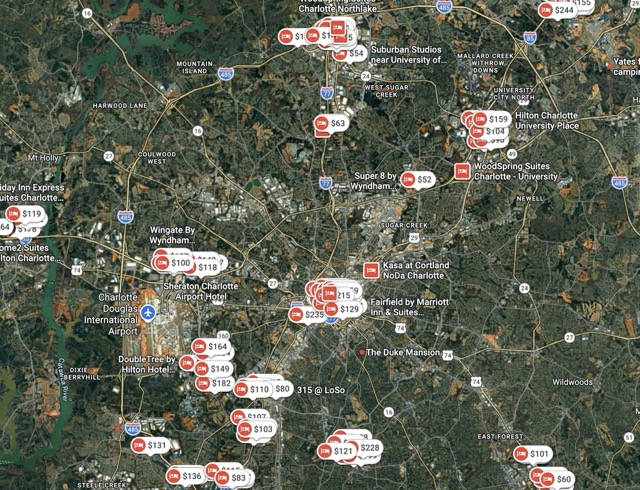
What if your next million-dollar opportunity was already sitting inside Google Maps? One Lucid Bots sales rep decided to find out. He drew a 60-mile circle around Charlotte, NC and searched for "Hilton." Twenty-five properties came back. At an average of $25,000 per property in annual cleaning value, that's $625,000 of potential revenue from a single hotel brand. He kept going — Marriott, Holiday Inn, Hampton Inn — and the total grew into the millions before he even searched for office buildings or hospitals. This post walks you through the same exercise so you can run it in your own market today.
The Power of Local Data
That quick exercise revealed a simple truth: you don't need expensive research reports to measure your drone cleaning market — just curiosity and a map.
Here's what a single metro area looks like when you run the full exercise:
- Office Buildings: 500 x $15,000 = $7.5M
- Medical Facilities: 150 x $50,000 = $7.5M
- Industrial Sites: 800 x $10,000 = $8M
Total addressable market in one metro area: over $20 million. That's before you've knocked on a single door.
Try It Yourself — Step by Step
- Open Google Maps and set your base location
- Search for key property types: "hotel," "office building," "warehouse," "hospital," "medical center"
- Log the number of results within your target radius (start at 60 miles)
- Estimate average annual cleaning value by property type
- Multiply and total — that's your addressable market
- Highlight properties within easy driving distance — those are your first-contact targets
Why This Matters
Mapping your market gives you three things most operators lack: confidence, focus, and a measurable opportunity. When you can see the potential in black and white, growth stops feeling hypothetical — it becomes inevitable.
You stop chasing any lead that comes in and start building a prioritized target list. You stop underpricing because you're afraid of losing a job and start quoting with the confidence of someone who knows there's plenty more pipeline behind it.
The Bottom Line
You don't need a research firm. You need an afternoon and a browser tab.
Run this exercise in your market this week. Write down the number you get. That's your opportunity — and it's already waiting.
Next: we'll compare traditional cleaning methods with drone cleaning to show exactly where that opportunity becomes profit.
Related Articles
.jpg)
Soft Washing, Pressure Washing, and Window Cleaning — Knowing the Difference Matters
Drone cleaning changes how solutions are delivered to a surface — but it doesn't change the fundamental methods that determine what actually gets a surface clean. Every exterior cleaning job, drone or traditional, falls into one of three categories: window cleaning, soft washing, or pressure washing. Each has a different mechanism, different pressure and flow parameters, and a different set of surfaces it's suited for. Today we are breaking down all three methods in plain language, explaining the key technical specifications behind each one, and walking through which surfaces call for which approach. We also cover the most common method selection mistakes — particularly the damage that results from using high pressure on surfaces that require soft washing — and explain why professional method knowledge is one of the clearest differentiators between operators who build long-term client relationships and those who don't. Including a surface-by-surface guide covering glass, stucco and EIFS, brick, metal panels, and concrete, with the key considerations for each. Built for operators who want to quote and execute with confidence, and for buyers who want to understand what they're paying for.
This is for drone cleaning operators who want to make confident, professional method selections on every job — and for property managers and facility directors who want to understand why their cleaning vendor is recommending one approach over another. Method selection is one of the most important decisions in exterior cleaning. Using the wrong technique can damage surfaces, void warranties, and cost you client relationships. This post gives you a clear framework for getting it right every time.
One of the most common mistakes in exterior cleaning — drone or traditional — is using the wrong method for the surface in front of you. Drone cleaning changes how cleaning solutions are delivered, but it doesn't change the fundamental principles that determine what actually gets a building clean. Every exterior job falls into one of three categories: window cleaning, soft washing, or pressure washing. Each one has different chemistry, different pressure requirements, and a different set of surfaces it works on. Knowing the difference isn't just technical knowledge. It's what separates operators who build lasting client relationships from those who cause damage and lose accounts.
Drone cleaning changes how cleaning solutions reach a surface. It doesn't change what cleans the surface once they get there. The same three fundamental methods still apply to every exterior cleaning job — and using the wrong one is one of the most expensive mistakes an operator can make.
Here's what each method does, how it works, and when to use it.
Window Cleaning
Window cleaning is designed for glass and glazed surfaces where streak-free results are non-negotiable. The process applies a specialized cleaning solution that breaks down contamination, then rinses with DI-filtered water to prevent spotting. The critical variable isn't pressure — its water purity. Water that isn't filtered to near-zero parts per million will leave mineral deposits on glass regardless of how well the chemical step works. Pressure for window cleaning typically runs between 800 and 1,200 PSI — enough to rinse effectively without risking seal damage or glass stress. The short version: streak-free glass comes from chemistry and water quality, not force.
Soft Washing
Soft washing is the method of choice for mold, mildew, algae, and organic growth on surfaces that can't handle high pressure — stucco, EIFS, painted wood, certain brick types, and many roofing materials. The process applies a chemical solution, typically sodium hypochlorite combined with a surfactant, at low pressure and allows it to dwell on the surface for 10 to 15 minutes. During that dwell time, the chemistry kills growth at the root level rather than just removing it from the surface. A light rinse then removes the dead material. Because soft washing addresses the source of the contamination rather than just the visible symptoms, surfaces stay cleaner longer after a soft wash than after a pressure wash. Operating pressure stays under 300 PSI, with flow rates around 10 to 12 GPM. The risk of surface damage at those parameters is minimal when dilution is correct.
Pressure Washing
Pressure washing uses mechanical force — high-pressure water — to remove surface contamination from hard, durable materials. It produces immediate visual results and works well on concrete, pavers, and certain metal surfaces where the structure can tolerate the force involved. Operating pressure can reach up to 4,400 PSI with flow rates under 8 GPM. The limitation of pressure washing is that it works at the surface level only. It removes what's visible without addressing the underlying biology, which means regrowth happens faster than it would after a soft wash treatment. Pressure washing is the right tool in the right context — it's not the right tool for every surface, and applying it incorrectly causes real damage.
Matching the Method to the Surface
Glass calls for window cleaning — filtered water, chemistry, and moderate pressure in the 800 to 1,200 PSI range. The only thing that matters more than pressure on glass is water purity. Stucco and EIFS are among the most damage-prone surfaces in commercial exterior cleaning. They require soft washing at under 200 PSI — high pressure on these materials strips finish coats, forces water behind cladding, and voids manufacturer warranties. Brick sits in the middle. It can often tolerate soft washing or light pressure in the 200 to 800 PSI range, but it always deserves a test patch first since older mortar can be fragile. Metal panels are variable depending on finish and coating — low to moderate pressure generally applies, and reactive chemicals should be avoided entirely. Concrete is the most forgiving surface in exterior cleaning and can handle pressure washing up to around 3,000 PSI, with soft washing as an effective option when organic growth is the primary issue. Always check for sealer compatibility before applying chemistry to concrete.
Why Method Selection Is a Professional Differentiator
Property managers who have had a building damaged by the wrong cleaning method don't forget it. High pressure on stucco strips finishes. Incorrect chemistry on metal panels causes oxidation. Pressure washing on roofing materials forces water under shingles. Each of these mistakes is preventable with basic method knowledge — and each one costs an operator a client relationship that could have been worth years of recurring revenue.
Professional cleaning is about method selection, not brute force. Drone cleaning doesn't replace that judgment. It rewards it — because operators who combine the access advantage of drone technology with the right method knowledge can take on jobs that traditional competitors can't safely execute.
The Big Takeaway
Knowing which method to use, and why, is what separates professionals from operators who cause damage and lose accounts. Soft washing, pressure washing, and window cleaning each have a purpose. Learn them well, apply them correctly, and your clients will notice the difference — and keep calling you back.

Drone Cleaning Isn't Magic. It's a Flying Spray Wand.
One of the most common barriers to selling drone cleaning isn't price or competition — it's confusion. When prospects don't understand how the service works, they hesitate. This blog removes that barrier entirely by explaining drone cleaning in the simplest possible terms, then giving operators the exact language to use in customer conversations. The core concept is introduced through a single memorable framing device from a Lucid Bots engineer: the drone is basically just a flying spray wand. From there, we will walk through how the system actually works — ground-based pump, hose, operator-controlled spray, chemistry doing the cleaning — and explain why the drone's job is to provide safe access, not scrubbing power. The second half of focuses entirely on customer communication: the dishwasher analogy that neutralizes the 'but how does it clean without scrubbing' objection, four tailored explanation scripts for different customer types (safety-focused, quality-focused, environmentally conscious, and cost-focused), and a clear guide on what not to lead with in sales conversations. Built for operators who want to demystify their service and close more deals with simpler, more confident explanations.
This is for drone cleaning operators who want to explain their service clearly and confidently — whether you're talking to a skeptical property manager, a curious onlooker at a demo, or a prospect who has never heard of drone cleaning before. Understanding how the technology actually works, and knowing how to communicate it in plain language, is one of the most practical sales skills you can develop. This post gives you both the knowledge and the words to use it.
One of the biggest misconceptions about drone cleaning is that it relies on complex or experimental technology. It doesn't. Drone cleaning uses the same proven chemistry and cleaning principles that exterior cleaning professionals have relied on for decades. The only difference is how those solutions get delivered to the surface. One Lucid Bots engineer explains it best: the drone is basically just a flying spray wand. That single description removes the mystery immediately, and when you can explain your service that simply, trust follows fast. This post breaks down how drone cleaning actually works and gives you the exact language to explain it to any customer.
"Simplicity is the ultimate sophistication." — Leonardo da Vinci
One of the biggest misconceptions about drone cleaning is that it relies on some kind of complex or experimental technology. It doesn't. Drone cleaning uses the same proven chemistry and cleaning principles the exterior cleaning industry has relied on for decades. The only difference is how those solutions are delivered, and that difference is what makes drone cleaning safer, faster, and more efficient than traditional methods.
One of our engineers explains it best:
"The drone is basically just a flying spray wand."
That single sentence removes the mystery immediately. And in sales conversations, that kind of clarity is worth more than any brochure.
How Drone Cleaning Actually Works
Here's the reality behind the technology, stripped of jargon. A ground-based pump pushes cleaning solution through a hose. The drone carries the end of that hose up to the surface being cleaned. The operator controls spray on and off from the ground. Chemistry and pressure does the actual cleaning, exactly the same way it does in traditional methods. The drone's job is to provide safe, precise access — not scrubbing power.
The drone doesn't replace cleaning expertise. It replaces ladders, lifts, and the risk that comes with them. Workers stay on the ground. Chemistry does the work at height. That's the whole model.
Why Customers Get Confused — And How to Fix It
Most prospects have never seen drone cleaning before you show up. When they hear 'drone,' they picture consumer hobby drones or military surveillance technology — neither of which helps your case. The flying spray wand framing works because it immediately connects the technology to something they already understand: a cleaning tool that reaches high places. From that foundation, the rest of the explanation lands easily.
Customers don't want to understand flight controllers, battery management, or payload engineering. They want answers to three questions: Is it safe? Does it work? Will it damage my building? The flying spray wand explanation addresses all three in a single sentence.
The Dishwasher Analogy — Your Best Tool for Skeptics
The most common objection new prospects raise is some version of: "But how does it actually clean without scrubbing?" This is a reasonable question, and it deserves a simple answer. Here's the one that works:
"There aren't scrub brushes in your dishwasher. The detergent breaks down the grime — and it works pretty well."
This analogy lands every time because everyone understands dishwashers, it normalizes chemical-based cleaning instantly, it addresses skepticism without being defensive, and it builds confidence in a way that technical explanations never do. Drone cleaning works the same way — chemistry first, delivery second. The drone just gets the chemistry exactly where it needs to go.
How to Explain Drone Cleaning to Any Customer
Not every prospect cares about the same thing. The best operators tailor their explanation to what the customer actually values. Here are four versions of the same core message, matched to four different customer types.
For Safety-Focused Customers
"We use the same proven chemistry as traditional exterior cleaning. Our drone just keeps people safely on the ground throughout the entire job. No lifts, no ladders, no workers at height."
For Quality-Focused Customers
"Our process works like a dishwasher. The chemistry does the cleaning, and we use DI-filtered water to prevent streaking. The result is consistent, streak-free surfaces without the risk of pressure damage."
For Environmentally Conscious Customers
"We use the minimum effective chemistry for each job and protect all landscaping before and after every application. Our approach is controlled and targeted — nothing goes where it shouldn't."
For Cost-Focused Customers
"Chemical cleaning removes growth at the root level, which means surfaces stay cleaner longer. Buildings that switch to this method typically need fewer cleanings per year, which lowers the total annual cost."
What Not to Lead With
When you're introducing drone cleaning to a new prospect, resist the urge to open with technology details. Flight time, battery specs, drone models, payload weights — none of that answers the questions your customer is actually asking. Lead with safety, results, and convenience. Let the technical details come out naturally if they're curious, not as your opening pitch.
The operators who explain drone cleaning most effectively don't sound like engineers. They sound like trusted service providers who happen to use a smarter tool.
The Big Takeaway
Drone cleaning isn't complicated — and it doesn't need to be presented that way. It's a safer, faster method of delivering proven cleaning chemistry to surfaces that are difficult or dangerous to reach by traditional means. Master the simple explanation. Use the dishwasher analogy when you hit skepticism. Tailor your language to what your customer cares about most. Then let the results speak for themselves.

From Maps to Money — How to Build and Scale a Profitable Drone Cleaning Business
Turn market mapping into measurable revenue. Follow this five-week plan to validate demand, win customers, and scale your drone cleaning operation.
This is for drone cleaning operators who are ready to move from exploring the opportunity to actively building a business around it. If you've identified your market, understand the drone advantage, and now want a concrete step-by-step plan to win your first contracts and scale toward six figures, this is your playbook. It's also useful for established operators who want to pressure-test their current growth approach against a proven framework.
You've seen the market size. You've seen why drone cleaning beats traditional methods. Now it's time to go get your share. The operators who succeed in this industry don't wait for leads to find them — they systematically map their market, identify their best targets, and engage directly with the people who make decisions. This blog walks through Lucid Bots' five-step Market Mapping Protocol: a proven week-by-week plan that takes you from a blank spreadsheet to a prioritized target list, direct outreach conversations, and a financial model that shows exactly what consistent execution is worth over three years.
The Five-Step Market Mapping Protocol
Step 1: Google Maps Analysis (Week 1)
One Lucid Bots sales rep did this exercise and found a 60-mile circle around Charlotte, NC contained 25 Hilton properties alone — worth $625,000 in annual cleaning value at $25,000 average per property. He added Marriott, Holiday Inn, and Hampton Inn, and the total grew into the millions before he even searched for office buildings or hospitals.
Run the same exercise in your market. Search within a 60-mile radius for:
- Hotels (search by brand: Hilton, Marriott, Holiday Inn, Hampton Inn, Hyatt)
- Office buildings and corporate campuses
- Warehouses and industrial facilities
- Hospitals and medical centers
Estimate cleaning value by property size:
- Boutique Hotels: $2,000-$4,000
- Mid-Size Hotels: $4,000-$6,000
- Large Hotels: $6,000-$8,000
Do the same exercise for offices and industrial sites. Total the numbers. That's your addressable market.
Step 2: Drive-By Assessment (Week 2)
Take your list of targets and visit 50 properties in person. This step is about observation, not selling. You're looking for:
- Visible staining, algae, mold, or streaking on building exteriors
- Surface types (metal panels, stucco, brick, glass) that affect pricing
- Access conditions (parking lot size, slope, nearby landscaping)
- On-site staff or front desk contacts who can point you to decision makers
Note your observations for each property. This becomes your intelligence file — and your demo target list.
Step 3: Target Market Prioritization (Week 3)
Not all properties are equal. Score each property type on four dimensions:
- Deal size potential
- Sales cycle speed (hotels decide faster than municipalities)
- Competition level in your area
- Recurring revenue potential (will they need this quarterly or annually?)
Focus first on the intersection of high deal size and high repeatability. Hotels and mid-size office buildings typically sit at that intersection — they have visible maintenance needs, predictable budgets, and decision makers who care about the building's appearance.
Step 4: Direct Outreach (Week 4)
The best lead generation tool in drone cleaning isn't an ad — it's a conversation. Use this simple script when you walk into a property:
"Hi, I'm [Name] from [Company]. We clean building exteriors using drone technology. Who handles decisions about exterior maintenance here?"
It's polite, specific, and opens real conversations. If the decision maker isn't available, ask for their name and contact information and follow up directly. If they are available, offer a demo on the spot — you have the equipment in the truck.
Step 5: Financial Modeling (Week 5)
These projections assume 8-10 jobs per month at roughly $3,500 average ticket value — a conservative baseline for operators targeting mid-size commercial properties like hotels and office buildings in most U.S. markets.
- Monthly target: 8-10 jobs x $3,500 average = $28,000-$35,000
- Year 1: $200,000-$400,000
- Year 2: $400,000-$800,000
- Year 3: $800,000-$1,500,000
These aren't fantasy numbers — they're what consistent execution of the four steps above looks like over time.
The Five-Point Market Framework
- Expand Your Vision — Every building exterior is part of one ecosystem. Stop thinking in service silos.
- Use the Google Maps Method — Spend one afternoon mapping your market. You'll be surprised by the total.
- Prioritize Smartly — Focus where deal size and recurring revenue overlap. Hotels and office towers first.
- Engage Directly — Visit, observe, and start conversations. Real relationships beat digital ads every time.
- Track Religiously — Consistent activity creates consistent growth. Log your outreach, your wins, and your losses.
The Final Word
The exterior cleaning market isn't small, slow, or saturated — it's massive, fragmented, and ready for disruption. Drone cleaning doesn't just make the work safer — it makes it scalable.
Start mapping. Start flying. The opportunity is already around you — you just have to see it.


.avif)


.avif)