From Delivery to Forecasting, Drones and Robotics Are Moving Into Everyday Infrastructure
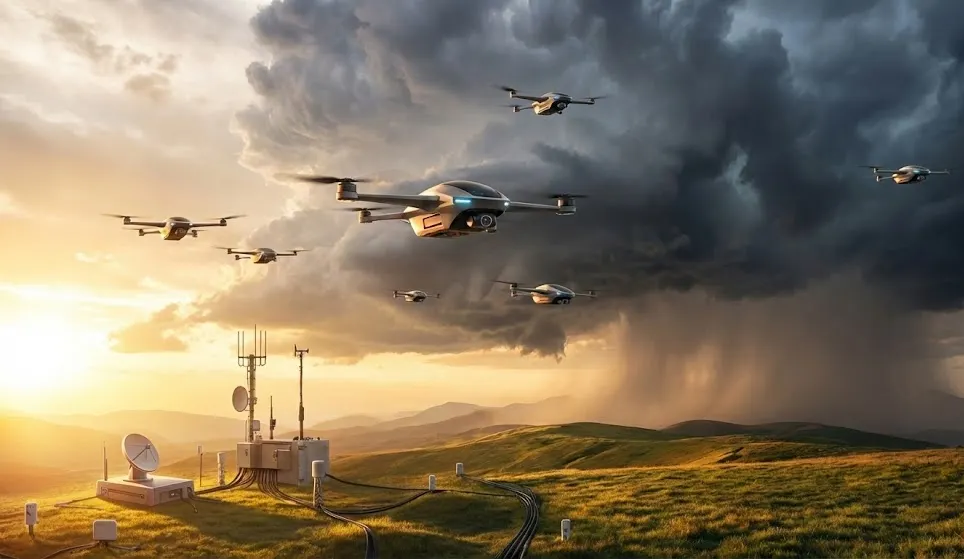
Drone tech is quickly turning into real infrastructure on multiple fronts. Zipline is pouring a fresh $600M into scaling its delivery network, expanding into Houston and Phoenix and aiming to enter at least four new states in 2026 as it blows past 2M lifetime deliveries. At the same time, University of Oklahoma researchers are using drones to capture frequent boundary-layer data for the 3D Mesonet, targeting better short-term forecasts for severe storms and tricky winter precipitation that today’s balloon schedule can miss. And on the broader robotics side, Jensen Huang is pitching “physical AI” as Europe’s once-in-a-generation opening, arguing the region can fuse its industrial base with AI, but only if it gets serious about energy supply and the infrastructure layer needed to compete.
Zipline to Expand Drone Delivery to Houston, Phoenix With $600M Raise
Zipline is gearing up for a major U.S. expansion in 2026, announcing plans to bring its home drone delivery service to Houston and Phoenix in early 2026 and to enter at least four new states by the end of the year. The move is backed by a fresh $600 million raise and comes alongside a milestone the company is using as proof of momentum: more than 2 million global deliveries since launching in 2016, which Zipline claims is greater than all other drone delivery providers combined, with Wing cited at just over half a million trips. Operationally, Zipline is leaning into regulatory and tech credibility to frame this as real infrastructure, not a pilot. It holds FAA Part 135 certification (2023) and received authorization to begin BVLOS operations (2024), and it has been pioneering UTM-enabled operations with Walmart in Dallas Fort Worth. The company also highlighted how quickly adoption is accelerating in DFW, with new sites reportedly hitting 100 daily deliveries in as little as two days, and positioned its two-platform approach as a scale play. Platform 1 handles longer-range deliveries, while Platform 2 focuses on neighborhood-style home delivery that can reposition between docks based on demand. Zipline says it is now valued at $7.6B, has flown 125 million autonomous commercial miles, and is expanding manufacturing capacity to support production of up to 15,000 drones per year, signaling it expects demand and deployment to keep compounding.
Major Takeaway: Zipline is betting that drone delivery has crossed the novelty threshold in the U.S., and with fresh capital, regulatory progress, and accelerating repeat usage, it is pushing to make autonomous logistics feel like an everyday utility across multiple states in 2026. Read More
OU Research Team Testing Drone Technology to Improve Weather Forecasting
A University of Oklahoma team is putting drones to work in a very specific gap in U.S. weather observing: the atmospheric boundary layer, where small changes can quickly turn into big forecasting misses. Through a new effort called the 3D Mesonet, researchers are flying instrumented drones from existing Oklahoma Mesonet sites to capture more frequent, more localized vertical profiles than traditional tools like weather balloons, which typically only launch twice a day. Backed by a contract from NOAA’s National Mesonet Program, the Oklahoma Climatological Survey is using the CopterSonde-SWX platform in weekly flights at the Kessler Atmospheric and Ecological Field Station, with a goal of ramping up to hourly launches through early April. The point is simple and high impact: more real-time boundary layer data could sharpen short-term forecasts for thunderstorms, severe winds, and winter precipitation types, especially in situations where the timing and location of storm initiation, or a narrow temperature shift that decides sleet versus freezing rain, really matters. The team is already sending test flight data to the National Weather Service, and OU is positioning Oklahoma as the first state to deliver these kinds of drone-based profiles through the National Mesonet Program. Longer term, they want to push toward multi-site operations that do not require a pilot and observer on site, moving the system closer to the always-on feel of the Mesonet’s automated towers.
Major Takeaway: The 3D Mesonet is a clear step toward making drone-based atmospheric profiling a practical forecasting input, turning boundary layer measurements from “nice to have” research data into a higher-frequency signal that could meaningfully improve short-term, high-stakes weather prediction. Read More
Nvidia’s Jensen Huang says AI robotics is a ‘once-in-a-generation’ opportunity for Europe
Jensen Huang used Davos to make a very direct pitch to Europe: the region’s biggest advantage in the next AI wave is not software, it is factories. His argument is that Europe already has an unusually strong industrial and manufacturing base, and the real unlock is fusing that capability with modern AI to create what he called “physical AI,” meaning autonomous robotics that can operate in the real world. In his framing, this is a chance for Europe to leap past the software era that has been dominated by the U.S. and define the next platform shift through machines that build, move, and do work. The momentum is already building. European industrial giants like Siemens, Mercedes-Benz, Volvo, and Schaeffler have been announcing new robotics projects and partnerships, while U.S. Big Tech has been doubling down too, with moves like Tesla’s heavy Optimus push, DeepMind publishing robotics-focused AI models, and Nvidia partnering with Alphabet on physical AI. The constraint, Huang said, is not imagination, it is infrastructure. Specifically, Europe needs to get serious about energy supply and costs if it wants to support the AI compute buildout required for this shift, because the “infrastructure layer” is where AI ecosystems are won or lost, and the broader AI buildout is still early compared to what is coming.
Major Takeaway: Huang is positioning AI robotics as Europe’s best shot at leading the next tech platform shift, but the message comes with a hard requirement that without major energy and infrastructure investment, Europe risks having the industrial talent and demand while missing the compute foundation needed to scale it. Read more
About Lucid Bots
Founded in 2018, Lucid Bots is an AI robotics company that is committed to uplifting humanity by building the world's most productive and responsible robots that can do dangerous and demanding tasks.
Headquartered in Charlotte, the company engineers, manufactures, and supports its products domestically, which include the Sherpa, a cleaning drone, and the Lavo, a pressure-washing robot.
Lucid Bots' products are elevating safety and efficiency for a growing number of customers around the world. Lucid is a Y Combinator-backed company, with investments from Cubit Capital, Idea Fund Partners, Danu Ventures, and others. Lucid Bots was recently recognized as the fastest growing robotics manufacturer in the United States.
.png)
.png)
.png)