From Sky to Soil to Shop Floor: Robotics Enters Its Infrastructure Era
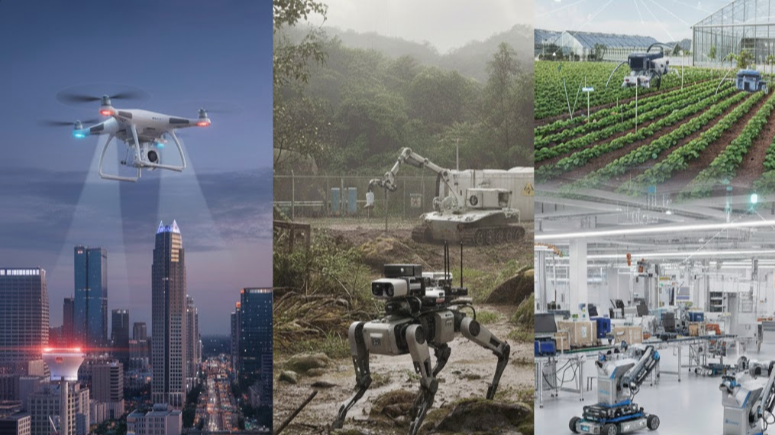
Drone services are projected to reach $142B by 2035 as AI-powered, autonomous systems become embedded across agriculture, infrastructure, logistics, and public safety. Orlando’s new Drone as a First Responder program shows how drones are shifting from pilot projects to real-time emergency infrastructure. At the same time, CMU is advancing rugged off-road robots for industrial sites and farms, expanding automation beyond controlled environments. In the UK, Siemens and partners are localizing autonomous mobile robot production, signaling a push toward flexible, infrastructure-light factory automation.
Drone Services Market Projected to Reach $142B by 2035
The global drone services market is projected to reach $142.22 billion by 2035, driven by accelerating demand across agriculture, infrastructure, energy, logistics, and public safety. Companies are deploying drones to inspect bridges and power lines, monitor crops, assess disaster zones, and test delivery operations—cutting costs while improving speed, safety, and data accuracy. Powered by AI-driven analytics and autonomous flight systems, drones are evolving from simple aerial cameras into real-time data platforms embedded directly into enterprise workflows. As regulations mature and enable more advanced operations, organizations are moving beyond pilot programs and scaling drone deployments as core operational infrastructure. Read More
Major Takeaway: The $142B forecast signals that drones are no longer experimental tools—they’re becoming essential, AI-powered infrastructure for modern industry.
Orlando approves $6.8M 'eyes in the sky' drone program to speed up emergency response
The Orlando City Council has approved a $6.83 million contract amendment with Axon Enterprise to launch a Drone as a First Responder program, expanding the city’s use of rooftop-based, automated drones for emergency response. The system will deploy 11 drones across nine docking stations covering areas from downtown Orlando to Lake Nona, with a target response time of two to three minutes. When a 911 call comes in, drones launch immediately, often arriving before patrol officers navigating traffic. During a seven-week trial at Orlando Police Department headquarters, a single drone reached the scene before officers on 33% of calls and provided critical situational information in 97% of cases. The program integrates with Axon Prepared technology, allowing drone pilots to listen to 911 calls in real time and feed live visuals into the same ecosystem used for body-worn and vehicle cameras. The contract includes a tech-refresh cycle, replacing drones every two and a half years and docking stations every five years, as the city positions itself alongside other early adopters like Dallas, Phoenix, and Las Vegas. Officials say deployments will be limited to specific 911 calls under state law, not routine patrol or broad surveillance.
Major Takeaway: Orlando’s investment signals that Drone as a First Responder programs are moving from pilot experiments to embedded public safety infrastructure, where speed to scene and real-time visibility are becoming core tools for triage, dispatch decisions, and proactive response. Read More
CMU’s Off-Road Robots Improve Efficiency and Human Safety at Industrial Sites and Farms
Carnegie Mellon University researchers are developing off-road robotic systems designed to operate in environments that are difficult, dangerous, or impractical for humans, from contaminated industrial sites to steep farmland. At the center of this effort is the new Robotics Innovation Center, which will include dedicated outdoor testing environments to accelerate development of robots capable of navigating rugged, unpredictable terrain. Mechanical engineering professor Aaron Johnson is advancing legged robot locomotion strategies that allow four-legged platforms to react dynamically to obstacles like vines, shrubs, and uneven hillsides, addressing challenges such as avoiding entanglement, managing unknown forces, and recovering when stuck. In parallel, civil and environmental engineering professor Greg Lowry is working with commercial partners to deploy robotic fleets that can autonomously collect soil samples across large contaminated sites, reducing worker exposure while improving mapping precision and enabling more targeted remediation. On the agricultural side, Robotics Institute professor George Kantor’s team has developed autonomous systems that insert nitrate sensors into crops, monitor plant health, and assist with tasks like pepper harvesting. The goal is to stabilize farm operations facing labor volatility and climate pressures, while accelerating crop breeding by automating measurement at scale. The new facility will allow researchers to test robots in real outdoor environments rather than improvised setups, tightening the feedback loop between design and deployment.
Major Takeaway: CMU’s off-road robotics work signals a broader shift toward autonomous systems that operate beyond paved surfaces and factory floors, using rugged locomotion and field-ready sensing to reduce human risk, improve data collection, and bring scalable automation to some of the most unpredictable industrial and agricultural environments. Read More
Siemens partnership creates UK’s first fully customisable autonomous mobile robot manufacturing capability
Siemens has partnered with Expert Technologies Group and RMGroup to establish the UK’s first fully customisable autonomous mobile robot manufacturing capability, marking a significant step toward localized, end-to-end AMR solutions for British industry. The collaboration combines Siemens’ SIMOVE technology with Expert Technologies Group’s FlexDrive AMR platform and RMGroup’s integration expertise to deliver scalable, infrastructure-light robots built and supported in the UK. Unlike traditional AGVs that rely on fixed tracks, these AMRs use onboard sensors, laser-based navigation, and real-time obstacle avoidance to operate in dynamic factory and warehouse environments. The systems can be configured for tasks ranging from moving components between workstations to supplying production lines and supporting warehouse logistics, while also feeding operational data into digital twin simulations. The partnership aims to address a recurring pain point in robotics deployments: integration failures and limited support from overseas providers. By creating a UK-made, UK-supported solution with financing options through Siemens Financial Services, the group is positioning autonomous mobile robotics as a practical, flexible upgrade path for manufacturers seeking productivity gains without heavy infrastructure investment.
Major Takeaway: The Siemens-led collaboration signals a shift from imported, off-the-shelf automation toward domestically built, fully customizable AMR ecosystems, positioning flexible, infrastructure-light mobility as a core pillar of the UK’s push to modernize factory logistics and stay competitive in advanced manufacturing. Read More
About Lucid Bots
Founded in 2018, Lucid Bots is an AI robotics company that is committed to uplifting humanity by building the world's most productive and responsible robots that can do dangerous and demanding tasks.
Headquartered in Charlotte, the company engineers, manufactures, and supports its products domestically, which include the Sherpa, a cleaning drone, and the Lavo, a pressure-washing robot.
Lucid Bots' products are elevating safety and efficiency for a growing number of customers around the world. Lucid is a Y Combinator-backed company, with investments from Cubit Capital, Idea Fund Partners, Danu Ventures, and others. Lucid Bots was recently recognized as the fastest growing robotics manufacturer in the United States.
🟢 New here?
Love startups, robots, and business growth stories?
Join the 2,100+ readers and subscribe to our Robot Rundown 🚀
.png)
.png)