At 23, he bet everything on a drone. Four years later, a single job pays $20,000
.jpg)
Ethan Steinbacher built Skyview Precision Cleaning from scratch around the Sherpa Drone — no prior cleaning operation, no pivot. He identified a precise market gap: the underserved 5-to-10 story building range, and built his entire business inside it. His biggest project to date: 20 dormitory buildings at Davidson College in under two weeks.
He worked at Lucid Bots before he ran his own operation.
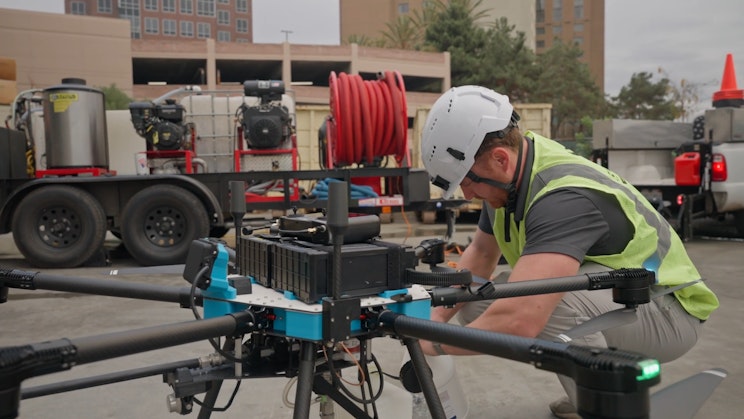
Ethan spent time inside Lucid Bots before launching Skyview Precision Cleaning — which means when he went out on his own, he already understood the technology at a level most operators spend years trying to reach. He was drawn to work on the cutting edge of something real, where he could see the direct impact of what he was doing. The Sherpa Drone checked both boxes. He was 23 when he launched, about four years into the trades, and had never run a cleaning business any other way.
Five to ten stories. Too high for poles, too small for lifts. Almost nobody is there.
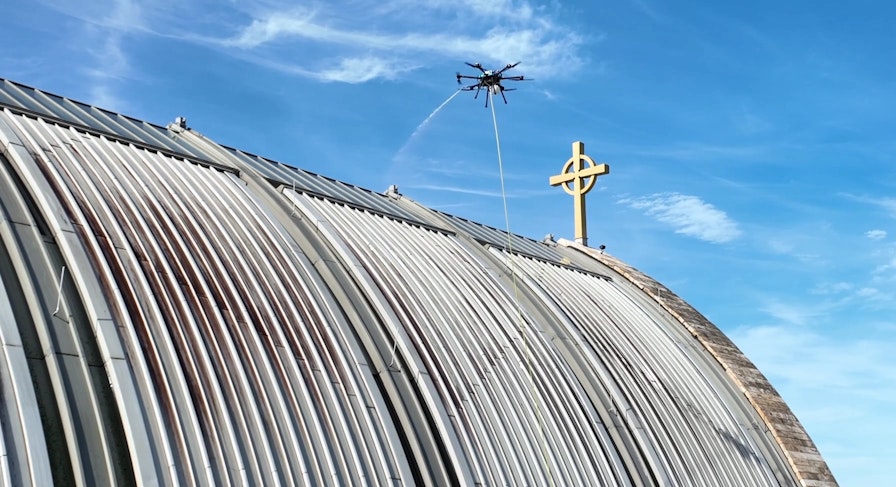
Ethan identified a specific structural gap in the exterior cleaning market before he ever bid a job. Buildings in the 5-to-10 story range are largely underserved — ground-based pumps can't reach them, and mobilizing a full lift or scaffold setup makes the economics unworkable for most property managers. The Sherpa Drone slots directly into that gap and lets Ethan compete on bids that would be inaccessible any other way.
He's also found a niche within the niche: interior courtyards in apartment complexes. No room for a lift, can't spray high enough from the ground, and the drone is often the only viable option. Those jobs have almost no competition.
"I make my most money when the drone is in the air. Everything else is just logistics."
A day-and-a-half job done in five hours. The tether changed the math.
Ethan's clearest turning point came during beta testing of the Power Tether, a continuous power supply that keeps the drone in the air indefinitely without battery swaps. He tested it on a 5-story office building he'd cleaned before on battery power. That job had previously taken a day and a half. With the tether, it was done in five to six hours. Not having to constantly land and swap batteries didn't just save time — it changed the entire rhythm of the workday. He's still adjusting to how much that one change rewrites the job.
His highest-value job since: a 10-story apartment project in Atlanta, completed in three days instead of five, generating roughly $20,000 in revenue.
10,000 windows. Four buildings. His first full-scale tether job.
Last week was Ethan's biggest Power Tether deployment yet — 10,000+ windows across four buildings, completed in 4 days. On battery power, a single flight covered roughly three columns of windows, five stories high, before the drone had to come down for a 10-to-15-minute swap. With the tether, his crew is covering three to four times that in a single continuous run. The long side of one building dropped from nearly three hours to about 1.5. Check out the full project video here.
The efficiency numbers matter. But the bigger shift is operational. On batteries, Ethan was constantly watching battery life, counting down the minutes until the next land-and-swap. The tether removed that entirely — and for the first time, he found himself stepping away from the drone mid-job, handing the controls to his crew, and focusing on other parts of the operation.
"It allows me to take a step back and focus on other aspects of the business."
Non-drone jobs run $600–$2,500. Drone jobs start at $1,500 and average $5–20K.
Ethan has never been in the cleaning business without the Sherpa drone, so he can't compare before and after. What he can tell you is where the money comes from: drone jobs. Non-drone work runs $600–$2,500. The drone starts at a $1,500 minimum and averages $5,000–$20,000 depending on scope. The Davidson College project, roughly 20 dormitory buildings cleaned in under two weeks — is a job he estimates would have taken over a month by traditional methods. That's the Sherpa Drone's value proposition in a single example.
Two people. Forty-five minutes to setup. A third of the day each on chemical, batteries, and rinsing.
Skyview runs two people on the vast majority of jobs — a pilot and one visual observer. Complex jobs occasionally add two or three more observers, but that's maybe one in ten. A typical day used to break into roughly thirds: spraying chemical, managing batteries and the rig, and rinsing and cleaning windows. The Power Tether has largely eliminated the battery management third — and Ethan is still recalibrating his day around that.
"Flying the drone is still my favorite part of the whole operation. That has never gotten old."
Everyone pictures a DJI quadcopter. Then the Sherpa Drone spins up.
The most consistent reaction Ethan gets from clients and property managers is surprise at the size of the drone. Most people hear "drone cleaning" and picture a small consumer quadcopter doing light work. When the Sherpa Drone lifts off, it stops people in their tracks. That moment of surprise tends to work in his favor — the gap between expectation and reality is wide enough that it becomes its own sales tool. Skeptics become believers on the spot.
Recurring window contracts and partnerships with other cleaning companies.
Ethan's primary growth focus is recurring window cleaning contracts. Windows get dirty frequently, traditional cleaning is cost-prohibitive for many property managers at that cadence, and the drone lets him offer faster, cheaper, and more frequent service than conventional methods. That combination has been a consistent winner in his market.
He's also building partnerships with other cleaning companies to co-tackle larger and more complex jobs — letting each side specialize, keeping overhead down, and opening up projects that would be out of reach operating solo. It's a growth model that doesn't require scaling headcount to scale revenue.
From Lucid Bots
Ethan is a clear example of what it looks like when someone understands a technology deeply before they try to build a business around it. He knew what the drone could do, identified exactly where that capability created an unfair advantage, and built Skyview Precision Cleaning squarely inside that gap. At 27, with no prior cleaning business to compare against, he has no bad habits to unlearn and no ceiling he's been conditioned to accept.
The recurring contract model he's building — paired with the tether efficiency gains he's already seeing — is the kind of compounding setup that doesn't look dramatic quarter to quarter but builds something real over time. We're watching it closely.
.jpg)