CLINTON COLLEGE CASE STUDY
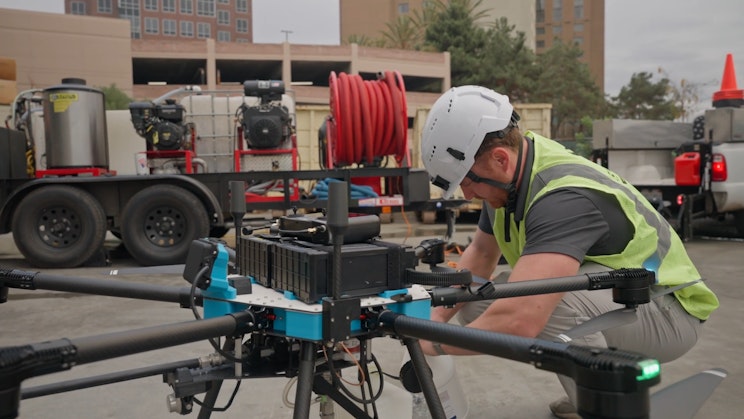
Learn how Lucid Drone Technologies deployed its C1 Cleaning drone to rapidly and effectively clean 11 buildings on campus safely!
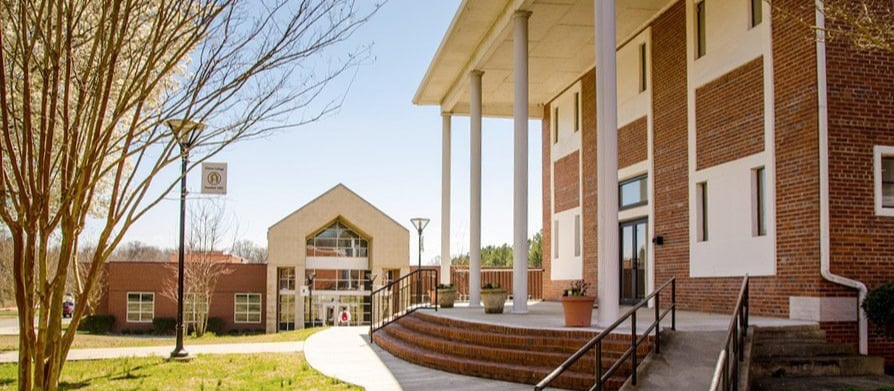
Clinton College is a HBCU located in Rock Hill, SC with over 125 years of educational excellence.
Summary
The Director of Maintenance at Clinton College was searching for a solution to get all the buildings on campus cleaned and ready to welcome back students. He had explored other options but quickly realized that several obstacles were impeding progress. He needed help to get it cleaned safely, efficiently, and within his budget constraints.
Challenges
Limestone columns had years of buildup and extended over the building. The college wanted a solution that would clean multiple buildings/surfaces.
Large lift equipment was not an option with the terrain around some buildings.
Solution
Lucid Bots deployed its cleaning drone to rapidly and effectively clean all 11 buildings on campus safely.
Lucid's cleaning drones leveraged a soft wash cleaning process to effectively remove all organic stains at the roots ensuring a longer duration between cleanings.
Results
- Completed the job in a third of the time with less man power than other companies proposed which lead to no disruption for the college.
- Saved the college 30% while being more profitable than the competition due to limited labor costs and rental fees.
- The drone was setup and packed up within 5 minutes of start and stop times leading to less disturbance and cleanup.
- No landscaping or roofing materials were damaged and no one was put in an unsafe situation.
Related Articles

From firefighter to running a drone cleaning company — and doubling revenue in a year
Nick Burgess didn't pivot to drone cleaning. He started there. Summit Drone Solutions was built from scratch around the Sherpa in SW Florida — and from year one to year two, gross revenue more than doubled. Here's how he did it and where he's taking it next.
A firefighter-paramedic who saw the market before it was obvious
Nick is 44 and spent most of his career as a firefighter and paramedic before going into business. He saw an ad for the Lucid C-1 around 2022, spent 2023 researching, connected with the Lucid Bots team, did serious market research, and jumped in. His read on the timing: enough industry presence to have credibility, but not yet oversaturated. SW Florida gave him a strong first market to build in.
The first year was steep. But the traction came — and Summit has been growing year over year since.
No prior cleaning business. The Sherpa opened every door.
Nick didn't have an exterior cleaning operation to pivot from — Summit was built around the drone from day one. What he didn't expect was how many adjacent services the Sherpa would unlock. Jobs he hadn't originally planned for started showing up, and Summit grew into a full-service exterior cleaning company almost organically. The drone wasn't just a service line — it became the foundation everything else was built on.
"You don't know what you don't know. Talk to operators who've been doing it — everyone in this industry is approachable."
The first 10-story building changed how he thought about the business.
Nick's turning point was the first time he put the Sherpa on a 10-story building. It was a real eye-opener — for his team and for his clients. Five-figure projects are meaningful, but what Nick has found most valuable over time isn't the big one-off jobs. It's the recurring maintenance contracts. Those are where the business compounds.
High demand doesn't always mean high margin. He did the math on roofs.
Nick started with roof cleaning — high demand in Florida, obvious fit for the drone. But after running the numbers carefully, he found the profitability wasn't what it appeared once all costs were accounted for. He shifted focus toward mid-rise window cleaning, which has proven more profitable, and brought on a dedicated marketer in 2025 to build that side of the business systematically. Growth has continued year over year since the shift.
Three-person crew. Scene size-up first. Pre-planning does most of the work.
Summit runs a crew of three for most jobs. They arrive, do a thorough scene size-up, and spend about 30 minutes prepping hose lines. A charging station and portable generator are positioned close to the work area. From there: one person pilots, one manages the hose, one handles batteries, fuel, DI water, and rover duties. Redundancy and pre-planning are what keep the drone in the air. Nick's approach — crawl, walk, run — is the same advice he gives to new operators before they tackle large buildings.
"Does it really work?" Everyone thinks the drone is cool. Owners want results.
The most common question Nick gets isn't about price or safety — it's basic skepticism. Building owners want to know it actually works. His answer isn't a hard sell; it's expectation management. For window cleaning, he markets the Sherpa as roughly 80% as effective as traditional methods. In practice, they often exceed that. Knowing the limitations is just as important as knowing the capabilities — and being honest about both is what earns the contract and keeps it.
"Knowing the limitations is just as important as knowing the capabilities."
Mid-rise window cleaning — with a marketer now actively building the pipeline.
Nick's number one growth opportunity is mid-rise window cleaning. The 5-to-10 story range is underserved — too high for ground-based crews, too small to justify full lift mobilization — and he's positioning Summit squarely in that gap. With a marketer on the team since 2025, the inbound pipeline is being built deliberately. Recurring contracts are the goal, not just one-off jobs. Summit more than doubled from 2024 to 2025 and is carrying that momentum into 2026.
From Lucid Bots
Nick's story matters to us because it's one of the clearest examples of what we hoped this technology would make possible — someone with no background in exterior cleaning who saw the opportunity, did the homework, and built a real business from the ground up.
Every other week we'll bring you another story like this — different operator, different market, different path in. Same commitment to sharing what's actually working. If you know someone who should be in this newsletter, send them our way. And if you think your story belongs here, we want to hear it.
.jpg)
From a ladder fall to a six-figure contract pipeline
David Wheeler was a white-collar career professional who landed on his hip from 8 feet up. That injury didn't just change his body — it changed his business. Here's how Drone Clean USA went from residential soft washing to major commercial jobs on the calendar.
What has the Sherpa Drone actually done for Drone Clean USA?
Before the drone, David was doing $20,000–$30,000 per month as a residential soft washer. He can now hit that same number in a single week. He's also targeting increasingly complex commercial projects, and revenue has grown 200% — and he's quick to point out that the quality-of-life gains have grown alongside the money.
"I can hit in a single week what used to take me a month."
An 8-foot fall and a company that actually answered the phone
David's entry into drone cleaning wasn't strategic — it was survival. He fell off an 8-foot ladder and landed hard on his hip, damaging it significantly. The experience made one thing clear: there had to be a safer way to do this work.
He researched drone cleaning companies and reached out to four of them. One was out of business. One emailed him back two weeks later. One never responded at all. Lucid Bots answered the phone.
That responsiveness was enough. He bought the Sherpa Drone, became a strategic partner, and has been an active feedback contributor ever since. Years later, he's getting that same hip replaced — but he's not climbing ladders anymore.
Residential soft wash, a dissolved partnership, and a slow pivot
David started in residential soft washing with a partner. After the partnership dissolved, he launched Drone Clean USA. The first two years with the Sherpa Drone were spent trying to make it work primarily for roof cleaning — a high-demand service that he eventually found was lower profitability than it appeared after careful analysis.
Year three was the turning point. He made the deliberate choice to focus residential work only on high-margin roofs, drop house washes entirely, and shift serious energy toward commercial acquisition. He calls it the best business decision he's ever made.
"The best business decision I've ever made was going all-in on commercial."
$20–30K per month to $20–30K per week
The revenue math for Drone Clean USA is straightforward. What used to be a solid month is now a strong week. Average per-job revenue has climbed to approximately $10,000 and is growing as David deliberately pursues more complex, higher-value commercial projects.
More notable to him than the revenue growth is what came with it: time. Time to volunteer. Time to rest. Time to do things outside of work that matter to him.
Minimum two people, maximum preparation, early starts on the coast
Drone Clean USA runs a minimum crew of two, scaling with job complexity. Critically, the job planning happens offsite — site visits are done in advance, SOPs are reviewed, and the crew knows exactly what to do when they arrive. Onsite setup is minimal by design.
When working on the coast, David prefers early morning starts before afternoon winds pick up. The team works opposite the sun to prevent solution drying on windows. Weather and wind contingencies are built into the schedule based on season. The crew often skips lunch to finish early, but hydration stays non-negotiable throughout the day.
Entire commercial portfolios — and a team being built to go get them
David's next move isn't another job type. It's building the infrastructure to own entire commercial portfolios. He's developing a team with dedicated acquisition, service delivery, and account management capacity. Portfolio-based pricing is available, but only with signed agreements — a policy that keeps the pricing structure sustainable and filters out uncommitted prospects.
A six-figure job is already on the calendar. Another commercial contract, if it closes fully, would be in a different category altogether.
60 years old, a brand new hip, and one clear regret
David Wheeler is 60. He spent most of his career in white-collar work before switching to the trades five years ago — two years before the Sherpa Drone, three years with it. He recently got a hip replacement on the same hip he damaged in that 8-foot fall. The injury that brought him to the Sherpa Drone has been corrected. He's not climbing ladders regardless.
What does he wish he'd known? That drone cleaning was even a category. He would have gotten into it sooner — and he says it plainly, without qualification.
"I didn't know this existed. If I had, I would have started sooner."
From Lucid Bots
David's story is one we think about when someone asks what kind of company Lucid Bots is trying to be. Not because of the pipeline or the revenue growth — though those numbers matter. Because of what happened after he bought the Sherpa Drone.
He didn't just use the product. He called us when something wasn't right. He shared what he was learning in the field. He gave feedback that shaped how the product developed. And he trusted that we were actually listening.
If you're running a Sherpa Drone and you haven't connected with the Client Success team, that's the first thing to fix. And if you're considering the Sherpa Drone and want to talk to someone who's been in the field with it for three years — David is the kind of operator who picks up the phone too.
— The Lucid Bots Team

Case Study: VEMAC Tilt-Up Concrete Staining Pilot – El Paso, TX
VEMAC used Lucid Bots’ Sherpa Drone to stain tilt-up concrete panels 3.4× faster with zero lifts and 100% safer operations. The pilot in El Paso proved that drone-based automation can dramatically cut labor time and costs while improving speed and safety on large-scale construction projects.
3× Faster. Zero Lifts. Same Great Finish.
When VEMAC needed to stain a series of large tilt-up concrete wall panels, they faced the same problem many builders encounter: slow, expensive, and risky work at height. Setting up lifts, repositioning between panels, and sending crews up and down all day consumed time, labor, and budget.
Lucid Bots’ Sherpa Drone changed that.
In a pilot on a 400 sq. ft. panel, Sherpa Drone applied two full coats in just 13 minutes, compared to 44 minutes with a traditional man lift. The crew stayed safely on the ground the entire time.
Sherpa Drone reduced labor time by 70%, eliminated lift use, and proved that vertical finishing can be done faster, safer, and more efficiently.
Why Tilt-Up Matters Now
Tilt-up construction is experiencing a major resurgence, driven by the rapid growth of data centers, logistics hubs, and large-scale industrial buildings.
Developers and general contractors are choosing tilt-up because it’s faster to build, structurally durable, and cost-effective for massive footprints. However, the finishing process—especially staining and coating—remains one of the most time-consuming steps.
That’s where Sherpa Drone comes in. By automating coating at height, Sherpa Drone removes one of the last manual bottlenecks in large-scale concrete construction, helping crews meet the high-speed demands of modern industrial projects.
The Challenge
VEMAC’s teams pride themselves on quality. Their finishing standards demand smooth coverage, consistent color, and no missed areas. But on large tilt-up projects, production speed was limited by lift logistics. Each new panel required new setup, safety checks, and careful maneuvering—costing valuable time across an entire site.
With project timelines tightening and labor costs rising, VEMAC needed a faster, safer, and more scalable way to apply coatings.
The Sherpa Drone Solution
Sherpa Drone is Lucid Bots’ aerial work platform designed for large-scale exterior maintenance and finishing. It replaces lifts and scaffolding with an intelligent, tethered drone system capable of precise spraying, washing, and coating applications at height.
At VEMAC’s El Paso job site, a Sherpa Drone equipped with a stain sprayer module applied two coats of H&C Colortop concrete stain. Operated by a ground pilot and supported by a two-person crew, the drone maintained consistent coverage and uniform finish across the test panel.
The entire process—from takeoff to the final coat—took less than 15 minutes, with no workers leaving the ground.
The Results
The Sherpa Drone dramatically outperforms traditional methods in both efficiency and safety. It completes two coats over 400 sq ft 3.4× faster (13 minutes vs. 44 minutes) while eliminating the need for workers at height, making the process 100% safer. Setup and teardown times drop by 85%, and the drone’s coverage rate improves from 9 to 61 sq ft per minute, a 6.7× increase in productivity.
Safety and Efficiency in One Flight
Each Sherpa Drone flight keeps the entire crew safely on the ground. There are no harnesses, no OSHA lift paperwork, and no exposure to height-related risks.
Crews can focus on mixing, material prep, and quality checks while the Sherpa Drone handles the vertical work. This parallel workflow boosts overall site productivity and reduces downtime.
Real ROI in Minutes
With Sherpa Drone, VEMAC achieved:
- 65%+ reduction in labor hours per panel
- 100% elimination of lift rentals
- 70% reduction in total application time
Across a large project with dozens of panels, this performance translates into days of time saved and measurable labor cost reductions.
Why It Matters
For modern contractors, productivity and safety are the key drivers of profitability. Sherpa Drone enables both:
- Speed: Complete vertical coating work up to 3–5× faster
- Safety: Keep every worker on the ground
- Consistency: Smooth, repeatable coverage across every panel
- Flexibility: Swap payloads for painting, staining, washing, or inspection
VEMAC’s pilot showed that Sherpa Drone isn’t just a prototype—it’s a practical way to modernize how tilt-up and exterior finishing work gets done.
Looking Ahead
After the success of this pilot, VEMAC is exploring Sherpa Drone for additional applications including media blasting, surface prep, and protective coating. These operations share the same challenge: repetitive, at-height labor that slows projects down.
Sherpa Drone’s ability to automate these tasks at scale positions it as a key tool for the next generation of construction and maintenance workflows.
See It in Action
Ready to skip the lifts?
Schedule a live demo and see how Sherpa Drone can cut your labor time in half—or better.


.avif)
.avif)