The Drone Advantage — Why Drone Cleaning Beats Traditional Methods
See how drone cleaning outperforms lifts and scaffolds on time, safety, and profit. A direct comparison that proves the future of exterior cleaning is airborne.
This is for drone cleaning operators who need to articulate their competitive advantage clearly — whether you're preparing for a sales conversation, building a proposal, or responding to a prospect who says "we already have a vendor." It's also for property managers and facility directors who are evaluating whether drone cleaning is actually better than what they're currently using. The short answer is yes — and this shows the data.
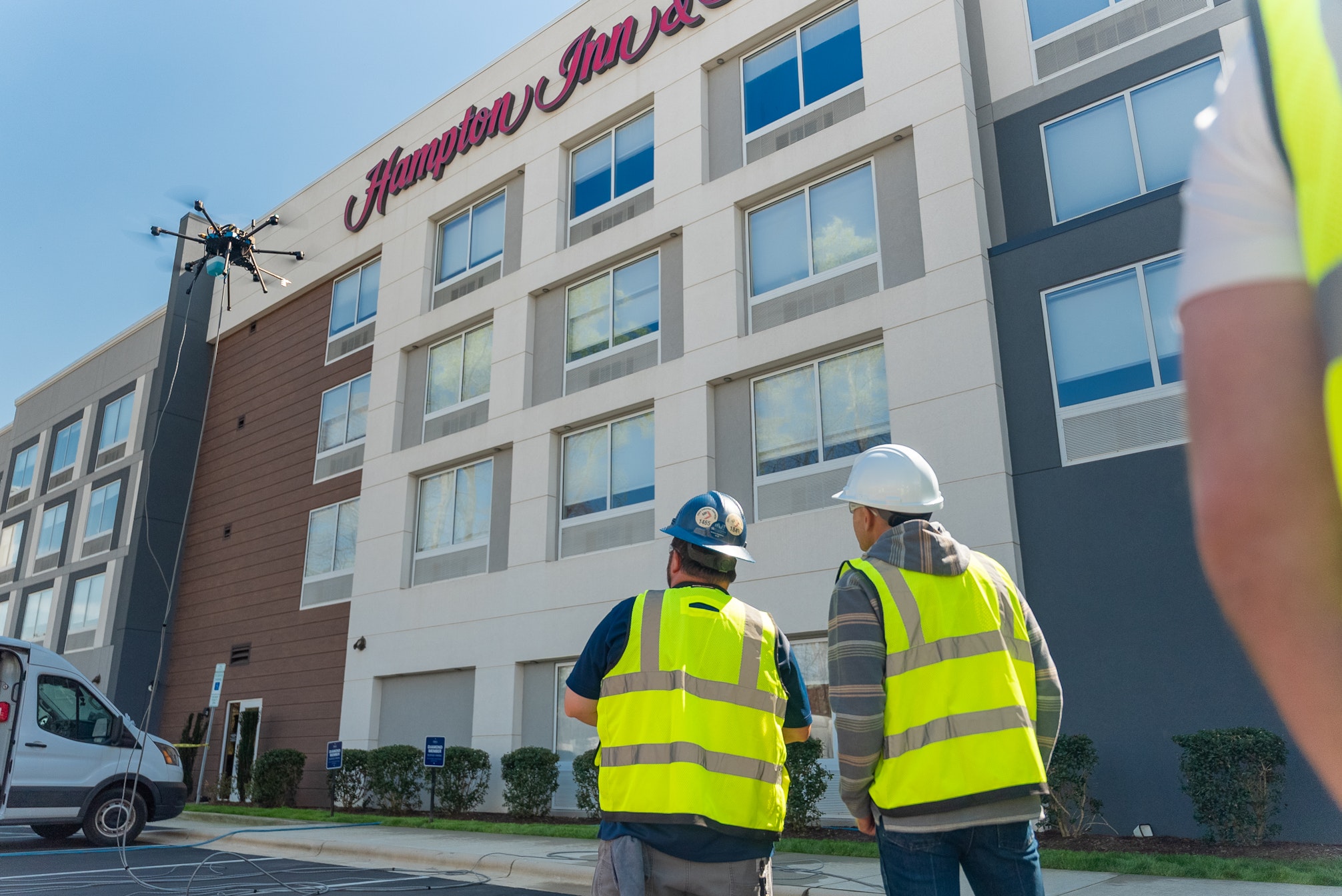
For decades, exterior building cleaning meant one thing: risk, labor, and lost time. Crews balanced on lifts, battled weather delays, and shut down parking lots for days at a time. Every 20 feet, the equipment had to be repositioned. Every job carried safety hazards that drove up insurance costs and frustrated tenants. Then drone cleaning changed the equation entirely. Today, a two-person drone crew can clean an eight-story building in a single day — with no lifts, less disruption, and dramatically better margins. This post breaks down the head-to-head comparison so you can see exactly where the advantage comes from.
The Four Failures of Traditional Cleaning
1. Repositioning Inefficiency
Lift-based cleaning allows you to cover only about 20 feet before the equipment must be lowered, repositioned, and raised again. On a large building, that process repeats dozens of times — burning hours that add up to days of unnecessary labor and cost.
2. Safety Hazards
High injury rates from lift and scaffold work drive up workers' compensation and insurance costs — a hidden expense that property managers often don't account for until something goes wrong. Falls and near-misses cost lives and dollars. Drone cleaning removes that liability from the equation entirely, keeping operators safely on the ground throughout the job.
3. Equipment Burden
Traditional setups require expensive lift rentals ($400-$1,000 per day), large crews, specialized rigging, and cooperative weather. Any one of those variables can delay or cancel a job, turning a two-day project into a week-long headache.
4. Customer Disruption
Parking lot closures, noise, and extended project durations frustrate tenants, guests, and property managers alike. A hotel that has to apologize to guests for noise and blocked entrances is not a happy client — and not a repeat client.
Head-to-Head: An Eight-Story Office Building
Let's look at a real scenario:
When you put the two methods side by side on an eight-story office building, the difference is hard to ignore. A traditional crew takes three days, requires four workers, and runs between $8,000 and $12,000 in total cost — all while carrying a high risk of injury. A two-person drone crew completes the same job in a single day at $4,000 to $6,000, with a safety profile that's 90% better than lift-based methods. That's a 60-80% reduction in time, a dramatically smaller crew, and equal or better margins — often at a lower price point for the customer.
Result: drone cleaning delivers a 60-80% reduction in time, dramatically improved safety, and equal or better profit margins — often at a lower price point for the customer.
That's the kind of efficiency leap that reshapes industries.
Beyond Efficiency: What Property Managers Actually Care About
Property managers don't choose vendors based on technology — they choose based on outcomes. And drone cleaning delivers on every outcome they care about:
- Safety: No workers elevated, no lift liability, no incident reports
- Speed: One day instead of three means less disruption to tenants and guests
- Consistency: Recurring maintenance plans keep the building looking clean year-round
- Simplicity: One crew, one platform, one vendor relationship
Drone cleaning turns an operational headache into a one-day maintenance win. That's not a feature — that's a business outcome.
The Takeaway
Drone cleaning isn't just a safer method — it's a smarter business model. As costs drop and regulations modernize, operators who adopt now will own the competitive advantage later.
Next: we'll show you how to translate that advantage into predictable, scalable revenue.

.jpg)
.jpg)