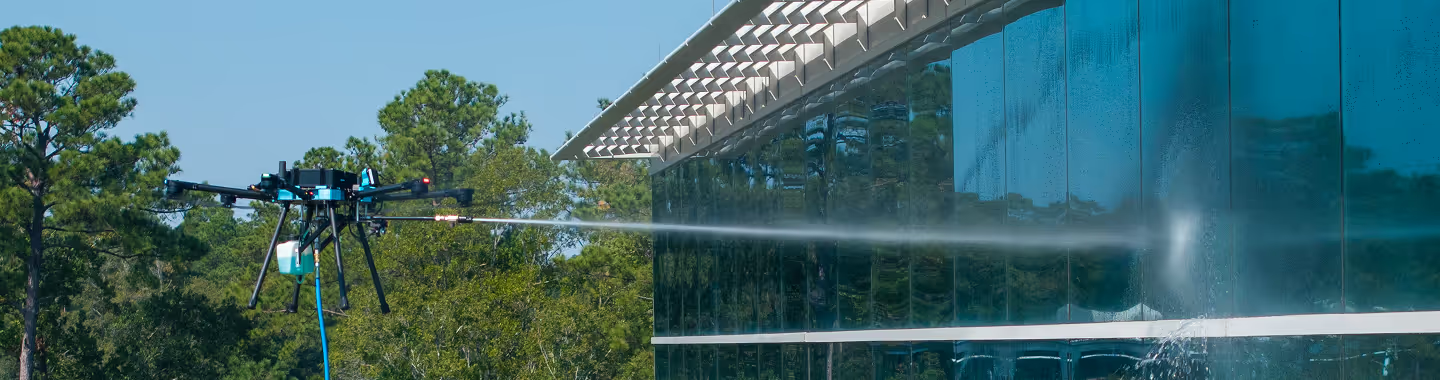
Experience Lucid Bots.
Discover a small sampling of what can be accomplished with Lucid Bots. The Lucid Bots resources page offers a comprehensive collection of case studies, videos, e-books, and more.

Commercial Drone Cost Breakdown: What Operators Actually Earn
Real commercial drone cost breakdown from $2,950/month subscription to $57,250 purchase, plus operator revenue data from customers and $75M+ in fleet revenue.
What Does a Commercial Cleaning Drone Actually Cost?
If you're researching commercial drone cost for a building cleaning business, you've probably seen numbers all over the map. Consumer drones for $500. Industrial inspection drones for $15,000. Vague claims about "starting a drone business" with no real pricing.
Here's the reality: a commercial cleaning drone that generates actual revenue on real job sites costs between $2,950 per month (subscription) and $57,250 (full purchase). And unlike most business equipment, most operators cover their monthly cost with a single job.
This guide breaks down every cost, every revenue number, and every financial decision point, backed by data from 500+ customers across the Sherpa Drone operator fleet.
Two Paths: Subscribe or Buy
Lucid Refresh Subscription (Recommended for New Operators)
Refresh puts a full Sherpa drone system in your hands with no upfront capital. Three tiers:
- Refresh Launch - $2,950/month: Sherpa drone, 8 batteries, 2 chargers, Lucid Suite software, data plan. Best for operators testing the market.
- Refresh Growth - $3,500/month: Everything in Launch plus window payload, 3-day Business-in-a-Box training, and Lucid Command fleet management. Best for growing businesses.
- Refresh Scale - $5,000/month: Everything in Growth plus additional payload options, power tether for unlimited flight time, and marketing content package. Best for multi-unit operators.
No long-term commitment. If the market isn't there, you walk away. If it is, you scale up or buy later with real revenue data behind the decision.
Outright Purchase
- Cleaning Bundle - $45,750: Starter plus additional cleaning capabilities
- Window Bundle - $57,250: Full system with window payload and specialized glass training
Add-ons: Power Tether for unlimited flight time ($17,600) and Midwest Rig Trailer ($23,499 to $25,499). Most buyers finance at approximately $3,500/month.
The Revenue Side: What Operators Actually Earn
Cost means nothing without revenue context. Here's what the fleet data shows:
- Total operator revenue (all time): $75M+ across all operators
- Jobs completed: 6,500+ across 3 continents
- Operators past $100K revenue: 43
- Fastest to $100K: Under 5 months
- Average monthly operator revenue: $15,000 to $20,000
- Average job revenue (Q3 2025): $13,500 across 189 jobs
Unit Economics: One Job Pays the Monthly Bill
Most operators finance at roughly $3,500/month. Average job revenue runs $13,500. One job covers the payment. Two jobs in a month equals approximately $23,500 after equipment costs. Three jobs per month puts you on pace for a $400,000+ annual business off one machine.
Hidden Costs to Plan For
Be realistic about the full cost picture:
- FAA Part 107 certification: $175 exam fee (one-time)
- Insurance: $1M-$2M general liability, varies by state but significantly lower than elevated-work policies
- Chemicals: Lucid Clear+ cleaning solution, roughly $50-100 per job
- Vehicle/trailer: You need a way to transport equipment. Some operators use existing trucks; others invest in a dedicated rig.
- Marketing: Business cards, website, Google Business Profile. The Growth and Scale Refresh tiers include professional photo/video content.
Total realistic startup cost including Refresh subscription, certification, insurance, and basic marketing: $5,000-$8,000 first month. Compare that to a traditional pressure washing business startup at $15,000 to $40,000 for equipment alone, before adding scaffolding rental, crew payroll, and elevated-work insurance.
Refresh vs. Purchase: Which Is Right for You?
Refresh isn't a rental. It's a lower-risk path to the same revenue. You get the same Sherpa Drone, the same payloads, and the same training. Lucid Suite is included from day one (purchase customers pay $500 to $700/month extra for Suite).
The operators making $15,000 to $20,000/month aren't differentiated by whether they bought or subscribed. They're differentiated by how fast they got to their first job. Refresh gets you there faster with less capital at risk.
Choose Refresh if: You're testing a new market, want to minimize upfront risk, or prefer predictable monthly costs.
Choose Purchase if: You have existing revenue/clients that guarantee immediate utilization, want to build equity in equipment, or plan to scale to multiple units quickly.
For a full comparison of drone vs. traditional methods, including cost per square foot analysis, read our drone vs. pressure washing comparison.
Frequently Asked Questions
How much does a commercial cleaning drone cost per month?
The Lucid Refresh subscription starts at $2,950/month for a full Sherpa Drone system including software, batteries, chargers, and support. For outright purchases financed, monthly payments run approximately $3,500. Either way, average job revenue of $13,500 means a single job covers the monthly cost.
How fast can I make back my investment in a cleaning drone?
Most operators report ROI after their first 2 jobs. With average job revenue of $13,500 and monthly costs between $2,950 and $3,500, the payback math works quickly. 43 operators have crossed $100,000 in total revenue, with the fastest reaching that mark in under 5 months.
Is financing available for commercial cleaning drones?
Yes. Outright purchases can be financed at approximately $3,500/month. Alternatively, Lucid Refresh subscriptions start at $2,950/month with no upfront capital and no long-term commitment, making it the lowest-risk way to enter the market.
Get a custom quote with financing options and Refresh pricing for your market.

Commercial Window Washing: The $10B Market Drone Operators Are Capturing
The commercial window washing market is worth $10B+ and growing. How drone operators are capturing share with lower costs, faster turnarounds, and zero workers at height.
The Commercial Window Washing Market Is Massive. Drones Are Taking Share.
"Commercial window washing" gets 22,200 searches per month. Most of those searches land on traditional cleaning company listings. Almost none of them mention drones.
That gap represents one of the largest untapped opportunities in commercial building services. The exterior building cleaning market is worth over $10 billion and growing by roughly $1 billion every year. It can't find workers. Scaffolding crews, boom lift operators, and rope access technicians are aging out faster than they're being replaced. Insurance costs keep climbing. OSHA regulations keep tightening.
Drone operators are filling that gap right now. Not with prototypes or pilot programs, but with revenue-generating businesses that are outcompeting traditional crews on cost, speed, and safety.
Why Traditional Window Washing Is Losing Ground
The economics of traditional commercial window washing have been deteriorating for years:
Labor shortage: Certified rope access technicians charge $40 to $60 per hour. Finding workers willing to hang off buildings at 150 feet is getting harder every year. The average age of commercial window cleaners keeps rising.
Equipment costs: Swing stages, scaffolding, and boom lifts aren't cheap. Scaffolding rental runs $2,000 to $5,000 per week. Boom lifts cost $500 to $2,000 per day. On a large high-rise project, equipment costs alone can exceed $50,000 before anyone touches a window.
Safety liability: Falls from elevation are among the leading causes of workplace death in the U.S. Every worker at height represents insurance exposure. Workers' comp premiums for elevated work are significantly higher than ground-level operations.
Building disruption: Scaffolding blocks entrances, closes sidewalks, restricts loading docks. Property managers hate it. Tenants hate it. It often takes longer to set up than the actual cleaning takes.
How Drone Window Cleaning Changes the Equation
The Sherpa drone's window cleaning payload enables on-demand chemical injection using Lucid Clear window cleaning solution. The operator switches between pure filtered water and a water/chemical mix while the drone stays in the air. One system handles both high-pressure facade work and delicate glass cleaning.
What this means for the market:
- Cost reduction: Eliminate scaffolding, swing stages, and boom lift rental entirely. One operator replaces a 3-4 person crew.
- Speed: A single operator cleans an 8-story building in 1-2 days vs. 3-5 days for a traditional crew including setup time.
- Zero fall risk: The operator stays on the ground. The drone handles the height. Insurance costs drop. OSHA exposure drops. Liability drops.
- No building disruption: No blocked entrances, no sidewalk closures, no loading dock restrictions. The building stays fully operational.
The Opportunity for Pressure Washing Business Owners
If you already run a pressure washing or exterior cleaning business, adding commercial window washing via drone is the highest-leverage growth move available right now. Here's why:
You already have the customer relationships. Your existing building maintenance clients need window cleaning. Most are paying someone else to do it. With the Sherpa Drone, you can capture that revenue yourself.
The search volume is enormous. 22,200 monthly searches for "commercial window washing" alone. The vast majority of results point to traditional companies. A drone operator with a basic Google Business Profile and a few job photos can capture local search traffic that traditional companies can't differentiate against.
Contract sizes are substantial. Single high-rise window cleaning contracts regularly exceed $50,000. Even mid-rise commercial buildings (5-10 stories) generate $5,000 to $15,000 per job.
Recurring revenue is built in. Most commercial properties require window cleaning quarterly or semi-annually. One contract becomes predictable recurring revenue year after year.
What It Takes to Get Started
Adding drone window cleaning to your business requires three things:
- FAA Part 107 certification: $175 exam, most pass first attempt. Lucid Bots provides study materials through Sherpa Academy.
- Equipment with window payload: The Sherpa Window Bundle ($57,250 purchase) or Refresh Growth subscription ($3,500/month) includes the window payload, 3-day Business-in-a-Box training, and professional marketing content.
- Your first target list: Start with mid-rise buildings (5-15 stories) in your local market. Commercial office buildings, hotels, apartment complexes, hospitals, and universities all need regular window cleaning.
Most operators complete their first paying job within 30-60 days of receiving equipment. At average job revenue of $13,500 (Q3 2025 data across 189 jobs), a single job covers a full month of equipment costs regardless of whether you buy or subscribe.
For the complete breakdown of equipment costs, financing options, and operator revenue data, read our guide to commercial drone building cleaning.
The Bigger Picture: Full Building Coverage
Window cleaning is the entry point, not the ceiling. The Sherpa Drone platform handles windows, facades, concrete, solar panels, roofing, and waterproofing from one system with interchangeable payloads. And the Lavo AI addresses ground-based commercial cleaning, handling concrete, asphault, and other hard surfaces while the Sherpa Drone handles vertical windows, facades, and more.
The operators growing fastest are positioning themselves as comprehensive building maintenance providers, a single vendor covering the entire facility. That's a value proposition traditional window washing companies can't match.
Frequently Asked Questions
How much does commercial window washing cost with a drone?
Drone-based commercial window washing typically costs 40 to 60% less per square foot than traditional methods for buildings above 3 stories. The savings come from eliminating scaffolding rental ($2,000-$5,000/week), reducing crew size from 3-4 workers to 1 operator, and cutting job duration by 50-70%.
Can drones clean windows on high-rise buildings?
Yes. The Sherpa Drone with window cleaning payload handles high-rise windows using adjustable pressure and on-demand chemical injection. The operator stays on the ground while the drone works at height, eliminating the need for rope access technicians ($40-$60/hour) or swing stages.
How do I start a drone window cleaning business?
You need an FAA Part 107 certification ($175 exam), a Sherpa Drone with window payload (via Refresh subscription starting at $3,500/month or purchase at $57,250), and training through Sherpa Academy. Most operators complete their first paying job within 30-60 days.
.jpeg)
What Is Building Maintenance Robotics?
A definition-style guide to building maintenance robotics: what it means, how autonomous cleaning drones and ground robots are replacing manual crews, and why operators are switching.
What Is Building Maintenance Robotics?
Building maintenance robotics refers to autonomous or semi-autonomous machines -- drones, ground robots, and crawling systems -- that clean, inspect, and maintain the exterior surfaces of commercial buildings. Instead of sending workers up ladders, lifts, or rope rigs, operators deploy robots that do the same work from the ground with a remote controller.
For exterior cleaning contractors, the practical definition is simple: a robot does the dangerous, repetitive work while your crew stays safely on the ground and completes more jobs per day.
Why Building Maintenance Robotics Matters for Cleaning Contractors
The commercial building maintenance market is massive, but traditional methods have not changed much in decades. Workers still climb scaffolding, hang from ropes, and operate boom lifts to wash windows, facades, and parking structures. That model has three problems that robotics solves directly.
1. Labor Is the Biggest Cost -- and the Hardest to Find
Finding workers willing to do dangerous exterior cleaning at height is increasingly difficult. Building maintenance robotics lets a two-person crew handle jobs that previously required four to six workers plus expensive lift rentals. Less labor means lower bids that still protect your margins.
2. Safety Liability Drops Dramatically
Falls from height remain a leading cause of workplace fatalities in construction and maintenance trades. When a drone or ground robot does the work, nobody is suspended above the ground. That means fewer workers' comp claims, lower insurance premiums, and less operational risk for your business.
3. You Can Service More Buildings Per Week
Robotic systems work faster than manual crews on large surface areas. A cleaning drone can cover a five-story facade in a fraction of the time it takes a traditional crew to set up scaffolding, wash, and break down. More buildings serviced per week means higher monthly revenue from the same equipment investment.
What Does a Building Maintenance Robotics Setup Look Like?
A typical setup for an exterior cleaning operator includes:
- Cleaning drone for facades, windows, solar panels, and rooftops above ground level
- Ground robot for driveways, parking garages, sidewalks, and other flat surfaces
- Fleet management software to track jobs, log flight data, and manage maintenance schedules
Lucid Bots builds all three: the Sherpa cleaning drone, the Lavo autonomous ground robot, and Lucid Command for fleet management.
What Does It Cost to Get Started?
A full building maintenance robotics package -- drone, ground robot, payloads, and training -- starts around $35,000. With financing from $2,950 per month, most operators break even within their first few commercial contracts. Compare that to the ongoing cost of lift rentals, extra crew wages, and insurance premiums for manual methods.
Is Building Maintenance Robotics Right for Your Business?
If you run an exterior cleaning company -- or you are considering starting one -- building maintenance robotics gives you a way to take on larger commercial contracts with fewer workers, lower risk, and faster turnaround. The economics favor operators who adopt early, before competitors in their market do the same.
Ready to see what robotic cleaning looks like on a real building? Schedule a demo and talk to an operator who already made the switch.
Cleaning Drone vs. Pressure Washing Crew: The Full Comparison
Full comparison of cleaning drone vs traditional pressure washing. Cost per sqft, speed, safety, ROI, and which method works best for different jobs.
Which Method Wins on Cost, Speed, Safety, and ROI?
If you run a pressure washing business or manage building exteriors, you've probably heard about cleaning drones. Maybe you've seen videos of them blasting grime off 15-story facades while a single operator watches from the ground. The question isn't whether drones work anymore. It's whether they make more financial sense than your current method.
This guide breaks down the real numbers: cost per square foot, labor requirements, safety exposure, speed, and return on investment. No hype, no theory, just what operators on both sides of the equation are actually experiencing.
Cost Per Square Foot: Where the Math Gets Interesting
Traditional pressure washing on a multi-story commercial building typically runs $0.15 to $0.75 per square foot, depending on height, access complexity, and local labor rates. That range widens fast once you factor in equipment rental.
A boom lift or swing stage can cost $500 to $2,000+ per day. Scaffolding on a large job might run $15,000 to $50,000 for setup alone. That equipment cost gets baked into every square foot.
Drone cleaning changes the equation. With the Lucid Sherpa covering over 300 square feet per minute (approximately 5,700 sqft per flight), the per-sqft cost drops significantly. Operators report job costs 50 to 80% lower than traditional methods once the upfront equipment investment is recovered.
The key variable: how many jobs you're running. A pressure washing crew amortizes their equipment across volume. A drone operator amortizes a $45,000 Sherpa (or $2,950/month through Lucid Refresh) across that same volume, but with dramatically lower per-job labor and equipment overhead.
Bottom line: For buildings above 3 stories, drone cleaning typically costs 40 to 60% less per square foot than traditional crew-based methods.
Speed: One Operator vs. a Full Crew
A traditional crew of 4 to 8 workers cleaning an 8-story commercial building exterior might spend 3 to 5 days on site. That includes setup time for lifts or scaffolding, safety checks, and the actual cleaning.
A single Sherpa operator can cover the same building in 1 to 2 days. The drone cleans over 300 sqft per minute with up to 19 minutes of flight time per battery set. No scaffolding setup. No lift positioning between sections. No crew coordination.
For the business owner, speed means two things: you can take on more jobs per month, and you can quote faster turnarounds that win contracts.
Safety: This Is Where Drones Win Definitively
Falls from elevation are consistently among the top causes of workplace fatalities in the U.S. Traditional exterior cleaning puts workers on ladders, scaffolding, swing stages, or boom lifts, often 50 to 200 feet above ground.
Drone-based cleaning eliminates elevated worker exposure entirely. The operator stays on the ground. The drone handles the height. That's not just a safety talking point - it directly impacts insurance costs, OSHA compliance burden, and liability exposure.
Operators switching from traditional methods to the Sherpa report meaningful drops in their workers' comp premiums. When you remove the primary risk factor (elevation), insurers notice.
What Each Method Handles Best
Pressure washing crews excel at: ground-level concrete, sidewalks, parking structures, tight interior spaces, heavy industrial degreasing at ground level, and jobs where water runoff containment is critical.
Cleaning drones excel at: building exteriors above 3 stories, window cleaning (with the Sherpa's window washing payload), facades, EIFS, stucco, curtain walls, solar panel cleaning, any surface that traditionally requires scaffolding or lift access, soft wash applications (300 PSI), and high-pressure applications up to 4,500 PSI.
The sweet spot for many operators: using both. Ground-level flatwork stays with the pressure washing rig. Everything above the first floor goes to the drone. This hybrid approach maximizes revenue per job while keeping the crew safe.
ROI Comparison: Payback Period
Traditional Pressure Washing Business Startup
- Truck, trailer, pump, surface cleaner, hoses: $15,000 to $40,000
- Boom lift rental per job: $500 to $2,000/day
- Crew payroll (4 workers): $1,200 to $2,400/day
- Insurance (elevated work): $5,000 to $15,000/year
- Payback: typically 6 to 18 months
Drone Cleaning Business with Sherpa
- Sherpa drone package: $45,000 (or $2,950/month with Lucid Refresh)
- Single operator: $200 to $400/day
- No lift/scaffold rental: $0
- Insurance (ground-level operation): significantly lower
- Training: included (Sherpa Academy + Part 107 certification)
- Payback: Most operators report ROI after 2 jobs
The Sherpa's 400% ROI comes from real operator data: what once required a crew of 8 and $150,000 in project expenses can now be handled by one person and a drone.
For a deeper look at commercial drone cleaning economics, equipment options, and operator revenue data, read our complete guide to commercial drone building cleaning.
The Verdict
This isn't drone vs. pressure washing as an either/or decision. It's about matching the right tool to the right job.
If you're cleaning parking lots, driveways, and ground-level concrete, a traditional pressure washing setup is proven and cost-effective. If you're cleaning building exteriors, windows, or anything that currently requires scaffolding or lifts, the economics have shifted. A cleaning drone like the Sherpa reduces labor costs, eliminates elevation risk, and lets a single operator handle jobs that used to require a full crew.
The operators growing fastest right now are the ones using both.
Frequently Asked Questions
Is a cleaning drone actually cheaper than a pressure washing crew?
For buildings above 3 stories, yes. Drone cleaning typically costs 40 to 60% less per square foot because you eliminate scaffolding rental ($2,000-$5,000/week), reduce crew size from 4-8 workers to 1 operator, and cut job duration by 50-70%. Ground-level flatwork is still more cost-effective with traditional equipment.
How fast can a drone clean a building compared to a crew?
A single Sherpa operator can clean an 8-story building in 1 to 2 days. A traditional crew of 4 to 8 workers typically needs 3 to 5 days on the same building, including scaffolding setup and safety checks.
Do I need a special license to operate a cleaning drone?
Yes. You need an FAA Part 107 Remote Pilot Certificate. The exam costs $175 and most people pass on the first attempt. Lucid Bots provides prep materials and training through Sherpa Academy.
Can I add drone cleaning to my existing pressure washing business?
Absolutely. Many of the fastest-growing operators run a hybrid model: traditional pressure washing for ground-level work and the Sherpa drone for everything above the first floor. Lucid Refresh starts at $2,950/month with no long-term commitment, so you can test the economics in your market before buying outright.
Ready to see the Sherpa in action? Book a demo and get a custom ROI analysis for your business.
.png)
Congress Races China as Nvidia Signals Robotics Era
This week, Congress heard urgent calls to ban Chinese-made robots from federal networks and build a national robotics strategy as China accounts for 54% of global robot installations versus just 9% for the U.S., Nvidia declared the physical AI era open at GTC with new foundation models and simulation tools, and global experts at Davos confirmed that robotics' foundational technical breakthroughs are complete and the industry is now entering the era of deployment.
U.S. Robotics Companies Want Federal Help to Keep Chinese Robots Out of America's Networks
Top U.S. robotics executives testified before the House Homeland Security cyber subcommittee this week, pressing lawmakers for federal dollars, new legislation, and a unified regulatory strategy to compete with state-funded Chinese rivals in a sector valued at an estimated $50 billion, as China accounted for 54% of global robot installations between 2020 and 2024 compared to just 9% for the United States. Matthew Malchano, vice president of software at Boston Dynamics, warned that Chinese company Unitree is capturing market share with U.S. police departments and universities despite contracting ties to the Chinese military and a wormable exploit discovered in 2025 that could allow attackers to take over entire robot fleets. Max Fenkell of Scale AI told lawmakers the U.S. is winning on AI model quality but losing on data and implementation, pointing to China's industrialized strategy of funding mile-long warehouse facilities dedicated to gathering and labeling robot training data, with no U.S. equivalent in place. Executives unanimously called on Congress to block federal agencies from purchasing Chinese-made robots, establish a single federal regulatory standard, and direct CISA to conduct a security review of foreign-made robots. Malchano also pressed for the National Commission on Robotics Act, sponsored by Rep. Jay Olbernolte, which would create a bipartisan commission to develop a national robotics strategy. The hearing comes as federal robotics spending accelerates, with the Coast Guard investing $350 million in autonomous systems by 2028, DHS finalizing a $1 billion AI analytics contract with Palantir, and ICE spending $78,000 last year on a robot capable of deploying smoke bombs.
Major Takeaway: The congressional hearing signals a shift from ad hoc procurement decisions to a broader policy reckoning over foreign robotics hardware, as lawmakers and industry leaders increasingly treat robot supply chains as a national security issue rather than a commercial one. Read More
Nvidia Declares the Rise of ‘Physical AI’ — and a World Run by Robots
At its GTC conference, Nvidia announced a sweeping push into "physical AI," with Jensen Huang declaring "Physical AI has arrived. Every industrial company will become a robotics company," backed by new foundation models, simulation frameworks, and a broad set of industry partnerships. New tools include Cosmos 3, a world foundation model combining synthetic world generation, vision reasoning, and action simulation; Isaac Lab 3.0 for large-scale robot learning on Nvidia DGX infrastructure; and GR00T N1.7, a robot foundation model enabling dexterous manipulation and autonomous task execution. Nvidia also previewed GR00T N2, based on its DreamZero research, which the company says helps robots succeed at unfamiliar tasks in new environments more than twice as often as leading vision-language-action models. In humanoid robotics, Boston Dynamics, Figure AI, and Agility Robotics are using Nvidia's simulation tools and AI models to accelerate development, while healthcare companies including CMR Surgical, Johnson & Johnson, and Medtronic are using Nvidia platforms to train and validate surgical robotic systems. On the cloud side, Microsoft, Nebius, and Alibaba Cloud are integrating Nvidia's physical AI data tools and robotics stack into their platforms. Through its Inception Program supporting more than 40,000 startups, Nvidia is also positioning itself as the foundational platform layer for emerging robotics developers, not just a chip supplier but the full-stack infrastructure for intelligent machines.
Major Takeaway: Nvidia's GTC announcements position the company as the compute and software backbone of the physical AI era, building a full-stack platform from simulation and training to deployment and safety that could define how the global robotics industry develops over the next decade. Read More
The Hardest Advances in Robotics Are Behind Us: What Comes Next
At the World Economic Forum's 56th Annual Meeting in Davos, experts in physical AI declared that the hardest technical breakthroughs in robotics are now complete, with the next decade focused on deploying autonomous systems from controlled industrial settings into the complexity of everyday life. BCG Managing Director Daniel Kuepper outlined the four foundational advances of the past decade: a 1,000x increase in compute power outpacing Moore's Law expectations by 25x, a narrowing simulation-to-reality gap enabled by digital twins and synthetic data, the rise of vision-language-action models that allow robots to interpret complex commands, and hardware that has become significantly cheaper and more capable. Experts confirmed that robots currently thrive in structured environments like ports, warehouses, and factories, with MIT's Daniela Rus noting that entire fleets already operate 24/7 moving shipping containers without human intervention, and BCG projecting that roughly 70% of global manufacturing operations will be largely autonomous by 2050. The next barrier is unstructured environments, where robots must handle unpredictability, assess risk, and make judgment calls, with Mech-Mind CEO Shao Tianlan noting the focus for the next few hundred days remains on controllable manufacturing and logistics settings. Amazon Robotics Chief Technologist Tye Brady identified object manipulation as the "holy grail" of robotics, explaining that tasks humans perform instinctively, like estimating how hard to grip a cup, require robots to explicitly simulate weight estimation, slip detection, and contextual reasoning. Experts agreed that fully autonomous systems are still years away and teleoperation remains essential for bridging the gap, but argued that the industry's innovation curve will eventually drive costs down and move robots from factory floors into homes, much like smartphones evolved from industrial tools to universal commodities.
Major Takeaway: The Davos consensus marks a meaningful inflection point for the robotics industry, as leaders across technology, manufacturing, and research agree that perception, mobility, and computing have been solved and the defining challenge is now deploying robots responsibly into the messy, unpredictable environments where most of human life actually happens. Read More
About Lucid Bots
Founded in 2018, Lucid Bots is an AI robotics company that is committed to uplifting humanity by building the world's most productive and responsible robots that can do dangerous and demanding tasks.
Headquartered in Charlotte, the company engineers, manufactures, and supports its products domestically, which include the Sherpa, a cleaning drone, and the Lavo, a pressure-washing robot.
Lucid Bots' products are elevating safety and efficiency for a growing number of customers around the world. Lucid is a Y Combinator-backed company, with investments from Cubit Capital, Idea Fund Partners, Danu Ventures, and others. Lucid Bots was recently recognized as the fastest growing robotics manufacturer in the United States.
🟢 New here?
Love startups, robots, and business growth stories?
Join the 2,100+ readers and subscribe to our Robot Rundown 🚀
What Is Autonomous Exterior Cleaning?
Autonomous exterior cleaning uses drones and robots to wash building facades, windows, and solar panels without scaffolding or manual labor.
Autonomous Exterior Cleaning: Definition
Autonomous exterior cleaning refers to using drones, robots, or other unmanned systems to wash, rinse, and maintain the outside surfaces of buildings, structures, and installations without requiring workers at height.
Instead of sending a crew up on scaffolding or swing stages, operators deploy a machine from ground level. The system navigates the surface, applies cleaning solution, and rinses it clean while the operator monitors from a safe distance.
Why It Matters for Cleaning Operators
For pressure washing and exterior cleaning businesses, autonomous systems change the economics of every job.
- Labor reduction: A two-person crew replaces what used to require four or five workers plus lift equipment.
- Speed: Autonomous systems like the Sherpa Drone can cover large facades in a fraction of the time manual methods require.
- Safety: No workers at height means lower insurance premiums and zero fall-risk liability.
- Access: Drones reach areas that are impractical or impossible for traditional equipment, including irregular architecture and multi-story facades.
How It Works in Practice
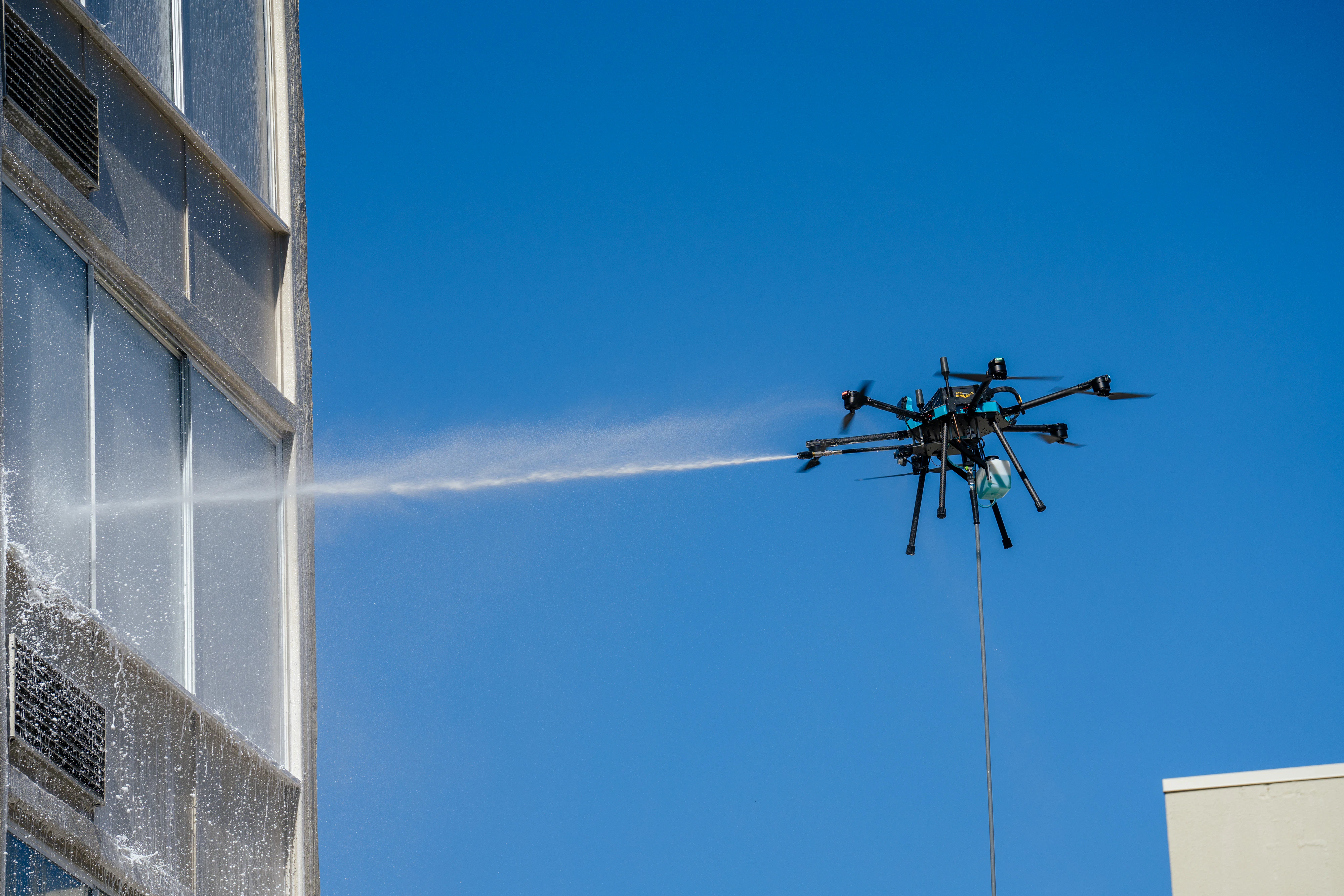
A typical autonomous exterior cleaning setup includes a drone or robot equipped with a spray nozzle, onboard chemical tank, and a camera system for real-time monitoring. The operator positions the machine, selects the cleaning pattern, and monitors the job from ground level.
Systems like the Sherpa Drone are capable of both soft-wash and high-pressure washing, adapting to the demands of each job. Soft-wash mode applies low-pressure cleaning solution to protect delicate surfaces — ideal for glass, stucco, vinyl, metal, painted finishes, and brick and mortar where aggressive pressure could cause damage or erode joints over time. For tougher jobs requiring more force, the drone can switch to high-pressure output to power through heavy buildup, staining, or more resilient surfaces.
Getting Started
Most operators finance their equipment. With monthly payments starting around $2,950, the barrier to entry is lower than purchasing a boom lift. The ROI comes from higher job throughput, fewer labor hours, and the ability to win contracts that require height access.
If you already run a pressure washing or exterior cleaning business, autonomous systems are a direct upgrade to your service capabilities. Schedule a demo to see how it fits your operation.
Cleaning Windows In DC With A Drone | VSI Aerial Case Study
Hear Geoffrey of VSI Aerial share insights about flying in D.C.
What are People Saying about Lucid Drones?
Hear what some of our customers think about working with Lucid Bots!
Lucid Bots' Lavo Bot Showcase
A quick montage showcasing the power of the Lavo Bot!
Cleaning a Pool Deck - Lavo Bot
Curious about more Lavo Bot applications? Check out how it can clean pool decks too!
What Happens When You Fly a Drone Into a Wall?
Safety is one of our top priorities. That is why we designed our drone with radar technology!
Sherpa Drone on a Rainy Day
The Sherpa Drone is waterproof to protect the internal components of the drone.
Lucid Bots Podcast
How Ryan Godwin is Transforming Exterior Cleaning with the Sherpa Drone
Dive into the future of exterior cleaning with Ryan Godwin, the visionary behind Lucid Bots. Discover how Ryan is leveraging cutting-edge robotics to revolutionize cleaning for buildings and outdoor surfaces—boosting efficiency, safety, and sustainability.
.avif)



.avif)