Country Club Roof Cleaning Case Study
Discover how Lucid Drone Tech helped a country club enhance their operations with drone technology in this informative case study.
Executive Summary
The Director of Facilities and Maintenance at The Peninsula Club Golf Course was searching for a solution to get the roof of the main clubhouse and recreational facility cleaned. He had explored other options but quickly realized that several obstacles were impeding progress. He needed help to get the cleaned safely, efficiently and within his budget constraints.
Challenges
- Clay roofing material could not be walked on and could not be cleaned effectively from the ground.
- The club only allows maintenance on Monday mornings.
- Large lifting equipment was not an option given the layout and landscaping around each building.
Solution
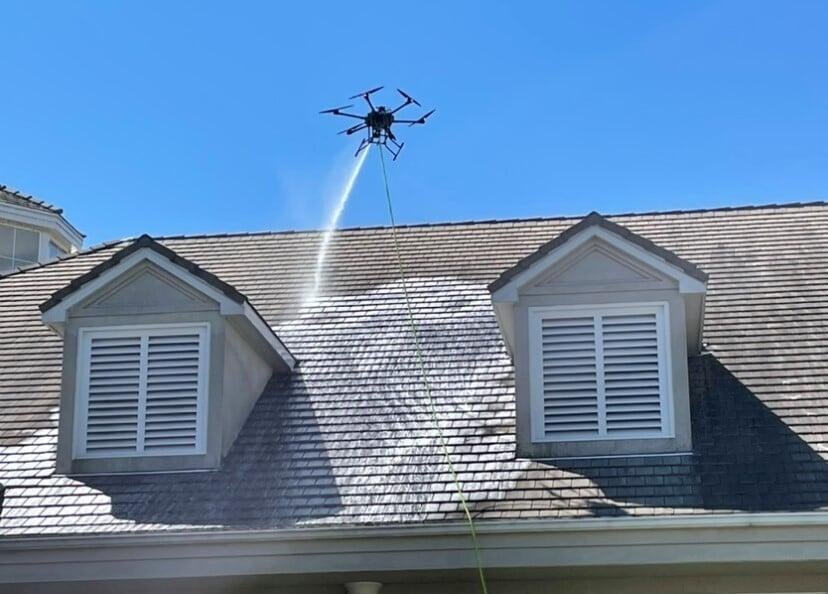
- Lucid Bots deployed its cleaning drone to rapidly and effectively clean both building roofs safely.
- Lucid's cleaning drones leveraged a softwash cleaning process to effectively remove all organic stains at the roots ensuring a longer duration between cleanings.
Results
- Completed the job in half the time with less manpower than other companies proposed which lead to less disruption for the club.
- Saved the club 30% while being more profitable than the competition due to limited labor costs and rental fees.
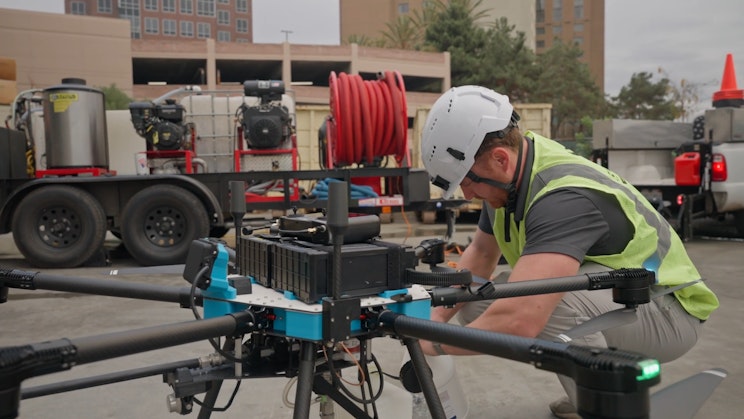
- The drone was setup and packed up within 5 minutes of start and stop times leading to less disturbance and cleanup for club members to see than traditional methods.
- No landscaping or roofing materials were damaged and no one was put in an unsafe situation.
- Members and staff were pleased with the outcome.
A Satisfied Customer
“Lucid Bots was very professional and respectful when it came to the job. The before and after pictures were simply amazing and we didn’t realize just how dirty our roofs really were. The members and club are very happy with the new look and we look forward to utilizing Lucid for our future exterior cleaning needs.”– John Williams, Director of Maintenance & Facilities, The Peninsula Club
Related Articles

From posting drone videos online to $5,000 a job
Luke Ramsey spent over a decade in construction before a Part 107 certificate and some drone content posted online led him somewhere unexpected: full-time drone cleaning at City Wide San Diego. With a background in Construction Management and Business Marketing, Luke originally got his FAA certification for rooftop inspections — not washing buildings. But after a friend at City Wide spotted his content and brought him in part time, one demo flight on the Sherpa Drone was all it took to convince him this was the direction the industry was heading.
Luke Ramsey got his FAA Part 107 for inspections, not cleaning. A friend saw his drone content online and brought him in part time. One demo later, he knew the technology was here to stay — and a part-time role became a full-time career at City Wide San Diego.
A construction manager who fell into drones — and never looked back
Luke is 32 with a degree in Construction Management and Business Marketing from Colorado State and over ten years in construction. He got his FAA Part 107 in 2022 to do rooftop and facade inspections — drones were a natural extension of the industry he already knew. He started posting drone content online, a friend at City Wide San Diego saw it, and reached out about flying their Sherpa Drone part time.
That part-time role became full time. Luke didn't plan to be in the cleaning industry — but once he saw what the drone could do, staying made obvious sense.
A water-fed pole and a hard ceiling at 3 stories.
Luke came into City Wide after the Sherpa Drone was already in place, so he can't speak to the before from personal experience. But the before is well documented: a water-fed pole and a policy of declining or subcontracting anything above 3 stories. The Sherpa didn't just extend the reach — it removed the ceiling entirely. Luke now flies jobs that the previous setup couldn't have touched at any price.
"The possibilities are endless."
His first demo. Three years of flying drones, and he'd never seen anything like it.
Luke had been flying drones professionally for three years before he ever touched a Sherpa Drone. His first demo at City Wide in early 2025 stopped him. Flying it felt exactly like operating a standard drone — the controls were familiar, the learning curve was manageable. What wasn't familiar was the result: reaching surfaces that had simply been unreachable before. He knew from that first flight that this technology wasn't a novelty. It was the direction the industry was heading.
$5,000 per job on average. High-ticket quotes in the pipeline.
City Wide averages around $5,000 per job with the drone. Luke's most profitable work is a recurring quarterly contract cleaning both buildings and solar panels — the kind of contract that compounds over time rather than requiring constant new sales. He has larger quotes pending approval in the pipeline and is actively building toward more inbound work through content — getting prospects to come to him after seeing the drone in action online rather than chasing them down.
Two people, one hour of setup, and one thing that's about to change everything.
Luke typically runs jobs with himself and one other person, occasionally a third on larger sites. Setup takes roughly an hour — mostly filling the tank with RO water. The main source of downtime is battery swaps, which breaks the rhythm and adds time to every job. He's been watching the power tether closely and expects it to cut job time roughly in half once it's fully integrated into his workflow. That kind of efficiency gain, on top of an already strong average ticket, is what has him most excited about where this is heading.
"I expect the tether to cut job time in half. That changes the math on everything."
The first question is almost always about squeegees.
The most common thing Luke hears from prospects and property managers is: do the windows need to be squeegeed after? His answer: typically no. Purified water and streak-free soap at 8 gallons per minute leaves windows clean without manual finishing in most conditions. The exceptions are heavily soiled glass or hard water buildup — and he's upfront about those cases rather than overpromising. Setting accurate expectations before the job is what builds the kind of trust that turns a one-time clean into a recurring contract.
Consistent work and inbound marketing. Building a pipeline that comes to him.
Luke's primary growth focus is consistency — landing recurring work and building a marketing engine through content that brings prospects inbound. He currently handles marketing himself, using the drone's visual impact online to generate interest before the first conversation even starts. His goal isn't to be the loudest voice in the market. It's to be the one people find when they finally decide they need a building cleaned properly.
From Lucid Bots
Luke's story is a reminder that this industry is still early enough that people are finding their way into it from directions nobody planned. A construction background, a Part 107 certificate, some drone content online — and suddenly you're flying a Sherpa Drone full time at one of the most productive cleaning operations in San Diego.
What we find compelling about Luke is how quickly he recognized what the technology made possible. He didn't need years of frustration with traditional methods to appreciate the drone. One demo was enough. That conviction, from someone who already knew drones, says something about where this industry is going.
If this story resonated, forward it to someone who should be reading it. And if you think your operation belongs in this series, we want to hear from you.
— The Lucid Bots Team
Learning Lab
Level up your operation — here's what's coming up
June 11th — Live Demo Event, Pennsylvania: See the Sherpa Drone in action at our Pennsylvania demo event. Great opportunity for prospects and current customers alike. Register here →
June 17th-19th — Exterior Cleaning 101 Training: 3-day immersive program focused on cleaning chemistry, business and pricing, and full Sherpa Drone flight training. Next available session: June 17th-19th. Register here →
June 25th — Live Webinar: Join us on June 25th at Noon EST / 9am PST for a LIVE demo and Q&A to learn how Sherpa Drone makes exterior cleaning accessible to anyone. Save your spot →
July 9th — Live Demo Event, Dallas / Fort Worth: Heading to Texas! Join us for a hands-on demo in the DFW area. See the full Sherpa Drone system live and meet the team. Register here →
Learn more about Lucid Bots →
.jpg)
At 23, he bet everything on a drone. Four years later, a single job pays $20,000
Ethan Steinbacher built Skyview Precision Cleaning from scratch around the Sherpa Drone — no prior cleaning operation, no pivot. He identified a precise market gap: the underserved 5-to-10 story building range, and built his entire business inside it. His biggest project to date: 20 dormitory buildings at Davidson College in under two weeks.
He worked at Lucid Bots before he ran his own operation.
Ethan spent time inside Lucid Bots before launching Skyview Precision Cleaning — which means when he went out on his own, he already understood the technology at a level most operators spend years trying to reach. He was drawn to work on the cutting edge of something real, where he could see the direct impact of what he was doing. The Sherpa Drone checked both boxes. He was 23 when he launched, about four years into the trades, and had never run a cleaning business any other way.
Five to ten stories. Too high for poles, too small for lifts. Almost nobody is there.
Ethan identified a specific structural gap in the exterior cleaning market before he ever bid a job. Buildings in the 5-to-10 story range are largely underserved — ground-based pumps can't reach them, and mobilizing a full lift or scaffold setup makes the economics unworkable for most property managers. The Sherpa Drone slots directly into that gap and lets Ethan compete on bids that would be inaccessible any other way.
He's also found a niche within the niche: interior courtyards in apartment complexes. No room for a lift, can't spray high enough from the ground, and the drone is often the only viable option. Those jobs have almost no competition.
"I make my most money when the drone is in the air. Everything else is just logistics."
A day-and-a-half job done in five hours. The tether changed the math.
Ethan's clearest turning point came during beta testing of the Power Tether, a continuous power supply that keeps the drone in the air indefinitely without battery swaps. He tested it on a 5-story office building he'd cleaned before on battery power. That job had previously taken a day and a half. With the tether, it was done in five to six hours. Not having to constantly land and swap batteries didn't just save time — it changed the entire rhythm of the workday. He's still adjusting to how much that one change rewrites the job.
His highest-value job since: a 10-story apartment project in Atlanta, completed in three days instead of five, generating roughly $20,000 in revenue.
10,000 windows. Four buildings. His first full-scale tether job.
Last week was Ethan's biggest Power Tether deployment yet — 10,000+ windows across four buildings, completed in 4 days. On battery power, a single flight covered roughly three columns of windows, five stories high, before the drone had to come down for a 10-to-15-minute swap. With the tether, his crew is covering three to four times that in a single continuous run. The long side of one building dropped from nearly three hours to about 1.5. Check out the full project video here.
The efficiency numbers matter. But the bigger shift is operational. On batteries, Ethan was constantly watching battery life, counting down the minutes until the next land-and-swap. The tether removed that entirely — and for the first time, he found himself stepping away from the drone mid-job, handing the controls to his crew, and focusing on other parts of the operation.
"It allows me to take a step back and focus on other aspects of the business."
Non-drone jobs run $600–$2,500. Drone jobs start at $1,500 and average $5–20K.
Ethan has never been in the cleaning business without the Sherpa drone, so he can't compare before and after. What he can tell you is where the money comes from: drone jobs. Non-drone work runs $600–$2,500. The drone starts at a $1,500 minimum and averages $5,000–$20,000 depending on scope. The Davidson College project, roughly 20 dormitory buildings cleaned in under two weeks — is a job he estimates would have taken over a month by traditional methods. That's the Sherpa Drone's value proposition in a single example.
Two people. Forty-five minutes to setup. A third of the day each on chemical, batteries, and rinsing.
Skyview runs two people on the vast majority of jobs — a pilot and one visual observer. Complex jobs occasionally add two or three more observers, but that's maybe one in ten. A typical day used to break into roughly thirds: spraying chemical, managing batteries and the rig, and rinsing and cleaning windows. The Power Tether has largely eliminated the battery management third — and Ethan is still recalibrating his day around that.
"Flying the drone is still my favorite part of the whole operation. That has never gotten old."
Everyone pictures a DJI quadcopter. Then the Sherpa Drone spins up.
The most consistent reaction Ethan gets from clients and property managers is surprise at the size of the drone. Most people hear "drone cleaning" and picture a small consumer quadcopter doing light work. When the Sherpa Drone lifts off, it stops people in their tracks. That moment of surprise tends to work in his favor — the gap between expectation and reality is wide enough that it becomes its own sales tool. Skeptics become believers on the spot.
Recurring window contracts and partnerships with other cleaning companies.
Ethan's primary growth focus is recurring window cleaning contracts. Windows get dirty frequently, traditional cleaning is cost-prohibitive for many property managers at that cadence, and the drone lets him offer faster, cheaper, and more frequent service than conventional methods. That combination has been a consistent winner in his market.
He's also building partnerships with other cleaning companies to co-tackle larger and more complex jobs — letting each side specialize, keeping overhead down, and opening up projects that would be out of reach operating solo. It's a growth model that doesn't require scaling headcount to scale revenue.
From Lucid Bots
Ethan is a clear example of what it looks like when someone understands a technology deeply before they try to build a business around it. He knew what the drone could do, identified exactly where that capability created an unfair advantage, and built Skyview Precision Cleaning squarely inside that gap. At 27, with no prior cleaning business to compare against, he has no bad habits to unlearn and no ceiling he's been conditioned to accept.
The recurring contract model he's building — paired with the tether efficiency gains he's already seeing — is the kind of compounding setup that doesn't look dramatic quarter to quarter but builds something real over time. We're watching it closely.

From firefighter to running a drone cleaning company — and doubling revenue in a year
Nick Burgess didn't pivot to drone cleaning. He started there. Summit Drone Solutions was built from scratch around the Sherpa in SW Florida — and from year one to year two, gross revenue more than doubled. Here's how he did it and where he's taking it next.
A firefighter-paramedic who saw the market before it was obvious
Nick is 44 and spent most of his career as a firefighter and paramedic before going into business. He saw an ad for the Lucid C-1 around 2022, spent 2023 researching, connected with the Lucid Bots team, did serious market research, and jumped in. His read on the timing: enough industry presence to have credibility, but not yet oversaturated. SW Florida gave him a strong first market to build in.
The first year was steep. But the traction came — and Summit has been growing year over year since.
No prior cleaning business. The Sherpa opened every door.
Nick didn't have an exterior cleaning operation to pivot from — Summit was built around the drone from day one. What he didn't expect was how many adjacent services the Sherpa would unlock. Jobs he hadn't originally planned for started showing up, and Summit grew into a full-service exterior cleaning company almost organically. The drone wasn't just a service line — it became the foundation everything else was built on.
"You don't know what you don't know. Talk to operators who've been doing it — everyone in this industry is approachable."
The first 10-story building changed how he thought about the business.
Nick's turning point was the first time he put the Sherpa on a 10-story building. It was a real eye-opener — for his team and for his clients. Five-figure projects are meaningful, but what Nick has found most valuable over time isn't the big one-off jobs. It's the recurring maintenance contracts. Those are where the business compounds.
High demand doesn't always mean high margin. He did the math on roofs.
Nick started with roof cleaning — high demand in Florida, obvious fit for the drone. But after running the numbers carefully, he found the profitability wasn't what it appeared once all costs were accounted for. He shifted focus toward mid-rise window cleaning, which has proven more profitable, and brought on a dedicated marketer in 2025 to build that side of the business systematically. Growth has continued year over year since the shift.
Three-person crew. Scene size-up first. Pre-planning does most of the work.
Summit runs a crew of three for most jobs. They arrive, do a thorough scene size-up, and spend about 30 minutes prepping hose lines. A charging station and portable generator are positioned close to the work area. From there: one person pilots, one manages the hose, one handles batteries, fuel, DI water, and rover duties. Redundancy and pre-planning are what keep the drone in the air. Nick's approach — crawl, walk, run — is the same advice he gives to new operators before they tackle large buildings.
"Does it really work?" Everyone thinks the drone is cool. Owners want results.
The most common question Nick gets isn't about price or safety — it's basic skepticism. Building owners want to know it actually works. His answer isn't a hard sell; it's expectation management. For window cleaning, he markets the Sherpa as roughly 80% as effective as traditional methods. In practice, they often exceed that. Knowing the limitations is just as important as knowing the capabilities — and being honest about both is what earns the contract and keeps it.
"Knowing the limitations is just as important as knowing the capabilities."
Mid-rise window cleaning — with a marketer now actively building the pipeline.
Nick's number one growth opportunity is mid-rise window cleaning. The 5-to-10 story range is underserved — too high for ground-based crews, too small to justify full lift mobilization — and he's positioning Summit squarely in that gap. With a marketer on the team since 2025, the inbound pipeline is being built deliberately. Recurring contracts are the goal, not just one-off jobs. Summit more than doubled from 2024 to 2025 and is carrying that momentum into 2026.
From Lucid Bots
Nick's story matters to us because it's one of the clearest examples of what we hoped this technology would make possible — someone with no background in exterior cleaning who saw the opportunity, did the homework, and built a real business from the ground up.
Every other week we'll bring you another story like this — different operator, different market, different path in. Same commitment to sharing what's actually working. If you know someone who should be in this newsletter, send them our way. And if you think your story belongs here, we want to hear it.


.avif)


.avif)