.png)
Congress Races China as Nvidia Signals Robotics Era
This week, Congress heard urgent calls to ban Chinese-made robots from federal networks and build a national robotics strategy as China accounts for 54% of global robot installations versus just 9% for the U.S., Nvidia declared the physical AI era open at GTC with new foundation models and simulation tools, and global experts at Davos confirmed that robotics' foundational technical breakthroughs are complete and the industry is now entering the era of deployment.
U.S. Robotics Companies Want Federal Help to Keep Chinese Robots Out of America's Networks
Top U.S. robotics executives testified before the House Homeland Security cyber subcommittee this week, pressing lawmakers for federal dollars, new legislation, and a unified regulatory strategy to compete with state-funded Chinese rivals in a sector valued at an estimated $50 billion, as China accounted for 54% of global robot installations between 2020 and 2024 compared to just 9% for the United States. Matthew Malchano, vice president of software at Boston Dynamics, warned that Chinese company Unitree is capturing market share with U.S. police departments and universities despite contracting ties to the Chinese military and a wormable exploit discovered in 2025 that could allow attackers to take over entire robot fleets. Max Fenkell of Scale AI told lawmakers the U.S. is winning on AI model quality but losing on data and implementation, pointing to China's industrialized strategy of funding mile-long warehouse facilities dedicated to gathering and labeling robot training data, with no U.S. equivalent in place. Executives unanimously called on Congress to block federal agencies from purchasing Chinese-made robots, establish a single federal regulatory standard, and direct CISA to conduct a security review of foreign-made robots. Malchano also pressed for the National Commission on Robotics Act, sponsored by Rep. Jay Olbernolte, which would create a bipartisan commission to develop a national robotics strategy. The hearing comes as federal robotics spending accelerates, with the Coast Guard investing $350 million in autonomous systems by 2028, DHS finalizing a $1 billion AI analytics contract with Palantir, and ICE spending $78,000 last year on a robot capable of deploying smoke bombs.
Major Takeaway: The congressional hearing signals a shift from ad hoc procurement decisions to a broader policy reckoning over foreign robotics hardware, as lawmakers and industry leaders increasingly treat robot supply chains as a national security issue rather than a commercial one. Read More
Nvidia Declares the Rise of ‘Physical AI’ — and a World Run by Robots
At its GTC conference, Nvidia announced a sweeping push into "physical AI," with Jensen Huang declaring "Physical AI has arrived. Every industrial company will become a robotics company," backed by new foundation models, simulation frameworks, and a broad set of industry partnerships. New tools include Cosmos 3, a world foundation model combining synthetic world generation, vision reasoning, and action simulation; Isaac Lab 3.0 for large-scale robot learning on Nvidia DGX infrastructure; and GR00T N1.7, a robot foundation model enabling dexterous manipulation and autonomous task execution. Nvidia also previewed GR00T N2, based on its DreamZero research, which the company says helps robots succeed at unfamiliar tasks in new environments more than twice as often as leading vision-language-action models. In humanoid robotics, Boston Dynamics, Figure AI, and Agility Robotics are using Nvidia's simulation tools and AI models to accelerate development, while healthcare companies including CMR Surgical, Johnson & Johnson, and Medtronic are using Nvidia platforms to train and validate surgical robotic systems. On the cloud side, Microsoft, Nebius, and Alibaba Cloud are integrating Nvidia's physical AI data tools and robotics stack into their platforms. Through its Inception Program supporting more than 40,000 startups, Nvidia is also positioning itself as the foundational platform layer for emerging robotics developers, not just a chip supplier but the full-stack infrastructure for intelligent machines.
Major Takeaway: Nvidia's GTC announcements position the company as the compute and software backbone of the physical AI era, building a full-stack platform from simulation and training to deployment and safety that could define how the global robotics industry develops over the next decade. Read More
The Hardest Advances in Robotics Are Behind Us: What Comes Next
At the World Economic Forum's 56th Annual Meeting in Davos, experts in physical AI declared that the hardest technical breakthroughs in robotics are now complete, with the next decade focused on deploying autonomous systems from controlled industrial settings into the complexity of everyday life. BCG Managing Director Daniel Kuepper outlined the four foundational advances of the past decade: a 1,000x increase in compute power outpacing Moore's Law expectations by 25x, a narrowing simulation-to-reality gap enabled by digital twins and synthetic data, the rise of vision-language-action models that allow robots to interpret complex commands, and hardware that has become significantly cheaper and more capable. Experts confirmed that robots currently thrive in structured environments like ports, warehouses, and factories, with MIT's Daniela Rus noting that entire fleets already operate 24/7 moving shipping containers without human intervention, and BCG projecting that roughly 70% of global manufacturing operations will be largely autonomous by 2050. The next barrier is unstructured environments, where robots must handle unpredictability, assess risk, and make judgment calls, with Mech-Mind CEO Shao Tianlan noting the focus for the next few hundred days remains on controllable manufacturing and logistics settings. Amazon Robotics Chief Technologist Tye Brady identified object manipulation as the "holy grail" of robotics, explaining that tasks humans perform instinctively, like estimating how hard to grip a cup, require robots to explicitly simulate weight estimation, slip detection, and contextual reasoning. Experts agreed that fully autonomous systems are still years away and teleoperation remains essential for bridging the gap, but argued that the industry's innovation curve will eventually drive costs down and move robots from factory floors into homes, much like smartphones evolved from industrial tools to universal commodities.
Major Takeaway: The Davos consensus marks a meaningful inflection point for the robotics industry, as leaders across technology, manufacturing, and research agree that perception, mobility, and computing have been solved and the defining challenge is now deploying robots responsibly into the messy, unpredictable environments where most of human life actually happens. Read More
About Lucid Bots
Founded in 2018, Lucid Bots is an AI robotics company that is committed to uplifting humanity by building the world's most productive and responsible robots that can do dangerous and demanding tasks.
Headquartered in Charlotte, the company engineers, manufactures, and supports its products domestically, which include the Sherpa, a cleaning drone, and the Lavo, a pressure-washing robot.
Lucid Bots' products are elevating safety and efficiency for a growing number of customers around the world. Lucid is a Y Combinator-backed company, with investments from Cubit Capital, Idea Fund Partners, Danu Ventures, and others. Lucid Bots was recently recognized as the fastest growing robotics manufacturer in the United States.
🟢 New here?
Love startups, robots, and business growth stories?
Join the 2,100+ readers and subscribe to our Robot Rundown 🚀
.png)
2026 Outlook: Drones Get Real & NVIDIA Gets Physical
The drone industry is maturing fast as startups shift from pilots to repeatable commercial deployments across agriculture, infrastructure, and industrial operations. At the same time, new U.S. security rules are reshaping the market by limiting foreign-made drones, increasing pressure on domestic manufacturers to scale. Meanwhile, platforms like NVIDIA’s physical AI stack are accelerating real-world robotics adoption, reinforcing the move toward reliable, production-ready systems rather than experimental tech.
Drone startups set sights on sustained growth in 2026
Drone startups are heading into 2026 expecting steadier growth as the industry moves beyond experimentation and into repeatable commercial deployments. Founders say the next phase will be defined less by pilots and more by long-term contracts, performance at scale, and reliable operations across real job sites. Clearer regulations and increased demand for domestically produced systems have helped reduce uncertainty and attract new investment. While defense remains a key driver, companies serving agriculture, infrastructure, logistics, and commercial cleaning and inspection are also positioning themselves for broader adoption by offering bundled hardware, software, and services designed for professional use.
Major Takeaway: Drone startups are shifting from early trials to commercial traction, with growth increasingly tied to reliability, long-term customer relationships, and real-world applications such as industrial facility operations and commercial services in 2026. Read More
FCC foreign drone ban could impact U.S. farmers
The Federal Communications Commission has placed new restrictions on foreign-made drones and components, effectively blocking many new models from being authorized for sale or import in the United States. The move, driven by national security concerns, means drones that dominate agriculture and commercial facility operations may no longer be available unless approved by U.S. security agencies. Farmers and industry groups warn the timing could be difficult, as many rely on drones for precision spraying, mapping, crop monitoring, and other automated workflows. While drones already in use remain legal, limited replacement options could increase costs and uncertainty for operators who depend on drones as core infrastructure.
Major Takeaway: A security-driven policy shift is colliding with industries that rely on drones as essential tools, including agriculture and commercial operations. The ruling highlights how urgently domestic manufacturing must scale to support precision farming and other professional drone use cases. Read More
NVIDIA releases new physical AI models as global partners unveil next-generation robots
At CES 2026 in Las Vegas, NVIDIA announced a major expansion of its physical_toggle AI stack, unveiling open models, frameworks, and tools designed to accelerate how robots perceive and act in the real world. The company released new open-source models like Cosmos and GR00T to support world understanding and task execution, along with simulation tools that shorten the path from research to deployment. Global partners including Boston Dynamics, Caterpillar, Franka Robotics, and others demonstrated next-generation machines spanning humanoids, industrial robots, and autonomous systems built for factories, warehouses, and industrial facility operations. NVIDIA also introduced new edge hardware designed to support high-performance robotics in environments where reliability and uptime matter.
Major Takeaway: NVIDIA is helping push robotics toward real-world deployment at scale. By combining physical AI, simulation, and edge computing, the company is accelerating adoption in industries that depend on automation for industrial cleaning, inspection, logistics, and facility operations. Read More
About Lucid Bots
Founded in 2018, Lucid Bots is an AI robotics company that is committed to uplifting humanity by building the world's most productive and responsible robots that can do dangerous and demanding tasks.
Headquartered in Charlotte, the company engineers, manufactures, and supports its products domestically, which include the Sherpa, a cleaning drone, and the Lavo, a pressure-washing robot.
Lucid Bots' products are elevating safety and efficiency for a growing number of customers around the world. Lucid is a Y Combinator-backed company, with investments from Cubit Capital, Idea Fund Partners, Danu Ventures, and others. Lucid Bots was recently recognized as the fastest growing robotics manufacturer in the United States.
.avif)
1 Hour, 53 Seconds of Continuous Drone Cleaning
Sherpa Drone just completed 1 hour and 53 seconds of continuous exterior cleaning using Lucid Bots’ new power tether—unlocking effectively unlimited flight time.
Lucid Bots builds U.S-made robots for dirty, dangerous cleaning work.
On a recent exterior cleaning job, Sherpa Drone stayed in the air for 1 hour and 53 seconds of continuous cleaning at 3,500 PSI and 8 GPM.
No battery swaps.
No landing every few passes.
Just steady exterior cleaning at height while the crew stayed on the ground.
Our CEO, Andrew Ashur, put it simply: this was the longest commercial drone cleaning flight we've ever seen – and a big step toward making drones a true all-day tool on real jobsites.
Why this flight matters
Until now, drone cleaning has been limited by batteries.
A typical day with Sherpa Drone looks like:
- Clean for 10–20 minutes
- Land
- Swap batteries
- Take off, line up again
- Repeat
It works, but you lose time and rhythm on every swap. Jobs get planned around chargers and packs instead of just buildings, water, and crew.
With our new power tether, that equation changes.
By feeding power from the ground, it gives Sherpa Drone effectively unlimited flight time: the practical limit on a job is no longer at the fault of the drone batteries. Limitations become things like crew endurance, site scheduling, generator fuel, etc. rather than remaining battery capacity. We're not removing constraints entirely, but we are moving them off the drone's batteries.
On this record flight, the drone didn't come down because the battery was dead. It came down because the section of work was done.
That's the shift we care about.
What actually happened on the job
This wasn't a lab test or a parking-lot demo. It was a live exterior cleaning job with all the usual constraints.
On this flight:
- Mode: High-pressure exterior cleaning at height
- Runtime: 1 hour, 53 seconds of effectively continuous work
- Pressure / flow: 3,500 PSI, 8 GPM
- Crew: Operators stayed safely on the ground
Sherpa Drone handled every pass on the wall. The crew focused on:
- Managing hoses and water supply
- Watching for quality of clean
- Keeping eyes on the site, not on battery timers
Under the hood, we paired the power tether with updated onboard power electronics designed for long flights. From the operator's point of view, though, it felt simple:
"It just stayed up and kept cleaning."
That's the experience we're building toward.
What this unlocks for operators
For contractors, facility managers, and building service companies, this milestone shows up in a few concrete ways.
1. More work per crew per day
With no battery swaps, more of the day is actual cleaning. Sherpa Drone becomes an all-day workhorse for glass, facades, and other exterior surfaces at height.
2. Less time in lifts
Sherpa Drone does the work at height so crews can stay safely on the ground. That means:
- Fewer lifts to rent, move, and maintain
- Fewer people working on edges, roofs, or swing stages
3. Simpler planning
Instead of planning around chargers and packs, you plan around:
- Water
- Generator fuel
- Crew schedules
In other words, the things you already think about on a pressure washing job.
What's next
This was Lucid's first and longest exterior cleaning jobsite flight with the power tether. It's a milestone, not the finish line.
From here, our team is focused on:
- Repeating long-duration flights on more buildings and surfaces
- Gathering real-world feedback from operators
- Making the power tether available to more Sherpa Drone customers
We automate the ordinary, so humans can do the extraordinary.
If you want fewer people in lifts and more work done from the ground, talk with our team about using Sherpa Drone with the power tether on your next job.
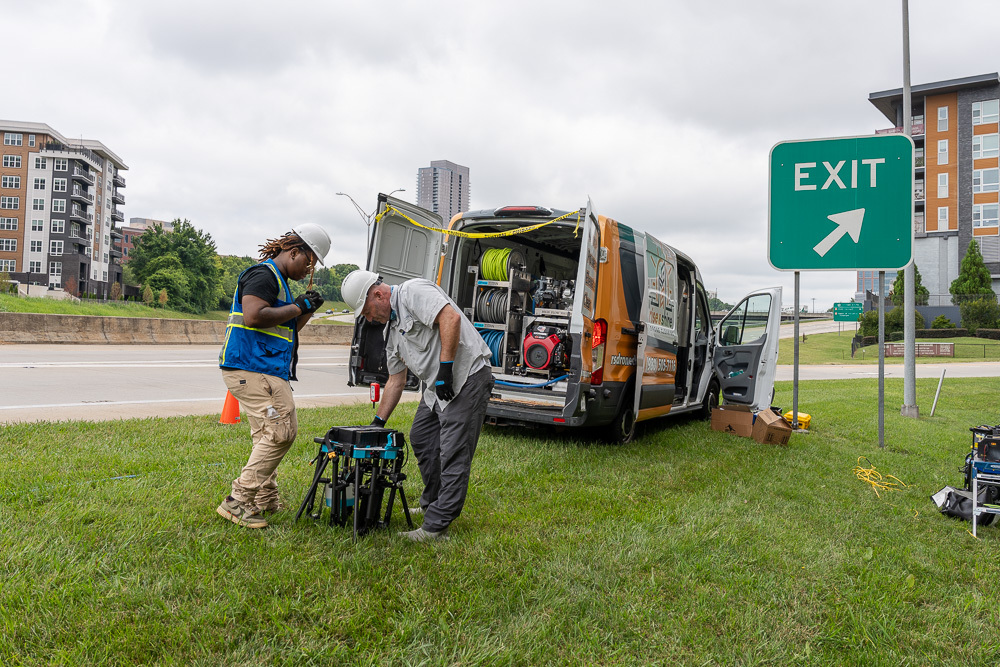
The “Big Beautiful Bill” Explained and Why 2025 Is the Smartest Year to Invest in Your Drone Fleet
Discover how the One Big Beautiful Bill Act (OBBBA) lets small businesses deduct 100% of drone equipment costs in 2025. Learn how investing in Lucid Bots’ Sherpa Drones this year can maximize your tax savings and boost your cleaning business growth.
If you’re running a small building-services or cleaning business, you’ve probably heard some buzz about the “One Big Beautiful Bill Act” (OBBBA).
You don’t need to be a tax expert to understand it. This bill is a big win for small business owners investing in equipment that helps them grow.
Here’s what it means in simple terms, and how it could save you thousands when you buy a Sherpa Drone before the end of 2025.
What the Big Beautiful Bill Does
According to EisnerAmper’s Contractor’s Cheat Sheet, the OBBBA makes several long-term updates to U.S. tax law designed to boost construction, maintenance, and building upgrades.
Here are the two most important changes for small business owners buying tools or equipment:
- Permanent 100% Bonus Depreciation
Contractors and building-services companies can now deduct the full cost of qualifying equipment immediately, starting January 2025.
That means if you buy a Lucid Bots Sherpa Drone, a Sherpa Drone and Tethered system, or our Lavo Bot and Sherpa Drone combo, you could potentially write off the entire amount this year and not spread it over 5 or 7 years like before.
EisnerAmper notes that this provision now applies to both new and used assets, and it’s permanent, so you get the deduction right away, improving your cash flow. - Expanded Section 179 Deduction
The OBBBA also raises the Section 179 deduction limit to $2.5 million, with a phase-out beginning at $4 million.
Section 179 lets small businesses deduct equipment purchases that are actively used for work. So this is your trucks, pressure washers, and yes even our drones.
As EisnerAmper’s Real Estate update explains, this expansion makes Section 179 far more powerful for smaller operators, especially those upgrading tools, vehicles, or building systems.
How This Works in Real Life
Let’s say you run a small exterior-cleaning or maintenance company and earned $300,000 in profit this year.
You decide to purchase a Lucid Sherpa Drone for $90,000 in November 2025.
If you qualify under Section 179 or 100% bonus depreciation, you can deduct that full $90,000 from your taxable income lowering your taxable earnings to $210,000.
That could translate to tens of thousands of dollars in tax savings, depending on your state and filing status.
Why Timing Matters
Many of these incentives like 100% bonus depreciation and the higher Section 179 limits are tied to equipment placed in service after January 2025.
But here’s the key:
Projects and purchases made before the end of 2025 are best positioned to take full advantage of the bill before any future tax adjustments or sunsets kick in.
So, if you’ve been planning to expand your cleaning fleet, the 2025 tax year is your window to buy and deploy your equipment.
Why It’s Perfect for Lucid Bots Customers
Lucid Bots builds robots that help you do more with less. Our Sherpa Drones replace risky, slow manual cleaning work letting you take on bigger jobs with the same crew.
Because drones like Sherpa qualify as business equipment, they can be deducted under the same rules outlined in EisnerAmper’s OBBBA analyses. That means your investment could reduce your tax bill while expanding your capacity.
And if you’re planning to grow your business in 2026, now might be the perfect time to purchase more than one drone to take more advantage of 2025’s powerful tax incentives before they change.
Important Note
This article is for informational purposes only.
It is not financial or tax advice.
Tax laws can change, and your business situation is unique. Always check with your licensed accountant or tax advisor to confirm eligibility before making purchasing decisions.
Bottom Line
The Big Beautiful Bill was designed to reward small businesses that invest in American infrastructure and that includes companies keeping our buildings clean, bright, and safe.
By purchasing your Lucid Bots drone before December 31, 2025, you can:
- Save big on taxes
- Boost cash flow
- Get to work faster with safer, smarter tech
In short: make 2025 the year your business takes flight and let the Big Beautiful Bill help fund your future.
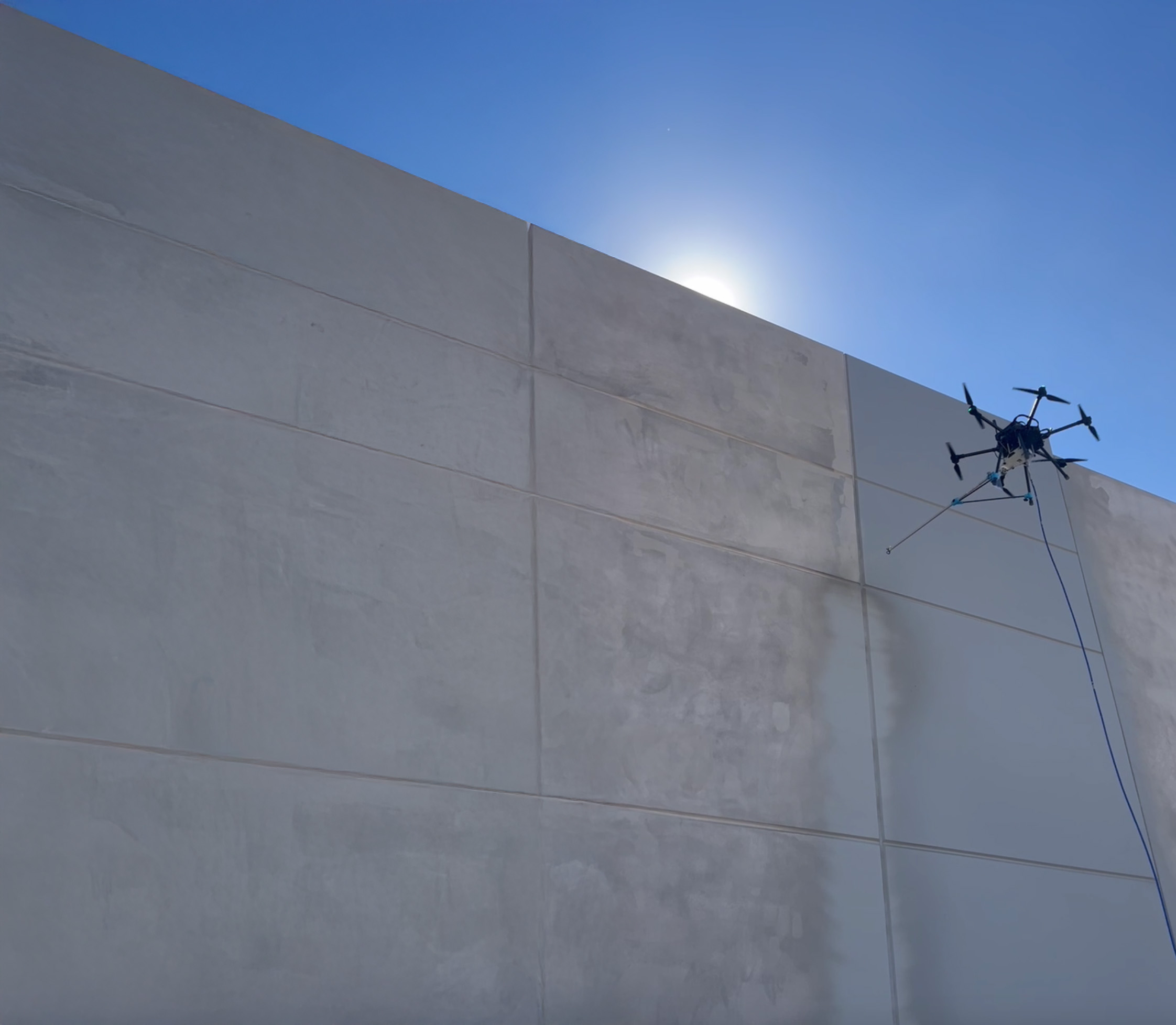
Case Study: VEMAC Tilt-Up Concrete Staining Pilot – El Paso, TX
VEMAC used Lucid Bots’ Sherpa Drone to stain tilt-up concrete panels 3.4× faster with zero lifts and 100% safer operations. The pilot in El Paso proved that drone-based automation can dramatically cut labor time and costs while improving speed and safety on large-scale construction projects.
3× Faster. Zero Lifts. Same Great Finish.
When VEMAC needed to stain a series of large tilt-up concrete wall panels, they faced the same problem many builders encounter: slow, expensive, and risky work at height. Setting up lifts, repositioning between panels, and sending crews up and down all day consumed time, labor, and budget.
Lucid Bots’ Sherpa Drone changed that.
In a pilot on a 400 sq. ft. panel, Sherpa Drone applied two full coats in just 13 minutes, compared to 44 minutes with a traditional man lift. The crew stayed safely on the ground the entire time.
Sherpa Drone reduced labor time by 70%, eliminated lift use, and proved that vertical finishing can be done faster, safer, and more efficiently.
Why Tilt-Up Matters Now
Tilt-up construction is experiencing a major resurgence, driven by the rapid growth of data centers, logistics hubs, and large-scale industrial buildings.
Developers and general contractors are choosing tilt-up because it’s faster to build, structurally durable, and cost-effective for massive footprints. However, the finishing process—especially staining and coating—remains one of the most time-consuming steps.
That’s where Sherpa Drone comes in. By automating coating at height, Sherpa Drone removes one of the last manual bottlenecks in large-scale concrete construction, helping crews meet the high-speed demands of modern industrial projects.
The Challenge
VEMAC’s teams pride themselves on quality. Their finishing standards demand smooth coverage, consistent color, and no missed areas. But on large tilt-up projects, production speed was limited by lift logistics. Each new panel required new setup, safety checks, and careful maneuvering—costing valuable time across an entire site.
With project timelines tightening and labor costs rising, VEMAC needed a faster, safer, and more scalable way to apply coatings.
The Sherpa Drone Solution
Sherpa Drone is Lucid Bots’ aerial work platform designed for large-scale exterior maintenance and finishing. It replaces lifts and scaffolding with an intelligent, tethered drone system capable of precise spraying, washing, and coating applications at height.
At VEMAC’s El Paso job site, a Sherpa Drone equipped with a stain sprayer module applied two coats of H&C Colortop concrete stain. Operated by a ground pilot and supported by a two-person crew, the drone maintained consistent coverage and uniform finish across the test panel.
The entire process—from takeoff to the final coat—took less than 15 minutes, with no workers leaving the ground.
The Results
The Sherpa Drone dramatically outperforms traditional methods in both efficiency and safety. It completes two coats over 400 sq ft 3.4× faster (13 minutes vs. 44 minutes) while eliminating the need for workers at height, making the process 100% safer. Setup and teardown times drop by 85%, and the drone’s coverage rate improves from 9 to 61 sq ft per minute, a 6.7× increase in productivity.
Safety and Efficiency in One Flight
Each Sherpa Drone flight keeps the entire crew safely on the ground. There are no harnesses, no OSHA lift paperwork, and no exposure to height-related risks.
Crews can focus on mixing, material prep, and quality checks while the Sherpa Drone handles the vertical work. This parallel workflow boosts overall site productivity and reduces downtime.
Real ROI in Minutes
With Sherpa Drone, VEMAC achieved:
- 65%+ reduction in labor hours per panel
- 100% elimination of lift rentals
- 70% reduction in total application time
Across a large project with dozens of panels, this performance translates into days of time saved and measurable labor cost reductions.
Why It Matters
For modern contractors, productivity and safety are the key drivers of profitability. Sherpa Drone enables both:
- Speed: Complete vertical coating work up to 3–5× faster
- Safety: Keep every worker on the ground
- Consistency: Smooth, repeatable coverage across every panel
- Flexibility: Swap payloads for painting, staining, washing, or inspection
VEMAC’s pilot showed that Sherpa Drone isn’t just a prototype—it’s a practical way to modernize how tilt-up and exterior finishing work gets done.
Looking Ahead
After the success of this pilot, VEMAC is exploring Sherpa Drone for additional applications including media blasting, surface prep, and protective coating. These operations share the same challenge: repetitive, at-height labor that slows projects down.
Sherpa Drone’s ability to automate these tasks at scale positions it as a key tool for the next generation of construction and maintenance workflows.
See It in Action
Ready to skip the lifts?
Schedule a live demo and see how Sherpa Drone can cut your labor time in half—or better.
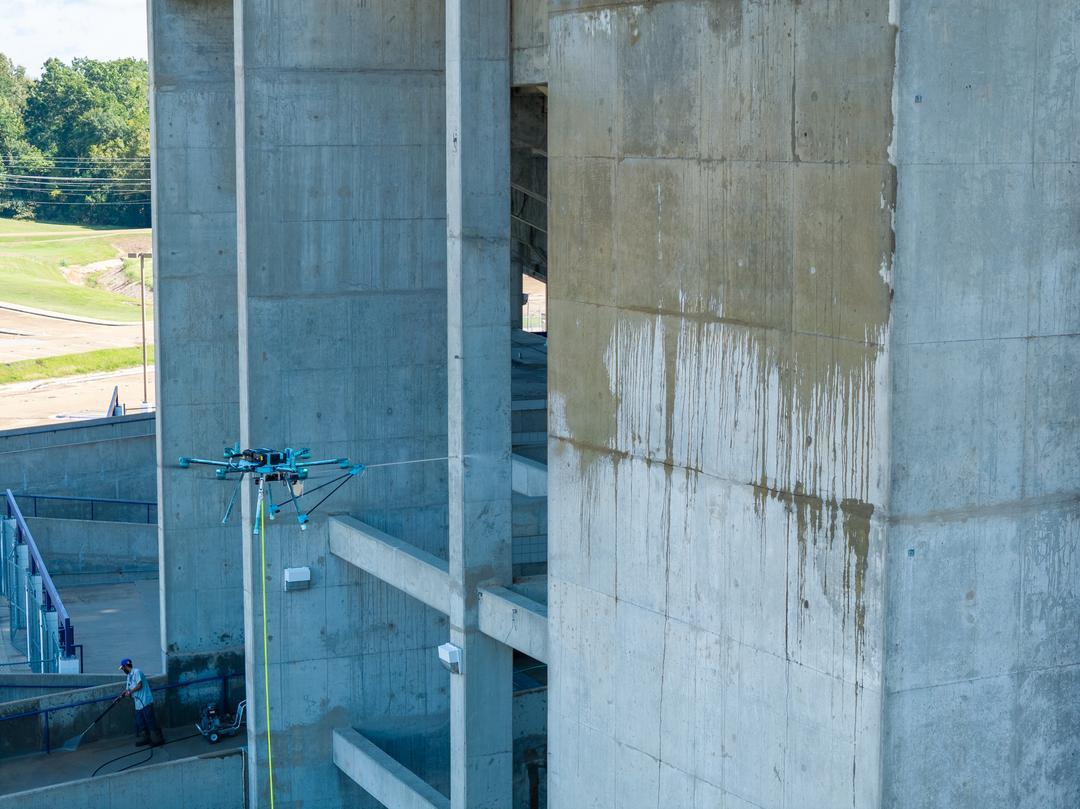
Lucid Bots Showcases New Drone Sealing Technology at Alcorn State Stadium
Lucid Bots successfully tested its new application sprayer module to protect the concrete facade at Alcorn State Stadium’s facade in a fraction of the time, validating a safer, faster, and more cost-effective approach to concrete and building envelope protection.
Lucid Bots successfully tested its new application sprayer module to protect the concrete facade at Alcorn State Stadium’s facade in a fraction of the time, validating a safer, faster, and more cost-effective approach to concrete and building envelope protection.
300% more efficient than traditional methods.
80% cost savings vs. traditional methods.
Overview
At Jack Spinks-Marino Casem Stadium in Lorman, Mississippi, Lucid Bots partnered with contractor FlyByShine to test its next-generation sprayer module designed for drone-based drone-based water repellent application. Using PROSOCO’s industry leading water repellent, Siloxane WB Concentrate, the project demonstrated how Lucid Bots’ technology can transform large-scale concrete protection.
“By the time you scaffold a building like this and put the product on, work through all of any kind of tweaks that need to be done...I would say it’s a lot faster, 20 times”
— Bill Daniel, Prosoco
The Challenge
Traditional Methods Are Too Slow, Risky, and Expensive
Waterproofing stadiums and other vertical concrete assets has always been a costly and time-consuming process. Scaffolding or lifts must be rented and assembled, and workers are sent up as high as 90 feet in the air. This increases liability, slows down timelines, and often discourages facility managers from performing necessary maintenance.
The Solution
Lucid Bots’ Sprayer Module Proves Its Value
Lucid Bots deployed its Sherpa drone with the new application sprayer module to apply Prosoco’s siloxane-based sealer directly to the stadium facade. Partnering with Fly By Shine for on-site operations, Lucid demonstrated that thousands of square feet could be waterproofed in a single day—without scaffolding, lifts, or worker risk at height.
Key Outcomes:
- 4x Faster than traditional methods
- 80% Cost Savings vs. scaffolding and lifts
- Safer by keeping crews on the ground
- Consistent, Professional Finish meeting manufacturer standards
Customer Validation
FlyByShine’s team provided field feedback during the test and confirmed the commercial potential of the solution:
“Before another contractor could even get scaffolding up, we were already done. The simplicity of what we just did is shocking.”
— Ric McCluskey, Owner, Fly By Shine
“It’s really safe. Nobody is 90 feet in the air — the drone does the work.”
— John Young, Prosoco
Looking Ahead
This successful trial confirmed that Lucid Bots’ sealing solution is ready to move into beta with select partners. The company is packaging the module into a Sealing Kit including payload, pump, regulators, hose, and intuitive software, enabling contractors to deliver faster, safer, and more profitable sealing jobs.
Key Takeaway: Lucid Bots is redefining infrastructure maintenance. By eliminating scaffolding and lifts, reducing costs, and improving safety, the new sprayer module empowers contractors like FlyByShine to take on projects once considered too complex, costly, or risky.

Built in America, Built for ROI: What Our First 500 Robots Taught Us
Robots are not apps. You cannot A/B test your way to a machine that changes an industry. You have to ship, stand next to customers while it works, and take responsibility for the outcome. We have deployed 500 robots into real businesses. It took five years to go from 0 to 100. We went from 400 to 500 in four months. We are sharing a non-exhaustive list of what we learned in hopes that it helps others think clearly about robotics. It is an important and still nascent industry, and our vantage point is unique because we build, deploy, service, and scale robots in the field every day, from Charlotte, NC.
Robots are not apps. You cannot A/B test your way to a machine that changes an industry. You have to ship, stand next to customers while it works, and take responsibility for the outcome.
We have deployed 500 robots into real businesses. It took five years to go from 0 to 100. We went from 400 to 500 in four months.
We are sharing a non-exhaustive list of what we learned in hopes that it helps others think clearly about robotics. It is an important and still nascent industry, and our vantage point is unique because we build, deploy, service, and scale robots in the field every day, from Charlotte, NC.
Our three fundamental beliefs about the future
- Robots are the future of dull, dirty, dangerous, and demeaning jobs. Robots increase human dignity by removing work that ruins bodies and shortens careers.
- Robots must be built in the United States. A domestic supply chain is essential for economic resilience and national security.
- Robots plus automation unlock human abundance. Everything that moves will be automated over time.
1) Master one job, design for expansion
Reputation is currency in the trades. You earn it by mastering one task first and becoming the reliable tool crews ask for. That first win proves you can deliver a robot people trust and businesses rely on.
Think LEGO, not Swiss Army knife. A Swiss Army knife can technically do many things, but none as well as a purpose-built tool and it rarely holds up in industrial or professional use. Build a common brain and stable base with standardized connection points, then add specialized payloads only when the job requires them. Architect for expansion while you execute, so new capabilities click into the same system without a ground-up rebuild.
This is the NVIDIA arc: start with a concrete performance problem in graphics, build a repeatable architecture, then extend the same core into new workloads and markets. Robotics should follow the same pattern: master one job, keep the base constant, and add specialized payloads and software as new bricks.
Generalist robots that are mediocre at everything always lose to robots that are great at the task at hand in real commercial and industrial settings. I don’t care what the headlines say. Adoption in B2B robotics always comes down to ROI.
Marketing doesn’t win. Proof and clear ROI in the field wins at scale.
2) Focus on transformative ROI
Marketing gets you a meeting. Proven outcomes get you adoption. In serious commercial settings, pilots are auditions, not victories.
Our bar
- Up to 5x faster. A radical shift in how the work is done, not an incremental improvement. Customers need a compelling reason to switch from the status quo.
- We emphasize growth and efficiency over simple labor reduction: throughput per crew, revenue per day, job cycle time, consistency, and rework avoided.
- Proof comes from production jobs, not demos.
Sidebar: Why B2B adoption beats B2C
Household robotics has allure, but adoption lags even for products that work and are affordable. Quick show of hands: what percent of your neighbors run robot lawn mowers? They have been around for years, often cost under $1,000, and still see low penetration. In B2B, the buyer has an active P&L and adopts when the job gets done faster, safer, and more profitably. That is where the next wave of robotic adoption will compound.
3) Own the customer relationship
Integrate hardware, software, training, service, and parts so you own the outcome. That earns trust and creates a distribution moat through workflow integration, training, and the internal playbooks your customers build around your platform.
Owning the outcome also makes you faster. If you do not own repairs or training, every product update creates drag and cost. Control the loop, iterate quickly, and keep customers happy through change.
4) Control the full stack: software is not enough
Early advice we heard: focus on software and let someone else handle hardware. That is the quickest way to be three layers removed from your user and to lose control of reliability and iteration.
Hard take: If you want to sell to customers who use the product every day, outsourcing the physical stack is the dumbest thing you can do. You will be slow to fix issues, slow to improve, and you will not own the future of your product.
Why full stack control wins
- Reliability and safety. You control tolerances, power, thermals, EMI, sensing, and failure modes. That is where uptime is won.
- Iteration speed. Hardware, firmware, and software evolve together. You ship coordinated updates instead of waiting on vendor roadmaps.
- Serviceability and telemetry. Consistent interfaces and LTE connected diagnostics make field support fast and predictable.
- Independence. You are not gated by third party repair loops or parts bans. You can fix defects and improve the product on your schedule.
Owning the stack is not about perfection. It is about earning the right to improve fast in the real world.
5) Reliability and customer success are non-negotiable
You win only when your customer wins. Customer wins and reliability are your marketing. Measure it and organize the company around improving it.
How we measure progress
- Our north star is Robot Operating Minutes (ROM). More minutes doing productive work means customers are winning.
- We track the ratio of operating hours to customer issues and work to improve it continually.
Most customers do not expect perfection with frontier tech. They expect visible progress, quick action, and clear communication when something goes wrong.
6) Robots are learning and data platforms
A production robot should both do work and produce a stream of high quality operational data. This data improves autonomy, reduces downtime, informs preventive maintenance, and opens software revenue. Tesla is a useful parallel: large scale deployments created the driving data that now powers Full Self Driving. The same logic applies in industrial robotics.
The goal is not to simply sell data. Use it to deliver better outcomes and, where appropriate, monetize the insight stream.
7) Supply chain is strategy
You cannot service customers if you cannot build and repair machines. Component choices, vendor depth, domestic availability, and test coverage matter. Invest early in:
- Second sources for critical parts
- Clear QA and QC at incoming, in process, and final assembly
- Bills of materials that are stable and serviceable in the field
- Spare parts logistics that match your installed base
A great supply chain turns reliability into a habit, not an act of heroism.
8) Build in the USA: resilience, security, velocity
Building domestically is not about symbolism. It is a performance choice.
- Economic resilience. Domestic sourcing shortens lead times, reduces single points of failure, and avoids customs and port delays that stall revenue.
- National security. Critical infrastructure depends on trustworthy supply chains. A U.S. based stack reduces exposure to geopolitical shocks and policy whiplash.
- Data privacy and control. When hardware, firmware, and fleet data are under domestic control, compliance is simpler and customer risk is lower.
Service speed is the most visible difference. Before we built our own systems, we relied on international technology. Repairs routinely took months. With DJI, our average turnaround was about 4.5 months, and some units never returned. International shipping and queue times erased revenue opportunities. When a robot is a P&L asset, a quarter without it is unacceptable. Domestic design, parts, and repair centers mean fixes in days, not months.
This shift is happening across categories. For products that matter to operations, domestic build is becoming the default expectation.
9) Operations are as hard as the tech
Standing up a facility, production line, vendor management, technician training, and repair flows is real work. Scalable hardware powered by software and electronics is even harder. The best way to deliver a scalable robot is to focus relentlessly on quality. Treat service as a product. Design for maintainability: fast access to wear parts, diagnostic telemetry, and procedures that a field tech can run in minutes. Connectivity is critical. If you send robots into the wild without LTE, your ability to troubleshoot and support customers will struggle. Ubiquitous connectivity is how you manage a growing fleet.
Robots are like cars. Even with a century of learning, cars still need tires, oil, and brake pads regularly changed. Your robots will need planned maintenance and unplanned repairs. Design the machine and the org for that reality.
10) Training beats turnover
Many industrial customers have high crew turnover. If your training assumes a stable team, the deployment will stall. Make training easy, accessible, and scalable so a new operator can become productive quickly and safely.
11) Field time compounds
One hour on a job site is worth ten in the office. You will learn more standing with a customer than you will in any simulator. Ship, observe, fix, and repeat. The feedback loop is where moats form.
We require every employee to attend at least one job site per year, regardless of role. If you are in engineering, customer success, sales, and adjacent teams, it is many more. Field time sharpens judgment and keeps the whole company grounded in customer outcomes.
12) Move fast to learn, not just to move
Speed without learning is noise. Move fast when you can extract a new truth from the field. Slow down when changes stop teaching you.
A simple guardrail: every change ships with a hypothesis and a metric. If you cannot write both in a sentence, you are guessing.
13) Solve for problems, not features
Customers change behavior when you change their economics. Focus on big, frequent, painful work and aim for step changes, not marginal gains. Always anchor on the customer problem. Robots that do not solve real world problems are useless. Features that impress in demos but fail on job sites do not matter. Keep asking: does this change an outcome the P&L can feel?
14) Be inevitable, not just innovative
Pick markets where adoption is a matter of when, not if: labor shortages, safety exposure, and chronic inefficiency. Show up with a working product, a clear ROI, and a plan to support it for years. That is what leadership looks like.
15) Build the team you can trust, then listen to them
Robotics is a team sport. Hire people who take ownership, who will meet you at midnight at a customer site, and who tell you the truth
The next decade will be decided by deployed minutes, not demos or press cycles. Our north star is Robot Operating Minutes because minutes compound into learning, reliability, and customer trust. That is how Tesla turned fleet miles into Full Self Driving and how NVIDIA turned a graphics engine into a compute platform. Robotics follows the same pattern: specialize, deploy, learn, expand.
We build in the United States because resilience matters. We focus on B2B because outcomes are measurable. We design like LEGO so new payloads click into a proven base. We own the outcome so iteration is fast and support is real.
If you are building, chase customer outcomes over features. If you are buying, demand radical performance, not incrementalism. If you are investing, back teams that ship, service, and learn in the field.
Robots are the arms and legs of AI. Done right, they raise productivity, improve safety, and increase human prosperity. We are just getting started. See you at 1,000.
.png)
Robotics Breakthroughs: $39B Humanoid Bet, Ireland Joins the Race, and Drones Go Mainstream
Figure hits a $39B valuation as investors double down on humanoid robots built for real-world jobs. Galway-based Forge Robotics joins Y Combinator, plugging Ireland’s robotics scene into Silicon Valley’s accelerator network. And Uber Eats is partnering with Flytrex to bring FAA-approved drone deliveries directly into its app—pushing autonomous last-mile logistics closer to the mainstream.
TL;DR
Figure hits a $39B valuation as investors double down on humanoid robots built for real-world jobs. Galway-based Forge Robotics joins Y Combinator, plugging Ireland’s robotics scene into Silicon Valley’s accelerator network. And Uber Eats is partnering with Flytrex to bring FAA-approved drone deliveries directly into its app—pushing autonomous last-mile logistics closer to the mainstream.
Robotics startup Figure valued at $39 billion in latest funding round
Figure, a California-based company focused on humanoid robotics, has successfully raised fresh funding, which establishes its valuation at $39 billion. This substantial valuation underscores surging investor confidence regarding the commercial potential of general-purpose robots. The startup is actively developing humanoid robots specifically engineered to handle a variety of industrial and service assignments, including essential tasks in manufacturing support and warehouse environments. The newly acquired capital is designated for expanding production capacity, growing the engineering team, and expediting broader commercialization efforts. Financial backers have indicated that Figure is favorably positioned to capitalize on recent advancements in specialized hardware and artificial intelligence, developments that are rendering sophisticated humanoid robots increasingly practical and highly capable.
Major Takeaway: With a multibillion-dollar valuation, Figure is rapidly emerging as a frontrunner in the competitive humanoid robotics race, effectively demonstrating how investors are strategically betting on robots that possess the flexibility to handle diverse real-world functions. Read More
Forge Robotics joins Y Combinator to scale robotic automation from Galway
The Irish startup Forge Robotics, based in Galway, has secured acceptance into Y Combinator, providing the company with a powerful platform to accelerate its growth and global presence. This acceptance integrates Ireland’s burgeoning robotics sector directly into Silicon Valley’s influential accelerator network. Forge Robotics focuses on manufacturing robotic automation systems for manufacturing and logistics sectors. Their core product strategy revolves around developing modular, flexible platforms designed to adapt seamlessly across different industries. Participation in the program is intended to help the company refine its product offering, attract new talent, and foster connections with international investors. Its inclusion highlights the increasing trend of Europe’s robotics ecosystem becoming integrated within the global startup pipeline centered in Silicon Valley.
Major Takeaway: Forge Robotics’ entry into Y Combinator signals the growing globalization of robotics innovation, illustrating how startups situated outside major technological centers can effectively connect with crucial global networks and capital. Read More
Uber Eats to expand drone deliveries through Flytrex partnership
Uber Eats is partnering with drone startup Flytrex to broaden the scope of food delivery conducted by air, commencing deployment in specific metropolitan areas across the United States. Flytrex contributes the essential flight systems and hardware, having recently obtained necessary FAA approval for nationwide Beyond-Visual-Line-of-Sight (BVLOS) operations. Uber Eats will integrate this aerial service directly into its consumer application. The initiative is designed to achieve multiple benefits: reducing delivery times, mitigating traffic congestion, and providing customers with swift, contactless service. If successful, this strategic partnership holds the potential to transition drone-based last-mile logistics into a widely accepted, mainstream commercial practice.
Major Takeaway: By establishing this partnership with Flytrex, Uber Eats is making a significant investment in drones to transform the food delivery landscape, introducing enhanced autonomy, scale, and speed to essential last-mile logistics operations. Read More
About Lucid Bots
Founded in 2018, Lucid Bots is an AI robotics company that is committed to uplifting humanity by building the world's most productive and responsible robots that can do dangerous and demanding tasks.
Headquartered in Charlotte, the company engineers, manufactures, and supports its products domestically, which include the Sherpa, a cleaning drone, and the Lavo Bot, a pressure-washing robot.
Lucid Bots' products are elevating safety and efficiency for a growing number of customers around the world. Lucid is a Y Combinator-backed company, with investments from Cubit Capital, Idea Fund Partners, Danu Ventures, and others. Lucid Bots was recently recognized as the fastest growing robotics manufacturer in the United States.

Smarter Roads, Bigger Compute, Cleaner Cities
Autonomy is scaling fast as Kodiak rolls out its first factory-built self-driving truck, Nvidia and OpenAI back a multibillion-dollar UK AI infrastructure push, and HARR-E brings on-demand robotics to urban trash collection.
TL;DR
Autonomy is scaling fast as Kodiak rolls out its first factory-built self-driving truck, Nvidia and OpenAI back a multibillion-dollar UK AI infrastructure push, and HARR-E brings on-demand robotics to urban trash collection.
Nvidia and OpenAI to back major investment in UK AI infrastructure
Nvidia and OpenAI are joining forces to support a multibillion-dollar investment in the UK’s AI infrastructure, aiming to strengthen the country’s position as a global leader in artificial intelligence. The funding will go toward building advanced data centers, expanding access to cutting-edge GPUs, and supporting research in AI and robotics. UK officials say the investment will accelerate innovation across industries, from healthcare to autonomous systems, while reducing dependence on foreign compute resources. The move highlights the growing geopolitical significance of AI infrastructure in shaping economic competitiveness.
Major Takeaway: With Nvidia and OpenAI backing, the UK is set to rapidly expand its AI capabilities—building the compute backbone needed for future breakthroughs in robotics and beyond. Read More
Kodiak Robotics delivers its first factory-made autonomous truck
Kodiak Robotics has rolled out its first factory-produced autonomous truck, marking a milestone in the commercialization of self-driving freight. Built in partnership with a major OEM, the truck integrates Kodiak’s autonomous driving system directly on the factory floor rather than as a retrofit. This streamlines production, improves reliability, and signals readiness for large-scale deployment. The company says the trucks will be used in long-haul freight operations, targeting cost savings and efficiency for logistics providers while addressing driver shortages.
Major Takeaway: By moving from retrofits to factory production, Kodiak is signaling that autonomous trucking is shifting from experimental pilots to scalable, real-world deployment. Read More
New HARR-E robot lets you summon trash pickup like Uber for your garbage
A new service featuring the HARR-E robot is bringing on-demand waste collection to neighborhoods, letting residents summon trash pickup through an app much like calling an Uber. The autonomous, wheeled robot navigates streets to collect garbage and transport it to designated processing points. Designed to reduce missed collections and improve urban cleanliness, HARR-E also integrates with smart city infrastructure for efficient routing and scheduling. Developers see the system as a scalable way to modernize waste management and cut reliance on traditional collection trucks.
Major Takeaway: By turning trash collection into an on-demand robotic service, HARR-E shows how everyday city infrastructure is getting smarter, cleaner, and more autonomous. Read More
About Lucid Bots
Founded in 2018, Lucid Bots is an AI robotics company that is committed to uplifting humanity by building the world's most productive and responsible robots that can do dangerous and demanding tasks.
Headquartered in Charlotte, the company engineers, manufactures, and supports its products domestically, which include the Sherpa, a cleaning drone, and the Lavo Bot, a pressure-washing robot.
Lucid Bots' products are elevating safety and efficiency for a growing number of customers around the world. Lucid is a Y Combinator-backed company, with investments from Cubit Capital, Idea Fund Partners, Danu Ventures, and others. Lucid Bots was recently recognized as the fastest growing robotics manufacturer in the United States.

Autonomy, AI, and the Future of Work
This week’s robotics rundown covers the U.S. Air Force adopting autonomous aircraft, NVIDIA powering the next AI and robotics wave, Finland investing in demining robots, and ex-Amazon execs raising $20M to automate housing construction.
TL;DR
This week’s robotics rundown covers the U.S. Air Force adopting autonomous aircraft, NVIDIA powering the next AI and robotics wave, Finland investing in demining robots, and ex-Amazon execs raising $20M to automate housing construction.
United States Air Force Signs Purchase Agreement with Reliable Robotics
The U.S. Air Force has signed a purchase agreement with Reliable Robotics, a company specializing in autonomous flight systems, to accelerate the adoption of remotely piloted and fully automated aircrafts. Reliable’s technology focuses on certifiable autonomy, allowing planes to operate with reduced or no onboard crew while maintaining high safety standards. The deal is part of the Air Force’s broader push to modernize logistics, surveillance, and cargo transport with cost-effective, flexible autonomy solutions. This agreement also signals growing military confidence in private-sector innovations to strengthen national defense capabilities.
Major Takeaway: By partnering with Reliable Robotics, the Air Force is moving closer to deploying fully autonomous aircraft—reshaping military logistics and highlighting the Pentagon’s commitment to next-gen aviation technology. Read More
Amazon, Meta Among Early Adopters of NVIDIA Blackwell Platform for Generative AI and Robotics
Amazon, Meta, and other major tech firms are among the first adopters of NVIDIA’s new Blackwell platform, designed to supercharge generative AI and robotics workloads. The platform combines advanced GPUs, optimized software, and scalable infrastructure, making it easier to train and deploy large AI models as well as physically capable robots. Early users are expected to leverage Blackwell for applications ranging from warehouse automation to immersive AI-driven virtual environments. By partnering with industry leaders, NVIDIA is aiming to set the new standard for high-performance computing in robotics and AI.
Major Takeaway: With Blackwell, NVIDIA is positioning itself at the core of the next AI and robotics boom—providing the compute backbone that will drive both digital intelligence and real-world automation. Read More
Finland seeks demining robots amid exploding focus on combat robotics
Finland is stepping up its investment in military robotics with plans to acquire demining robots capable of clearing explosives from conflict zones. The initiative comes as part of a broader European trend toward integrating robotic systems into defense operations, including logistics, surveillance, and frontline support. Demining robots are seen as especially critical for protecting soldiers while speeding up recovery in war-torn areas. The move underscores how militaries are looking to robotics not just for combat roles but also for lifesaving tasks in hazardous environments.
Major Takeaway: Finland’s push for demining robots highlights how defense robotics is expanding beyond combat—focusing on safety, efficiency, and protecting human lives in high-risk zones. Read More
These former Amazon Robotics executives just landed $20 million to tackle the housing crisis
A team of former Amazon Robotics executives has raised $20 million in funding to launch a new company aimed at addressing the housing crisis with advanced robotics. The startup plans to build robotic systems that automate key parts of housing construction, from prefabrication to on-site assembly, with the goal of lowering costs and speeding up building timelines. By leveraging their experience scaling robotics in warehouses, the founders believe they can bring similar efficiency and automation to construction. The funding round reflects growing investor interest in applying robotics to solve major societal challenges like affordable housing.
Major Takeaway: By bringing warehouse automation expertise into construction, these former Amazon leaders aim to speed up housing production and lower costs—potentially reshaping how homes are built. Read More
About Lucid Bots
Founded in 2018, Lucid Bots is an AI robotics company that is committed to uplifting humanity by building the world's most productive and responsible robots that can do dangerous and demanding tasks.
Headquartered in Charlotte, the company engineers, manufactures, and supports its products domestically, which include the Sherpa, a cleaning drone, and the Lavo Bot, a pressure-washing robot.
Lucid Bots' products are elevating safety and efficiency for a growing number of customers around the world. Lucid is a Y Combinator-backed company, with investments from Cubit Capital, Idea Fund Partners, Danu Ventures, and others. Lucid Bots was recently recognized as the fastest growing robotics manufacturer in the United States.
Lucid Bots Podcast
How Ryan Godwin is Transforming Exterior Cleaning with the Sherpa Drone
Dive into the future of exterior cleaning with Ryan Godwin, the visionary behind Lucid Bots. Discover how Ryan is leveraging cutting-edge robotics to revolutionize cleaning for buildings and outdoor surfaces—boosting efficiency, safety, and sustainability.