.png)
Congress Races China as Nvidia Signals Robotics Era
This week, Congress heard urgent calls to ban Chinese-made robots from federal networks and build a national robotics strategy as China accounts for 54% of global robot installations versus just 9% for the U.S., Nvidia declared the physical AI era open at GTC with new foundation models and simulation tools, and global experts at Davos confirmed that robotics' foundational technical breakthroughs are complete and the industry is now entering the era of deployment.
U.S. Robotics Companies Want Federal Help to Keep Chinese Robots Out of America's Networks
Top U.S. robotics executives testified before the House Homeland Security cyber subcommittee this week, pressing lawmakers for federal dollars, new legislation, and a unified regulatory strategy to compete with state-funded Chinese rivals in a sector valued at an estimated $50 billion, as China accounted for 54% of global robot installations between 2020 and 2024 compared to just 9% for the United States. Matthew Malchano, vice president of software at Boston Dynamics, warned that Chinese company Unitree is capturing market share with U.S. police departments and universities despite contracting ties to the Chinese military and a wormable exploit discovered in 2025 that could allow attackers to take over entire robot fleets. Max Fenkell of Scale AI told lawmakers the U.S. is winning on AI model quality but losing on data and implementation, pointing to China's industrialized strategy of funding mile-long warehouse facilities dedicated to gathering and labeling robot training data, with no U.S. equivalent in place. Executives unanimously called on Congress to block federal agencies from purchasing Chinese-made robots, establish a single federal regulatory standard, and direct CISA to conduct a security review of foreign-made robots. Malchano also pressed for the National Commission on Robotics Act, sponsored by Rep. Jay Olbernolte, which would create a bipartisan commission to develop a national robotics strategy. The hearing comes as federal robotics spending accelerates, with the Coast Guard investing $350 million in autonomous systems by 2028, DHS finalizing a $1 billion AI analytics contract with Palantir, and ICE spending $78,000 last year on a robot capable of deploying smoke bombs.
Major Takeaway: The congressional hearing signals a shift from ad hoc procurement decisions to a broader policy reckoning over foreign robotics hardware, as lawmakers and industry leaders increasingly treat robot supply chains as a national security issue rather than a commercial one. Read More
Nvidia Declares the Rise of ‘Physical AI’ — and a World Run by Robots
At its GTC conference, Nvidia announced a sweeping push into "physical AI," with Jensen Huang declaring "Physical AI has arrived. Every industrial company will become a robotics company," backed by new foundation models, simulation frameworks, and a broad set of industry partnerships. New tools include Cosmos 3, a world foundation model combining synthetic world generation, vision reasoning, and action simulation; Isaac Lab 3.0 for large-scale robot learning on Nvidia DGX infrastructure; and GR00T N1.7, a robot foundation model enabling dexterous manipulation and autonomous task execution. Nvidia also previewed GR00T N2, based on its DreamZero research, which the company says helps robots succeed at unfamiliar tasks in new environments more than twice as often as leading vision-language-action models. In humanoid robotics, Boston Dynamics, Figure AI, and Agility Robotics are using Nvidia's simulation tools and AI models to accelerate development, while healthcare companies including CMR Surgical, Johnson & Johnson, and Medtronic are using Nvidia platforms to train and validate surgical robotic systems. On the cloud side, Microsoft, Nebius, and Alibaba Cloud are integrating Nvidia's physical AI data tools and robotics stack into their platforms. Through its Inception Program supporting more than 40,000 startups, Nvidia is also positioning itself as the foundational platform layer for emerging robotics developers, not just a chip supplier but the full-stack infrastructure for intelligent machines.
Major Takeaway: Nvidia's GTC announcements position the company as the compute and software backbone of the physical AI era, building a full-stack platform from simulation and training to deployment and safety that could define how the global robotics industry develops over the next decade. Read More
The Hardest Advances in Robotics Are Behind Us: What Comes Next
At the World Economic Forum's 56th Annual Meeting in Davos, experts in physical AI declared that the hardest technical breakthroughs in robotics are now complete, with the next decade focused on deploying autonomous systems from controlled industrial settings into the complexity of everyday life. BCG Managing Director Daniel Kuepper outlined the four foundational advances of the past decade: a 1,000x increase in compute power outpacing Moore's Law expectations by 25x, a narrowing simulation-to-reality gap enabled by digital twins and synthetic data, the rise of vision-language-action models that allow robots to interpret complex commands, and hardware that has become significantly cheaper and more capable. Experts confirmed that robots currently thrive in structured environments like ports, warehouses, and factories, with MIT's Daniela Rus noting that entire fleets already operate 24/7 moving shipping containers without human intervention, and BCG projecting that roughly 70% of global manufacturing operations will be largely autonomous by 2050. The next barrier is unstructured environments, where robots must handle unpredictability, assess risk, and make judgment calls, with Mech-Mind CEO Shao Tianlan noting the focus for the next few hundred days remains on controllable manufacturing and logistics settings. Amazon Robotics Chief Technologist Tye Brady identified object manipulation as the "holy grail" of robotics, explaining that tasks humans perform instinctively, like estimating how hard to grip a cup, require robots to explicitly simulate weight estimation, slip detection, and contextual reasoning. Experts agreed that fully autonomous systems are still years away and teleoperation remains essential for bridging the gap, but argued that the industry's innovation curve will eventually drive costs down and move robots from factory floors into homes, much like smartphones evolved from industrial tools to universal commodities.
Major Takeaway: The Davos consensus marks a meaningful inflection point for the robotics industry, as leaders across technology, manufacturing, and research agree that perception, mobility, and computing have been solved and the defining challenge is now deploying robots responsibly into the messy, unpredictable environments where most of human life actually happens. Read More
About Lucid Bots
Founded in 2018, Lucid Bots is an AI robotics company that is committed to uplifting humanity by building the world's most productive and responsible robots that can do dangerous and demanding tasks.
Headquartered in Charlotte, the company engineers, manufactures, and supports its products domestically, which include the Sherpa, a cleaning drone, and the Lavo, a pressure-washing robot.
Lucid Bots' products are elevating safety and efficiency for a growing number of customers around the world. Lucid is a Y Combinator-backed company, with investments from Cubit Capital, Idea Fund Partners, Danu Ventures, and others. Lucid Bots was recently recognized as the fastest growing robotics manufacturer in the United States.
🟢 New here?
Love startups, robots, and business growth stories?
Join the 2,100+ readers and subscribe to our Robot Rundown 🚀
Lucid Bots and NVIDIA: Riding the Next Industrial Revolution
NVIDIA is laying the foundation for the next industrial revolution with over 2 million developers building robotics on its platforms. From Isaac Sim for digital twins and testing, to Isaac ROS GEMs for advanced autonomy, and Jetson for real-time edge AI — NVIDIA is the backbone of embodied intelligence. At Lucid Bots, we’re harnessing this ecosystem to build robotic systems that take on the world’s dirtiest, most dangerous jobs — transforming industries with safer, faster, and smarter automation.
NVIDIA just announced a milestone that signals more than progress — it signals a shift in history. Over 2 million robotics developers are now building on its platforms, from Isaac Sim for simulation to Jetson for edge AI computing. This isn’t just a developer count; it’s the early scaffolding of the next industrial revolution.
The first industrial revolution mechanized human labor. The second scaled it with electricity and assembly lines. The third digitized it with computing and the internet. Now, the fourth industrial revolution is physical again — driven by embodied AI and robotics that can perceive, decide, and act in the real world.
At Lucid Bots, we are building for this moment. Our focus is on developing robotic systems that take on dangerous, dirty, and time-intensive jobs and preserve human value. We’re pushing forward technologies that protect people while scaling efficiency — transforming how work gets done in the built world.
NVIDIA as the Backbone of the Revolution
For Lucid Bots, NVIDIA’s ecosystem is more than validation — it’s infrastructure.
- Isaac Sim provides photorealistic simulation environments where we maintain digital twins of our Lavo Bot robots and Sherpa Drones. We run software-in-the-loop (SITL) and hardware-in-the-loop (HIL) regression tests with stereo, RGB-D, LiDAR, and IMU sensor models. This tightens the sim-to-real loop and reduces risky, expensive field iterations.
- Isaac ROS GEMs are core to our autonomy stack. With Visual SLAM, our drones and ground robots gain a strong sense of position in real time even when GPS is weak or unavailable. For recurring missions, Map Localization enables a robot to recognize a site and align to a saved map within seconds. Together, these capabilities shorten deployment times, reduce operator workload, and ensure consistent, repeatable performance in tasks like high-precision surface cleaning, data capture, and inspection.
- Jetson edge compute powers real-time autonomy, enabling perception, obstacle avoidance, and sensor fusion directly onboard our robots.
Combined with a global community of 2M+ developers, this infrastructure accelerates R&D, de-risks deployment, and ensures Lucid Bots can move faster than the market.
The Market in Transition
We believe this revolution is already underway. Just as factories a century ago transformed productivity with machines, industries today will transform safety and efficiency with intelligent robots.
- Property and facilities management is a $1T+ global market, facing rising costs, labor shortages, and regulatory pressure.
- Legacy approaches — scaffolding, diesel light towers, and manual cleaning — are relics of the last era.
- Robotics doesn’t just replace these methods; it leapfrogs them, delivering safer, cleaner, and more cost-effective outcomes at scale.
Why Lucid Bots, Why Now
The industrial revolutions of the past favored companies that seized the moment when the right infrastructure converged with unmet demand. That’s exactly where we are today. NVIDIA’s milestone proves the infrastructure is here. The demand for safer, more efficient operations is only accelerating.
Lucid Bots is positioned at this intersection. Our systems are not science projects — they are field-tested, revenue-generating platforms, designed for immediate deployment at scale.
For investors and pioneers, the story is clear: the fourth industrial revolution is no longer on the horizon. We’re building it — and delivering it — now.
.png)
Robots Powering Energy, Economy, and Agriculture
This week, small autonomous bots are transforming how solar farms are built, slashing labor needs and speeding renewable energy projects. Morgan Stanley projects AI and robotics could save S&P 500 companies $920 billion annually, underscoring automation’s massive economic impact. And with backing from Bill Gates and Nvidia, FieldAI is gearing up to bring adaptable, AI-powered robots into agriculture and beyond.
TL;DR
This week, small autonomous bots are transforming how solar farms are built, slashing labor needs and speeding renewable energy projects.
Morgan Stanley projects AI and robotics could save S&P 500 companies $920 billion annually, underscoring automation’s massive economic impact. And with backing from Bill Gates and Nvidia, FieldAI is gearing up to bring adaptable, AI-powered robots into agriculture and beyond.
These little robots are changing the way solar farms are built, saving time and money
Tiny autonomous robots are being deployed to streamline solar farm construction, cutting both time and costs. Unlike traditional methods that rely on large crews and heavy machinery, these compact machines can handle tasks like carrying panels, positioning them precisely, and even assisting with installation in rough or uneven terrain.
Developers say the robots not only improve efficiency but also reduce labor shortages and safety risks on massive solar sites. With renewable energy projects scaling rapidly, these small bots could play an outsized role in accelerating the clean energy transition.
Major Takeaway: By automating repetitive, labor-intensive tasks, small robots are making it faster, cheaper, and safer to build large-scale solar farms—helping speed the rollout of renewable power. Read More
Morgan Stanley says AI and robots could save S&P 500 companies $920 billion a year
A new Morgan Stanley report estimates that agentic AI systems and robotics could cut annual costs for S&P 500 companies by as much as $920 billion. The savings would come from automating knowledge work, streamlining operations, and reducing labor-intensive tasks across industries.
Analysts highlight that the biggest impact will likely be in areas like customer support, logistics, and manufacturing, though adoption timelines will vary by sector. While the report notes efficiency gains, it also acknowledges potential disruptions to jobs as automation scales.
Major Takeaway: AI and robotics aren’t just about futuristic tech—they represent one of the biggest cost-saving opportunities in corporate history, with massive productivity gains but real risks for the workforce. Read More
Bill Gates, Nvidia back robotics startup FieldAI to accelerate automation in agriculture and beyond
FieldAI, a robotics startup focused on applying AI and automation to agriculture and other industries, has raised new funding from big-name backers including Bill Gates and Nvidia. The company is building adaptable robots that can perform multiple tasks—from harvesting crops to managing logistics—using advanced computer vision and AI models.
Support from Nvidia will help integrate cutting-edge simulation and compute resources, while Gates’ involvement underscores the potential for robotics to improve food security and sustainability. FieldAI aims to scale its platform to tackle labor shortages and boost efficiency across global industries.
Major Takeaway: With support from Gates and Nvidia, FieldAI is positioning itself as a key player in bringing AI-powered robotics to agriculture—an industry ripe for efficiency gains and innovation. Read More
About Lucid Bots
Founded in 2018, Lucid Bots is an AI robotics company that is committed to uplifting humanity by building the world's most productive and responsible robots that can do dangerous and demanding tasks.
Headquartered in Charlotte, the company engineers, manufactures, and supports its products domestically, which include the Sherpa, a cleaning drone, and the Lavo Bot, a pressure-washing robot.
Lucid Bots' products are elevating safety and efficiency for a growing number of customers around the world. Lucid is a Y Combinator-backed company, with investments from Cubit Capital, Idea Fund Partners, Danu Ventures, and others. Lucid Bots was recently recognized as the fastest growing robotics manufacturer in the United States.
A Look at UnitX's Journey to $6.1B in Inspections
"UnitX has scaled to 820+ systems across 135 factories, inspecting $6.1B of products each year. Here’s how the team is transforming manufacturing with Robotics 2.0."
Welcome to the first edition of Robot Rundown’s Founders Spotlight, a series dedicated to showcasing the innovators shaping the future of robotics.
Today, we're featuring UnitX, a company that's gone from just a handful of images to inspecting billions of dollars in products.
Back in 2018, Keven Wang saw a massive gap in manufacturing quality control — slow, costly, and inconsistent inspections.
His answer? Build a robotics company that fuses AI, optics, and edge hardware to accelerate human productivity.
Numbers: Today, UnitX has 820+ systems running in 135+ factories worldwide, inspecting $6.1B of product annually.
Products: UnitX makes money from AI inspection platforms, software licenses, and service subscriptions.
Their lineup includes FleX, an AI-powered inline inspection system that deploys in under a week, and GenX, a generative AI tool that can train defect detectors from as few as three images.
Paired with software-defined imaging system, core AI brand and edge computing devices, these systems catch defects faster, with higher accuracy, and at massive scale.
Coolest milestone: Using their GenX system, with just 3 images, GenX will synthetic defect images. This will enhance the AI models training efficiency and enhance detection accuracy. It deployed at a Tier-1 EV battery line — slashing defect “escapes” by 9X.
What’s next: The Global FleX/GenX rollout with top-tier unicorn brands and systems integrator partners across automotive, EV, and electronics.
The next 12 months are all about scaling worldwide.
Funding: UnitX has raised $59M to date — enough to put them in the upper tier of industrial AI players.
Most misunderstood: “We’re not just software—we’re a Robotics 2.0 company integrating AI, imaging system, and edge hardware”
Founder tip: “Design for deployment speed and reliability, prove ROI fast, and productize serviceability from day one.”
The robotics company is quietly positioning itself to redefine factory floors worldwide — and if they execute, this could be the kind of infrastructure play that’s hard to dislodge.
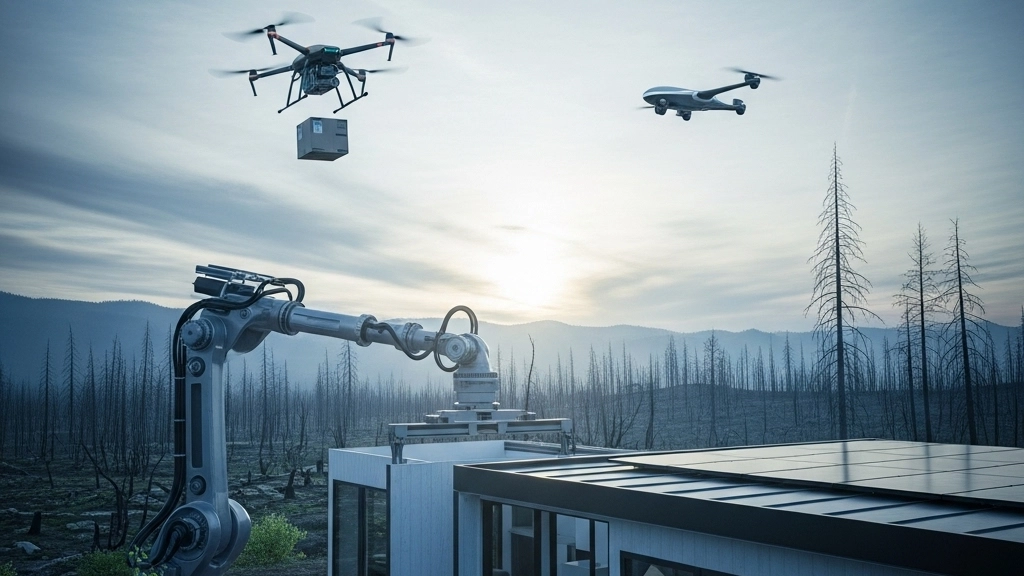
NVIDIA’s New Robotics Tools, Mobile Microfactories, and a Big Win for Drone Operations
NVIDIA is supercharging robot development with new Omniverse libraries, physics-accurate AI models, and scalable compute to speed simulation and deployment. In Los Angeles, Cosmic Buildings and ABB Robotics are bringing mobile microfactories to wildfire zones, producing modular homes on-site. Huntington Beach PD is adding drones for policing and search-and-rescue, while Flytrex just scored FAA approval for nationwide BVLOS deliveries—paving the way for large-scale, cost-effective drone logistics.
TL;DR
NVIDIA is supercharging robot development with new Omniverse libraries, physics-accurate AI models, and scalable compute to speed simulation and deployment. In Los Angeles, Cosmic Buildings and ABB Robotics are bringing mobile microfactories to wildfire zones, producing modular homes on-site. Huntington Beach PD is adding drones for policing and search-and-rescue, while Flytrex just scored FAA approval for nationwide BVLOS deliveries—paving the way for large-scale, cost-effective drone logistics.
NVIDIA Opens Portals to World of Robotics With New Omniverse Libraries, COSMOS Physical AI Models, and AI Computing Infrastructure
NVIDIA has unveiled a suite of new robotics tools, including expanded Omniverse libraries, COSMOS physical AI models, and upgraded AI computing infrastructure to accelerate robot design, simulation, and deployment. The Omniverse updates add richer digital twin capabilities, while COSMOS delivers physics-accurate models for more realistic AI training. NVIDIA is also scaling its cloud-based compute offerings to handle increasingly complex simulations, aiming to reduce development time from months to weeks. These advancements target a wide range of sectors—from manufacturing to logistics—by enabling more capable and adaptable robots.
Major Takeaway: NVIDIA’s latest toolkit blends realistic physics, powerful simulation, and scalable compute, giving robotics developers the means to build smarter, more capable machines faster than ever. Read More
Cosmic Buildings uses ABB Robotics to create robotic microfactories for rebuilding after Los Angeles wildfires
Construction startup Cosmic Buildings is teaming up with ABB Robotics to deploy mobile microfactories that can rapidly produce modular housing components in areas devastated by wildfires around Los Angeles. These container-sized facilities house robotic arms capable of fabricating walls, floors, and other structural elements on-site, cutting transportation needs and speeding up rebuilding. The system is designed to be scalable and relocatable, enabling fast response to disaster zones and reducing reliance on centralized factories. Cosmic aims to use the approach to deliver affordable, sustainable housing more quickly in both emergency and long-term projects.
Major Takeaway: By combining mobile microfactories with robotic automation, Cosmic and ABB are rethinking how to rebuild communities—bringing manufacturing to the disaster site instead of the other way around. Read More
Huntington Beach Adds Drones To Police Force
The Huntington Beach Police Department is expanding its aerial capabilities by adding drones to its toolkit for crime prevention and emergency response. The drones will be used for tasks such as monitoring large events, aiding in search-and-rescue operations, and providing real-time aerial perspectives during active incidents. Equipped with high-resolution cameras and thermal imaging, they can operate day or night and relay critical information to officers on the ground. Police officials emphasize that the program will follow privacy guidelines and aim to enhance public safety without replacing human officers.
Major Takeaway: Huntington Beach is joining a growing list of cities adopting drones for policing, highlighting how aerial robotics are becoming a standard tool for faster, safer, and more informed law enforcement. Read More
Flytrex approved by FAA for nationwide BVLOS drone delivery
Flytrex has received Federal Aviation Administration (FAA) approval to conduct nationwide drone deliveries beyond the visual line of sight (BVLOS), a milestone that removes one of the biggest regulatory barriers for large-scale operations. The Israeli startup already delivers food and retail goods in several U.S. cities, and this new clearance will allow it to expand to more regions without the need for visual observers. Flytrex says BVLOS capability will make drone delivery more cost-effective and scalable, potentially transforming last-mile logistics for suburban and rural areas.
Major Takeaway: With BVLOS approval, Flytrex is poised to take drone delivery mainstream—unlocking broader coverage, lower costs, and faster service across the U.S. Read More
About Lucid Bots
Founded in 2018, Lucid Bots is an AI robotics company that is committed to uplifting humanity by building the world's most productive and responsible robots that can do dangerous and demanding tasks. Headquartered in Charlotte, the company engineers, manufactures, and supports its products domestically, which include the Sherpa, a cleaning drone, and the Lavo Bot, a pressure-washing robot. Lucid Bots' products are elevating safety and efficiency for a growing number of customers around the world. Lucid is a Y Combinator-backed company, with investments from Cubit Capital, Idea Fund Partners, Danu Ventures, and others. Lucid Bots was recently recognized as the fastest growing robotics manufacturer in the United States.
Safety, Smarts, and Speed in the Sky
This week, FORT Robotics raised $18.9 million to scale safety for autonomous systems, the FAA unveiled its long-awaited Part 108 BVLOS proposed rule, and Belgium launched a medical drone delivery trial to improve healthcare response.
TL;DR
This week, FORT Robotics raised $18.9 million to scale safety for autonomous systems, the FAA unveiled its long-awaited Part 108 BVLOS proposed rule, and Belgium launched a medical drone delivery trial to improve healthcare response.
FORT Robotics adds $18.9M in Series B funding for robotic safety
FORT Robotics has secured $18.9 million in Series B funding to expand its platform for securing and controlling autonomous machines across industries like construction, manufacturing, and logistics. The company specializes in safety-critical communication—ensuring that robots, vehicles, and other autonomous systems can be reliably stopped or reprogrammed in real time to prevent accidents. Their wireless safety controllers and “machine trust” platform are designed to work with a wide range of equipment, protecting both operators and infrastructure. With the new funding, FORT plans to scale its engineering teams, enhance its cloud capabilities, and expand global deployments.
Major Takeaway: As robots move into more dangerous and dynamic environments, trust and safety become non-negotiable. FORT’s tech tackles one of the biggest barriers to autonomy: ensuring machines can be instantly controlled when it matters most. Read More
FAA Publishes Part 108 Proposal for BVLOS Drone Operations
The FAA has released its long-awaited Part 108 proposal, creating a clear framework for routine beyond visual line of sight (BVLOS) drone flights without case-by-case waivers. The rule shifts accountability from individual pilots to companies, introduces two authorization paths—permits for lower-risk missions and certificates for complex or high-density operations—and requires roles like Operations Supervisor and Flight Coordinator. It also mandates manufacturer-defined performance limits, detect-and-avoid tech in controlled airspace, and strict security and rest standards.
Major Takeaway: Part 108 moves BVLOS from experimental to scalable, enabling broader commercial drone use while setting high bars for safety, autonomy, and corporate responsibility. Read More
Medical drone delivery trials launched in Kempen, Belgium
Belgium has launched a pilot program in the Kempen region to test medical drone deliveries between hospitals, pharmacies, and laboratories. The initiative, backed by the European Union and several healthcare and aviation partners, aims to speed up the transport of critical supplies like blood samples, medication, and medical equipment. The drones will follow designated flight corridors and are equipped with safety features to operate in populated areas while meeting strict European airspace regulations. If successful, the program could be expanded nationwide to improve healthcare logistics and emergency response times.
Major Takeaway: By cutting transport times for vital medical supplies, Belgium’s drone delivery trials could make healthcare faster, more efficient, and better prepared for emergencies. Read More
About Lucid Bots
Founded in 2018, Lucid Bots is an AI robotics company that is committed to uplifting humanity by building the world's most productive and responsible robots that can do dangerous and demanding tasks. Headquartered in Charlotte, the company engineers, manufactures, and supports its products domestically, which include the Sherpa, a cleaning drone, and the Lavo Bot, a pressure-washing robot. Lucid Bots' products are elevating safety and efficiency for a growing number of customers around the world. Lucid is a Y Combinator-backed company, with investments from Cubit Capital, Idea Fund Partners, Danu Ventures, and others. Lucid Bots was recently recognized as the fastest growing robotics manufacturer in the United States.
Funding Flows Where Robots Show
Robotics funding is rebounding in 2025 as investors double down on AI-powered platforms like Raise Robotics and swarm-based aerospace systems that prove real-world utility beyond the lab.
TL;DR:
Robotics funding is rebounding in 2025 as investors double down on AI-powered platforms like Raise Robotics and swarm-based aerospace systems that prove real-world utility beyond the lab.
Startup Funding For Robotics Rises In 2025
After a slower period in 2023, global investment in robotics startups is picking up momentum, reaching $4.2 billion in the first half of 2025, marking a 10% year-over-year increase. This resurgence is largely fueled by a growing demand for AI-enabled robots capable of learning from data and adapting to complex tasks. Key sectors attracting this investment include logistics, manufacturing, and construction. Prominent companies like Apptronik (known for general-purpose humanoids), Figure (specializing in warehouse automation), and Covariant (focusing on AI for robot arms) are securing substantial funding rounds. This trend is supported by advancements in foundation models and increasing commercial interest in these technologies. However, analysts caution that the sector remains susceptible to economic challenges, and sustained growth will depend on successful real-world deployments and demonstrated customer return on investment (ROI).
Major Takeaway: Robotics funding is on an upward trend in 2025, particularly for ventures that combine AI and automation, with success largely determined by their proven practical utility rather than just impressive demonstrations. Read More
Raise Robotics Nets $7.75M in Seed Funding to Build Out Multipurpose Robot Platform
Raise Robotics has successfully secured $7.75 million in seed funding. This capital will accelerate the development of its multipurpose robot platform, which is designed to automate high-risk tasks on construction sites. Their initial focus is on steel connection fastening, one of construction's riskiest jobs. The system features a robotic arm mounted on a mobile base, equipped with sensors and computer vision capabilities, enabling it to adapt to the inherent variability of real-world job sites. This allows the robot to perform tasks such as bolting or inspecting structural connections. The platform also streamlines documentation processes in real-time by integrating with tools like Procore. With initial deployments already underway, Raise Robotics plans to scale its operations through a robot-as-a-service model, which permits contractors to lease units without incurring significant upfront costs.
Major Takeaway: Raise Robotics is directly addressing labor safety and efficiency challenges in the construction industry with versatile robots built to navigate the complexities of real-world construction environments. Their subscription-based model has the potential to facilitate the adoption of automation in an industry that has historically been resistant to such changes. Read More
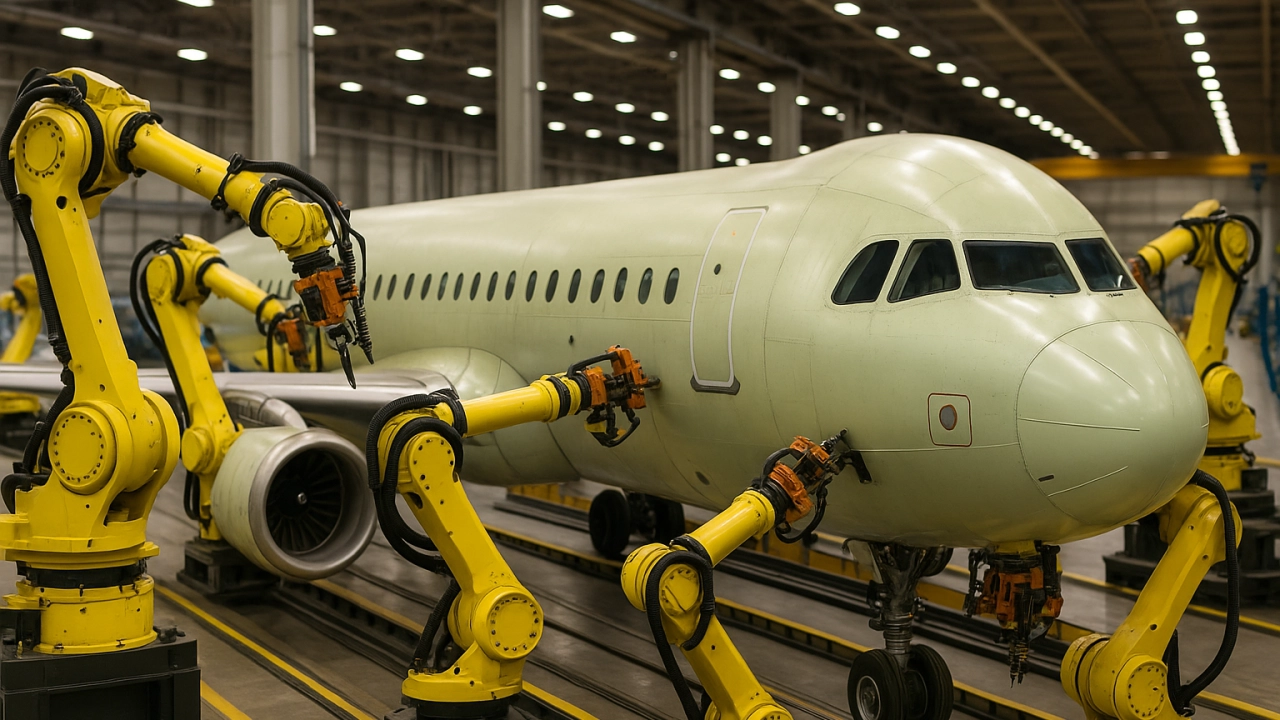
Swarm Robotics Could Spell the End of the Aerospace Assembly Line
A novel approach to aerospace manufacturing is emerging, moving away from traditional conveyor belts towards swarms of small, collaborative robots. Researchers at institutions like the University of Groningen and other European entities are actively developing these collaborative robot swarms. These swarms are designed to work in unison to construct large aircraft structures, entirely without the need for traditional fixed tooling or conventional assembly lines. The robots are engineered to communicate, self-organize, and intelligently divide tasks such as drilling and fastening across an aircraft fuselage. The ultimate objective is to establish a more flexible and scalable production system that can readily adapt to new designs or part configurations without requiring costly retooling.
Major Takeaway: Swarm robotics has the potential to replace rigid aerospace assembly lines with decentralized, dynamic manufacturing teams, representing a significant stride towards more adaptive, software-defined factories. Read More
About Lucid Bots
Founded in 2018, Lucid Bots is an AI robotics company that is committed to uplifting humanity by building the world's most productive and responsible robots that can do dangerous and demanding tasks. Headquartered in Charlotte, the company engineers, manufactures, and supports its products domestically, which include the Sherpa, a cleaning drone, and the Lavo Bot, a pressure-washing robot. Lucid Bots' products are elevating safety and efficiency for a growing number of customers around the world. Lucid is a Y Combinator-backed company, with investments from Cubit Capital, Idea Fund Partners, Danu Ventures, and others. Lucid Bots was recently recognized as the fastest growing robotics manufacturer in the United States.
.webp)
Sporks of AGI, Student Bots, and Tesla’s Big Bet
AI researchers say today’s models are early signs of general intelligence, students in DC are learning robotics through hands-on summer camps, and Elon Musk is focusing Tesla’s future on robotaxis and humanoid robots.
TL;DR
AI researchers say today’s models are early signs of general intelligence, students in DC are learning robotics through hands-on summer camps, and Elon Musk is focusing Tesla’s future on robotaxis and humanoid robots.
AI Researcher Says We’re Already Using “Sporks” of AGI
In his recent essay, Sergey Levine likens today’s AI models to sporks—blending narrow and general intelligence. They're flexible, adaptable, and kind of general. But they still need structure. Still need supervision. Still need humans.
That’s the gap between AGI theory and real-world robotics: abstraction vs. application.
If you want systems that can actually do work—on a roof, on a bridge, on a building—you need data from those real-world environments. Not lab environments. Not synthetic ones. The real thing.
Major Takeaway: Real-world robotics advances by doing, not theorizing—data from real jobs is the compounding edge that turns flexible tools into truly capable systems. Read More
At this summer camp, kids build soccer-playing, relay-racing robots
DC Public Schools hosted a free robotics summer camp where middle schoolers spent three weeks building and programming robots for a “Robot Olympics,” featuring events like robot soccer and cube sorting. The camp emphasizes hands-on learning, creativity, and fun—without grades or pressure—making it an inviting entry point into STEM. Students get meals, mentorship, and field trips, and even city leaders like Mayor Muriel Bowser stopped by to show support. The program is part of a broader effort to expand access to CTE and STEAM education citywide.
Major Takeaway: DC’s free robotics camps are giving students early access to engineering and coding skills in a supportive, low-stress environment—setting the stage for a more inclusive future in tech. Read More
Elon Musk Tells Tesla Investors to Focus on a Future Filled With Robots
Tesla’s Q2 numbers showed a sharp drop in EV sales and profits, prompting Elon Musk to shift investor attention toward the company’s future in robotics and autonomous vehicles. Musk unveiled a pilot robotaxi program in Austin using human-supervised Model Ys, with plans to scale rapidly across U.S. cities pending regulatory approval. He also claimed Tesla will be building 100,000 Optimus humanoid robots per month within five years. Still, analysts remain skeptical, citing competition from Waymo, technical hurdles, and Tesla’s reliance on vision-only autonomy.
Major Takeaway: Tesla is betting its future on robotaxis and humanoid robots, but delivering on that promise will require overcoming major technical, regulatory, and competitive challenges. Read More
About Lucid Bots:
Founded in 2018, Lucid Bots is an AI robotics company that is committed to uplifting humanity by building the world's most productive and responsible robots that can do dangerous and demanding tasks. Headquartered in Charlotte, the company engineers, manufactures, and supports its products domestically, which include the Sherpa, a cleaning drone, and the Lavo Bot, a pressure-washing robot. Lucid Bots' products are elevating safety and efficiency for a growing number of customers around the world. Lucid is a Y Combinator-backed company, with investments from Cubit Capital, Idea Fund Partners, Danu Ventures, and others. Lucid Bots was recently recognized as the fastest growing robotics manufacturer in the United States.
From R&D to ROI: Robots Go to Work
Robots transition from R&D to real-world applications, improving efficiency in industries like automotive manufacturing and developer tools. Discover how automation is transforming the future.
TL;DR
Robots are moving from R&D labs to the real world. Dongfeng is using humanoids on its car assembly line. Nvidia is all-in on humanoids and AVs as the next big wave. And Google just gave developers a powerful AI sidekick with Gemini CLI. The future of automation is unfolding right now — and it's getting more capable by the day.
Humanoid robots handle quality checks, assembly at auto plant in China
Chinese automaker Dongfeng Motor has deployed humanoid robots developed by UBTech on its assembly lines to handle tasks such as checking seatbelts, inspecting doors, filling oil, and applying labels. These robots, called Walker S, are equipped with high-resolution sensors and dexterous hands, enabling them to perform precision quality assurance. This move reflects a growing trend in China to use robotics to address labor shortages and improve manufacturing efficiency.
Major takeaway: Humanoid robots are no longer experimental—they’re now performing real work on factory floors, signaling a significant shift in how industries address labor challenges and scale production. Read more
Nvidia CEO says robotics is chipmaker’s biggest opportunity after AI
At Nvidia’s 2025 shareholder meeting, CEO Jensen Huang spotlighted robotics—particularly humanoid robots and autonomous vehicles—as the company’s next major frontier after AI. He introduced Isaac GR00T N1, a new open-source foundation model built to accelerate humanoid robot development. Companies like Neura Robotics and 1X Technologies are already leveraging this tool, pointing to its real-world potential in speeding up innovation.
Major takeaway: Nvidia is staking its future beyond AI on robotics, with humanoid robots and autonomous vehicles at the heart of its vision for what’s next. Read more
Introducing Gemini CLI: Your open-source AI agent
Google has introduced Gemini CLI, an open-source AI tool that brings advanced Gemini capabilities directly to the developer terminal. Built on the Gemini 2.5 Pro model, it supports a massive 1 million token context window for tasks like writing code, debugging, generating content, and conducting deep research. It also integrates with services like Gemini Code Assist, Google Search, and image/video generation tools (Veo and Imagen). Available in preview, developers can access it for free with generous usage limits.
Major takeaway: Gemini CLI delivers powerful AI tools straight to the command line, transforming how developers build, research, and create at scale. Read more
About Lucid Bots:
Founded in 2018, Lucid Bots is an AI robotics company that is committed to uplifting humanity by building the world's most productive and responsible robots that can do dangerous and demanding tasks. Headquartered in Charlotte, the company engineers, manufactures, and supports its products domestically, which include the Sherpa, a cleaning drone, and the Lavo Bot, a pressure-washing robot. Lucid Bots' products are elevating safety and efficiency for a growing number of customers around the world. Lucid is a Y Combinator-backed company, with investments from Cubit Capital, Idea Fund Partners, Danu Ventures, and others. Lucid Bots was recently recognized as the fastest growing robotics manufacturer in the United States.

Land Legs, Living Labs, Open Skies: The New Age of Robots Arrives
The robotics revolution is advancing rapidly with South Korea, Toyota, and the U.S. leading innovations on land, in cities, and in the skies.
TL;DR
Chaebol-backed Korea is racing to perfect humanoids, Toyota is turning Mt. Fuji into a living smart-city lab, and new U.S. rules are clearing the skies for home-grown drones—all signs that the robotics revolution is sprinting ahead on land, in cities, and in the air.
How South Korea’s Chaebols Are Pushing The Robotics Revolution
Major Takeaway: South Korea is positioning itself as a global leader in robotics through a powerful alliance between government, academia, and industrial giants.
Summary: South Korea is launching an ambitious national campaign to become a global leader in robotics, fueled by its most powerful conglomerates—Samsung, Hyundai, LG, and more. These companies are making strategic investments in humanoid robotics startups like Rainbow Robotics and collaborating through the newly formed K-Humanoid Alliance. This coalition aims to develop advanced humanoid robots by 2028 that can walk, lift, and operate autonomously across a range of environments. The effort reflects a highly coordinated industrial strategy backed by public-private synergy to dominate the robotics future.
Why It Matters: This is a rare example of a country aligning its corporate and public sectors to win a technological arms race. The level of coordination and capital behind it could set a blueprint for robotics leadership.
Toyota set to launch world’s first robot city at Japan’s Mount Fuji base in 2025
Major Takeaway: Toyota is transforming into a tech-first mobility company by building a smart city to test and scale future technologies in real-world conditions.
Short Summary: Toyota is building Woven City, a 175-acre experimental smart city at the base of Mount Fuji, set to launch in 2025. This “living laboratory” will house real residents—including Toyota engineers—who will live among autonomous vehicles, AI-powered homes, and sustainable energy systems like hydrogen fuel cells. By embedding cutting-edge technologies into everyday life, Woven City offers a bold reimagining of urban living and innovation at scale. It’s not just a testbed for products—it’s a fully functioning urban prototype for the mobility-centric future Toyota envisions.
Why It Matters: Rather than simulate the future, Toyota is building it. Woven City represents a radical approach to innovation where the testing ground is life itself.
Drones will soon be everywhere, as U.S. seeks to lead future of aviation
Major Takeaway: The U.S. is removing major regulatory roadblocks to fast-track drone innovation and reduce reliance on Chinese drone tech.
Short Summary: In a significant policy shift, the United States is removing key regulatory barriers to expand the use of drones and advanced aerial vehicles across industries. President Trump’s executive orders aim to legalize long-distance drone operations beyond visual line of sight (BVLOS), accelerate delivery services, and enable the commercial rollout of eVTOL aircraft. These moves are also designed to reduce U.S. reliance on dominant Chinese manufacturers like DJI. With new FAA rules expected soon, the initiative is poised to unlock innovation in logistics, aviation, public safety, and more.
Why It Matters: This shift will supercharge American drone startups and logistics companies, while reshaping urban air mobility and national security frameworks.
About Lucid Bots:
Founded in 2018, Lucid Bots is an AI robotics company that is committed to uplifting humanity by building the world's most productive and responsible robots that can do dangerous and demanding tasks. Headquartered in Charlotte, the company engineers, manufactures, and supports its products domestically, which include the Sherpa, a cleaning drone, and the Lavo Bot, a pressure-washing robot. Lucid Bots' products are elevating safety and efficiency for a growing number of customers around the world. Lucid is a Y Combinator-backed company, with investments from Cubit Capital, Idea Fund Partners, Danu Ventures, and others. Lucid Bots was recently recognized as the fastest growing robotics manufacturer in the United States.
Lucid Bots Podcast
How Ryan Godwin is Transforming Exterior Cleaning with the Sherpa Drone
Dive into the future of exterior cleaning with Ryan Godwin, the visionary behind Lucid Bots. Discover how Ryan is leveraging cutting-edge robotics to revolutionize cleaning for buildings and outdoor surfaces—boosting efficiency, safety, and sustainability.