How to Start a Drone Cleaning Business with Ryan Godwin
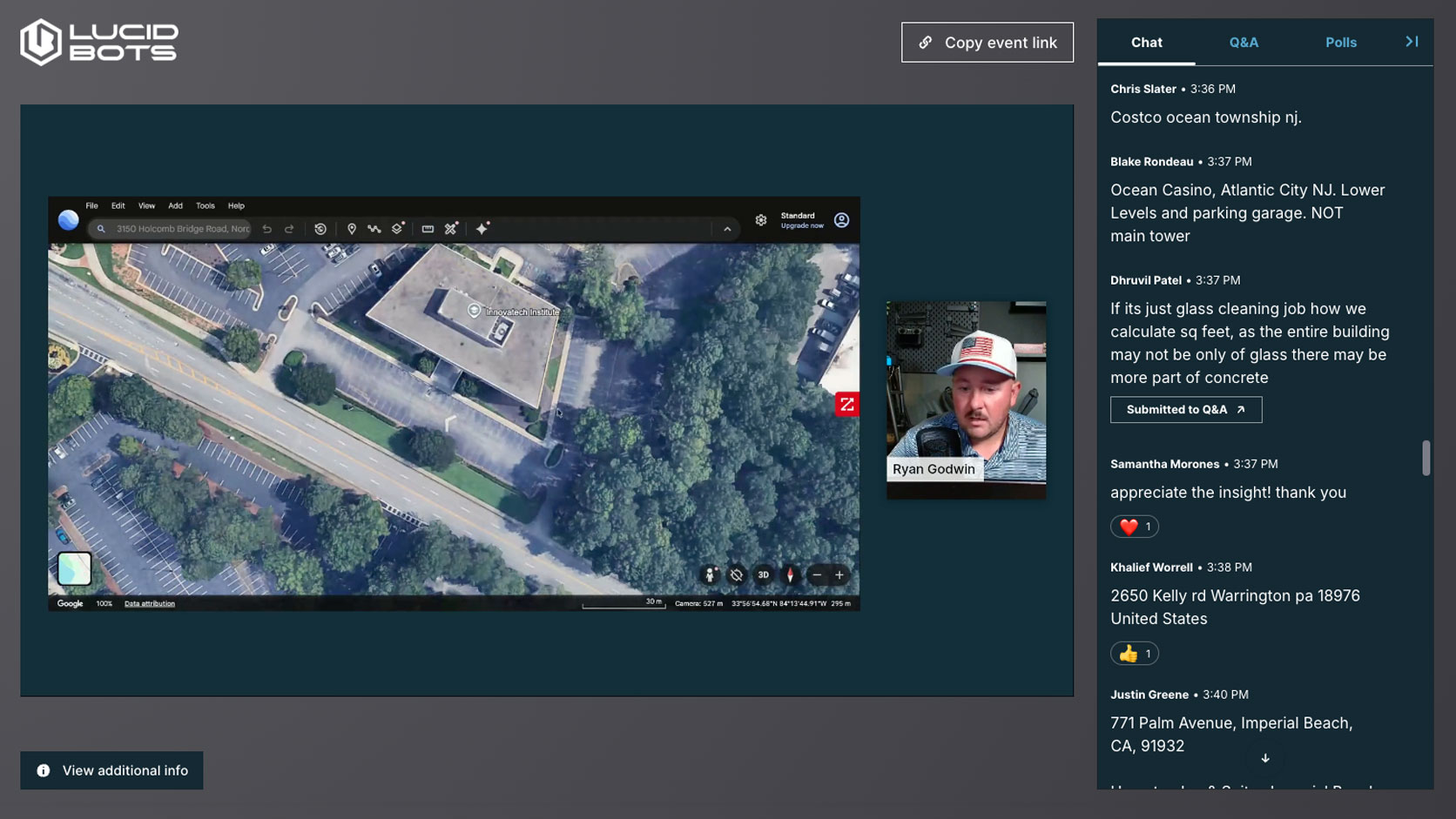
Ryan Godwin shares how he finds commercial cleaning work, evaluates buildings and builds estimates. Watch the August webinar, explore the key takeaways and read the transcript.
Watch the free webinar
How do you turn a cleaning drone into a commercial service business? In this recorded session, Ryan Godwin of Godwin Facility Services walks through the work behind the flight, from finding decision-makers to assessing buildings and putting together a bid.
Ryan runs a commercial exterior cleaning company and is a Lucid Bots partner, adviser and Exterior Cleaning 101 instructor. He brings examples from his experience, then works through buildings submitted by the audience.
Recorded August 18, 2026 · 71 minutes
Register on Wistia with your name and email to watch the recording. The recap and transcript below are available without registering.
We run these webinars every month. Visit our Events page to sign up for the next live session and ask your questions.
What you will learn
- How to find the people responsible for commercial properties.
- What to look for before deciding whether a building suits drone cleaning.
- How Ryan approaches project pricing and estimates exterior surface area.
- Why follow-up, documentation and preparation matter as much as equipment.
Five takeaways from the conversation
Build a repeatable cleaning business
Ryan opens with a distinction that shapes the rest of the session. Buying a drone is one part of building a commercial service business. Operators also need a process for finding work, assessing sites, quoting projects and delivering the result they promised. He discusses why commercial customers can take longer to buy and why consistent follow-up matters.
Start with the person responsible for the property
Facility managers, property managers, maintenance directors and general contractors are among the people Ryan recommends getting to know. His examples include local industry groups, direct outreach, site visits and demonstrations. The common thread is understanding the property's cleaning needs and staying in touch.
Price the project around its scope
Ryan's advice is to “price the problem, not the time.” He explains why an hourly quote can punish efficiency or make the customer pay for an operator's learning curve. In the live examples, he looks at exterior area, the surfaces being cleaned and the work required to reach them. A proposed job price is revenue, not profit. Labor, chemicals, travel and other costs still need to be accounted for.
Decide whether the drone fits the building
The live building reviews are a useful part of the replay. Ryan looks beyond square footage to surface condition, balconies, trees, overhead wires, access and water supply. Some buildings are better suited to other methods. He also distinguishes routine cleaning from restoration work and explains why new operators should build experience before taking on more complex sites.
Prepare before the first paid job
The session covers training, certification, insurance, job documentation and crew coordination. Ryan also discusses avoidable business mistakes, including underpricing, weak follow-up and failing to document results. His recommendation is to develop a repeatable process and expand as the team gains experience.
Find a topic in the recording
- 03:06 Building a commercial cleaning business
- 11:02 Project pricing and scope
- 12:41 Finding customers and following up
- 18:21 Preparing for the first paid job
- 27:07 Assessing a building
- 30:00 Working through a hotel estimate
- 57:58 Audience questions
The building estimates in this recording are worked examples, not completed sales or promised earnings.
Explore a setup for your business
Choose your equipment and compare paying upfront with financing in the Sherpa quote builder.
Webinar transcript
Read the webinar transcript
This transcript comes from the recording captions and has been formatted into paragraphs. Opening housekeeping and the dated class-registration segment are omitted. The recording is the reference for any captioning errors.
01:21 Introduction
Alright guys, I want to thank you for joining. This is a webinar based on, like, how to start a a a drone cleaning business. I think I've got a little bit of experience with it. We've been doing it for four or five, six years now. We're cleaning beforehand. We added the drones into the into the business as we as we went. So let's see. So a little bit about me. I own Godwin facility services. We travel all over the country. We're a Lucid Bots partner and adviser. So some of you may have talked to me on the phone or or heard the stories.
Half of them are true. Half of them are true. But, yeah, we we manage a commercial, exterior cleaning business, based in Mississippi. We travel all over the country. Just got back from Austin, about to go back out to Florida and all around the country. Teach our exterior cleaning one on one class. And then every number from from our classes, and this is based off real world experiences, hard lessons learned, our failures. I mean, it's okay to fail out in the open because it makes you better. It makes you a better better operator. So what we're doing in the next hour, we're gonna go over the business.
All this can be high level because we don't have enough time. Like, we've got an hour to do this. So we're gonna hit it at thirty thousand foot. If you have questions, put them in. And then, always, we have a class we offer for three days as well. But we're gonna go over the business. We're gonna do live bidding. We're gonna bid a couple of your buildings. So if you got those addresses, put them in the chat, and we will look at some of your live buildings to to bid. And then we'll have a q and a at toward the end.
03:06 Building a commercial cleaning business
So a couple of things we touch on in class is this is not a side hustle. It's a commercial service business. Right? You know, we're we're not after the residential houses. And I mean, why would you spend all this money on a drone and do nothing but houses? So we wanna go after the the commercial side of the business because it's, I mean, it's safety driven operations, and you can build systems to repeat, with with hotels, with with your commercial properties. They're pretty cookie cutter a lot of times. So once you build a process that works, you can kind of scale it and repeat it.
If you're starting from scratch, I mean, you got about a ninety day ramp up to about real margin, because the sales cycles are slower. Right? You know, residential is more like, fast cash, lower ticketed items and a lot more churn you have to do. So, with residential pressure washing, it's more of a, you know, it's not this isn't a weekend hustle. This isn't easy money. This isn't, anything going on, like that. I mean, it takes three to six months to get your first job sometimes in commercial. So when you're starting out, you got to kind of be cash flow positive and kinda keep that in mind and and you're always trying to hustle to get more business.
So I always talk about this in class, like my goal is not to manage your business. When we teach in class and we talk after and do consulting or anything like that, is to give you the foundation to build on. If I give you the right foundation, like you're building a house, then your house will stand. If you don't have a good foundation, it could fall and fall to pieces. I'm a really big believer in the coopetition mindset. A lot of people ask, why do I do this? Why do I teach? What do I get out of it?
Like you're just training the competitors. Well, coined the term coopetition because I really believe that a rising tide raises all ships and that, you know, I may need you one day, you may need me one day, and I don't want to be a bitter rival or have this competition mindset where we can actually work together and and make this industry better. This industry is so new that there's plenty of work for everybody. And I think if we help each other out, you all become better operators. And why it matters is poor operators damage reputation for everyone, not just for me or it's not, you know, drone versus drone.
It's it's literally a poor operator with any drone will, could could get the FAA looking at us, could, could could cause problems and and all that in the industry. So, you know, our job is to normalize drone cleaning and to to make it, something that's a common thing. But we've got to do it together. Right? And this is why it matters. This is why I teach. So why facilities are calling about this now? So OSHA pressure, you've got labor shortages, you got, risk from traditional methods, you've got, we're faster than than others than the traditional method, commercial demand, right, and premium pricing.
So with OSHA, you know, you have to be all have all these certifications and and had to recertify and do all these things. And also the number one cause of injury in the workplace is falls. Falls off ladders, falls off lifts, falls off buildings. That's the number one cause of injury in the workplace. Labor shortage, right? So, you know, it's harder to find labor today no matter what business you're in, no matter where you're at. So with a drone, when you have a video game style controller and and it's more like playing video games and hand eye coordination, It's easier to attract the younger generation to be involved and want to get, you know, into flying drones.
Plus they're cooler. Everybody likes them. So it helps that labor shortage and it helps, you know, people that don't want to do manual labor and they want to, you know, fly a drone. Risk transfer, same thing. Like I don't have to be on a lift ladder scaffolding, to risk my guys falling, me falling. It also transfers that risk mitigation to your clients. They don't have to worry about that either. And four to five times faster speed. So that's the asterisk I'll put right there. It depends on how skilled you are as a pilot. If you're a brand new pilot, you're not going be four to five times faster.
Is the drone capable of that? A hundred percent. A hundred percent. But you've got to be trained and kind of know what's going on. So this thing excels at that. Premium pricing. So everybody has a question about pricing. I will tell you this, the drone pricing versus traditional methods, I'm not charging for access with the drone. So your standard crew may come in and it may be ten thousand dollars for the project plus a lift. I may be eleven thousand five hundred dollars for the project and they're still higher because I have to put in the lift access in there.
So I'm getting a premium price for our cleaning, winning the bid because we're we're we're a little more affordable than than our competitor. So it's a win win and we make more money on the job.
08:21 Residential and commercial customers
So this is what this kind of sets your ceiling, right? I mean, is why drones and commercial space is there. Residential, your your projects are five hundred to eight hundred dollars a project. You can get a little more if you're doing complete like roof washes, window washes, garage washes, you know, driveway, sidewalk. You do the works basically at their houses. You could get up to fifteen, eighteen. I've seen, you know, back in the day we did residentials up to twenty two, twenty two hundred bucks. But, you know, an average ticket size is five to eight hundred eight hundred bucks for a house wash or a roof wash.
So it's fast cash flow for sure because most of the time it's we do the work and then and then we're paid instantly. But it's a smaller ticket. It's a higher churn. It's a constant price shopping. It's an emotional buyer. This is a big takeaway and key ticket for me. It's their own money. So they're emotionally attached to that money. So when you have somebody that's emotionally attached, they're going to scrutinize everything you do and it just makes for a harder work environment or harder, client to work with. It's good to use for practice. It's not good to build on for commercial cleaning.
It's really good to use your friends and family and start out by doing residential work to learn the business, to learn the chemicals, to learn the mixes. Commercial is your target though, dollars five thousand to fifty thousand dollars per project. Your average is somewhere around ten dollars somewhere in that ballpark, depending on size, scope and scale. It can lead to long term contracts and recurring revenue. You're dealing with a lot of professional buyers too that are used to spending that kind of money and they're not emotionally attached to it because it's in their budget. So you're getting a lot better customer in as far as like you know, relaying prices and and and they're not scared of those prices because they're used to spending a hundred thousand on AC HVAC or electrical or whatever or roof repairs or what have you.
There's a lot of money tied into, upkeeping a building. It's an easier sales, upsell cycle. So like when you're on-site, you're caught up for the facade, you can sell the windows on it. You can sell the roof. You can sell solar. You can sell flat work. Because a lot of times they're calling you for the facade and you can as you walk that facility and that property, you see these other things that need attention, and it's easier to point them out because they have a lot more of it. But it is a slower sales cycle.
That's the downfall to it, but it's worth the wait. I would say start commercial as soon as possible and work your way up from there.
11:02 Project pricing
Another big thing that happens in this is people, when they talk pricing and we talk pricing a lot in this industry and like the first questions we get asked is, well, how much do you charge or what's the thing or, you know, all this and that. It's this is this is what kills a lot of people is hourly pricing, right? It's when you are learning, it penalizes you. Or I'm sorry, it penalizes your, your customer. When when you become efficient, it penalizes you. So let's say, you know, if I'm if I'm really good at what I'm doing, I charge by the hour.
I'm gonna make less money on-site. That's not the correct, as a business owner, we wanna make as much money as possible, margins, pay for things, pay for people, take care of our families, all that kind of stuff. So it just penalizes efficiencies, or it makes your client pay for your learning, which causes strife and causes, you know, bad blood between between you two because why should they pay more for you to learn how to do what you said you could do when you went into the job? And facilities don't think hourly. They think project based, right?
They think about like, okay, I have this project. Now they don't want you to sell on the site forever, but they don't think of it in an hourly rate a lot of times when it comes to cleaning. You always want to price the problem, not the time. That's a big thing that we do because, you know, I'm not going to put one hundred and fifty dollars two hundred dollars an hour on a site and then, you know, something happens or there's a problem and we're losing, we're always going to price per square foot.
12:41 Finding commercial customers
So where the work actually comes from. This is another question I get a lot is like, hey, how do you find your work? How do you do? So I travel all over the country, so I've got different a lot of different avenues. But these, I've boiled these down to the kind of where you really want to go and find these people. So who to target? You've got facility managers, property managers, maintenance directors, asset managers, general contractors, plant managers. Those are the people you want to go after. So where you meet them is you meet them at the IFMA.
So that's a local chapter. A lot of people have them. So it's IFMA. It's for facility managers. You go, you join the chapter, you pay the fee, you go network with them. They normally hold socials and and events where you can talk to them, and get up close and personal with them. Same thing with Irem. Irem is for property managers, real estate agents, commercial property managers. That's that's the same kind of deal there. It's a it's a you pay a membership, you go to their socials, you sponsor an event, you go talk to them, you go, you know, you can have a have a beer and some chicken wings with them.
Right? And you talk about what you do. CBRE is another good one. JLL is another good one. CBRE and JLL accommodate for most of the commercial real estate in North America. So they're really good contacts to go to. Walk into those centers. There's they're they could get JBL JLL's and CBRE's everywhere. So walk in, talk to the local manager, show them, show the drone, show what you do, you know, do a little demo for them, get them on board with drone cleaning, and that'll help get you into these doors to start actually bidding projects. So BNI chapters, join your local chapter.
It's filled with professionals, lawyers, real estate agents, bankers. Those group of people know the people that you're trying to find. They normally have a personal connection with them. They've either done a loan for them, done a done a lawsuit for them or anything in between. So those chapters can help get you connected to the right people as well. Same thing. There's a fee. You join the groups, you go to the meetings, you go to the socials, and and you and you you work it from that angle. Chamber of commerce, a lot of times they'll do free openings like ribbon cutting ceremonies, things like that.
Join your local chamber, do a ribbon cutting. They also have, a lot of times, directories that have all the contacts of other chapter or or chamber members. So you can also get those and start going down that list as a call list on calling on and cold calling people, to start getting your business out there. And then also everyone you meet man, like that one, just be a good human, right? Like there's an example when I was in Indianapolis, Indiana, we were flying a project and a guy walked up to us and, I was flying.
I was like, hey man, give me two minutes. Let me get the drone on the ground. I'll answer all the questions you want. And, so he came up, we chitchatted a minute. He didn't tell me who he was, who he worked for, where was going on. I just treated him like a human and talked to him about drones and was nice. Right. And, gave him my card. And about a couple of weeks later, he called me and, we bid and won about three hundred thousand dollars worth of properties that they that he managed and and took care of because I he saw the drone was interested, and I treated him like a human and was just nice to him.
So ways to reach these people as well, cold emails, short professional. That's how you want to be. You don't want to go in this long rant of, you know, all these things because most of the times they don't don't read them. And if they do, they they're trying to read them quickly, or they'll look at the summary. So you just want to have a quick, short professional email, to for cold outreach. Linkedin outreach. Linkedin is the business to business facebook. Just how like everybody gets on facebook and knows everybody's business about everything going on And there's so much drama on there and all that LinkedIn is similar for the business world.
This is how you connect to a lot of these managers and people, out, reach out to them, send them videos of what you do, send them videos of the drone, send before and afters, but use out, linkedin as a good outreach tool. Phone calls still work as well. Get their numbers, have a conversation with them. They're a little tougher. They're going to cut you all faster. They're going to tell you, hey, we've got a guy. But once you tell them you have a drone or you're clean with a drone, the conversation changes completely. Site walks and demos.
Once you get them on on kind of on board, you go do a site walk with it to identify things, do a demo with them. Bid Prime is a good one we use, along with some others. You this basically an RFP, site. Basically, RFPs get collected and get sent to you. It's a paid subscription, So you can you can join it and select your area that you wanna work in, what you do, pressure washing or or whatever the case is, and Bid Prime will send you, bids that come up in your area. A really good tool to use, and and it's really helpful in in in getting bids that you just didn't even know about.
A CRM. You you have to have a good CRM, and you have to be able to manage that CRM and your customers properly, You want to always stay on top of mind with them. You always want to, you know, be reaching out, let it do automated reach outs. Sometimes it takes five to seven touches to close these these deals. It takes a while, because a lot of times they don't just buy instantly, right? And then in these groups, when you go into these property management meetings or these facility management meetings, you're like, man, don't want to go.
I don't want to go. I've been here six times. It just takes the right person, the right relationship you build to change your business completely. Because a lot of times it's who you know not what you know.
18:21 Preparing for the first paid job
So before your first paid job, these are things that really need to go. These are non negotiables for the most part. You have to have your part one zero seven license. You have to. You can't do anything with a drone, whether it's a cleaning drone, camera drone, anything for compensation. If you do that, you're breaking FAA rules and you're subject to fines and or license privileges being taken from you. You also need UAS insurance, so drone insurance. We carry a general liability policy, and we carry a general liability policy specific to drones. Because insurance companies, a lot of times, if your normal GL won't cover the drone if it damages something on the building.
You know, insurance companies always want to find a way not to pay you or pay out. So we always encourage you having it for the drone specific work. It'll save you in the future. And then it's up to you whether you want to self insure the drone or you want to join programs that manufacturers have, or whatever the case is there. I self insure mine, because I can repair it cheaper than I can pay a premium for for for insurance, through the through these for self for for if it crashes and I have to completely replace the drum.
Workers' comp. Even if you're solo, you have to have workers' comp. Like, most places won't even let you bid or submit a bid if your COI doesn't have workers comp on it, even if you're a solo entrepreneur trying to get these things going. So have it, have it from the beginning. It's a non negotiable. A lucid Sherpa and a rig. Industrial equipment built for the market. It's not a hobby drone. It's not, it's not a toy. It is a system that is built for commercial and industrial use. Also, insurance isn't a cost. A lot of people look at insurance as a cost.
I look at it as a selling tool. Right? I've got as much insurance as I could possibly get, in our business because when you go and you talk to these people, they they want risk mitigation and liability to be, you know, second, right? So, with insurance and having all these insurances, they know if something does go wrong, I can cover it. Because things do go wrong in business sometimes. So I want to have the correct insurances and I don't look at it as a cost, look at it as a tool to help me get in instead of being a chuck in a truck with no insurance and trying to get into this industry.
Insurance is non negotiable.
20:50 Common mistakes
The mistakes, the new operators make that end them, they end their careers or in their business or they're you know not in a good place is, underpricing. The lowest bid wins the worst client. Everybody's in the mindset of I've got to get the cheapest bid, the cheapest bid, I got to win the job, I got to win the job. It's that scarcity mindset that a lot of people have and to be honest, know there's abundance out there. The cleaning industry is massive. There are more cleaners than drone cleaners in this nation and that will change in the future.
There will be more drones added as we go on just naturally out of the drones actually being a tool that works. But, underpricing is a big thing. They think that they had to put out the lowest bid just to get that job just to say they did it. And and what happens is you'll do that job and you'll lose your margin and, you know, you've done great, you've done a good job, but when you make two thousand dollars off of it, you don't have another job for a week or two. What does that do for your payroll or what does that do for your, you know, your business?
So underpricing kills very quickly. Chasing residential, so it's fast cash, but it's hard to build a real business off of, residential. You have to do a lot, a lot, a lot of work, to do that. So your margins go down a lot with that. Skipping insurance, one incident can end it all. Like you have one incident, you spray the wrong chemical or you let it dwell too much. You know, you're brand new in the business and and all of sudden you've done thirty, forty thousand dollars worth of damage that you have to take care of.
If you don't have insurance, that's come out of pocket or you're gonna get sued. So it'll end your career pretty quickly. So insurance is is major in this industry. You've got to have it. So no follow ups doing the sales pipeline. A lot of people think, oh, I sent the bid. That's it. I'm done. You know, they should call me. It was a good bid and I got a drone. Well, if you don't follow-up and ask if they have any questions about the bid or don't be that squeaky wheel because a lot of times these property managers, they have other things on their mind.
They've got HVAC problems, electrical problems, you know, they're moving furniture around those places, they're managing a really big building. So, you know, cleaning kind of falls to the wayside a lot of times. So no follow ups equals, you know, a lot of times, no no bid, no contract. No documentation. Before and after pictures, you live and die bomb. It's your audition for the next job, and it also protects you. So if you take before pictures and there's damage already there, you can show that. So after the cleaning, you're not like the client's like, oh, you damaged that.
Well, no property manager. I've got these pictures here that shows it before we cleaned it where it's got this little, you know, damage or indentation here. We did not do we did not cause it. So it saves you, and then it also sells your next next job. Every before and after picture or video is an audition for the next job, and it also can lead to contract renewals. Getting over your skis. So a lot of people in this industry, think because the drone can go so high that they should go that high. So I really, you know,
24:01 Building experience
I really believe in the in the crawl walk run method. So the crawl walk run, you know, you buy your drone, you don't know anything, you you really have to build a basis on cleaning. You have to know how to clean, you have to know how to fly, you have to do all that stuff. So with a crawl, you need to get your part one zero seven, you need to get insured, you have, general liability, you need to practice on friends and family houses, you need to build a target list, right, of who you want to target in your first, you know, thirty days.
So from decision of doing it to getting ready to go do it, you need to start building that sales pipeline and start getting insured and certified. Go through trainings, do whatever you need to do to get ready. Your walk phase is the, you know, thirty one to sixty days, right? You're looking at about a ten to thirty percent margin a lot of times on those, and you're cleaning four to six story buildings, two story buildings, whatever that case is, because you're trying to learn how to properly apply chemicals and wash them away and actually get a good clean on these things.
The reason your margin is a lot lower those days is because you may have underbid it a little bit and you're learning your market and you're learning how to price jobs correctly. So you know, it's okay if you're in that ten to thirty percent, right? Most businesses take three to five years to be profitable. With this business, you can be profitable pretty quickly, but you have to take the right steps in order to establish a business that will last and not be a flash in the pan. Send unsolicited bids in your walk phase, Learn your real job cost.
What does it cost for labor, mobilization, chemical cost, all the things that go into to running your business. Your run phase, sixty to ninety days. I would expect you to have a little bit higher margin because you've learned your numbers and you're you're tweaking your bids. You're you're doing all that. So you're, you know, thirty to sixty percent margin. So you're at this point, you're at small to midsize offices, hotels, five to ten story commercial jobs, repeatable, consistent results, with renewals on the table. I really try to get renewals on the table as possible, meaning contracts to where we can do, you know, so we we can we can have recurring revenue and have work lined up for next year.
So but, yeah, your year one revenue, eighty five to, you know, hundred twenty. You know, that's that's kind of standard, right, if you're following these practices. Yeah. We're faster, of course, with a drone and then your target margin is thirty to sixty percent. So that's what year one kind of actually looks like. It's not all this fluff. You know, I know you've seen me on these big projects like this one right here And and, you know, they're a hundred thousand dollar project or the Domino Sugar is a hundred fifty, hundred sixty thousand dollar project or whatever the case is, right?
Those are because we have been running for a very long time and they are, you know, a lot harder to do and accomplish. So, you know, you wanna you want to, in the beginning, have smaller repeatable, buildings to then learn and do on. But yeah. So this is,
27:07 Assessing buildings
we're gonna go into a bid now, a real world bid. So how I identify a bid, how I, you know, read a building. So the first question I ever ask is, can I can I fly it? Is the airspace correct? Is the weather correct? Is the area accessible by drone? Are there any major hurdles or anything? You know, what is it made of? Is it is it masonry, EFIS, stucco, glass, metal, limestone, marble, polished, non, you know, how how bad is the staining? Is this is this a drone job at all? I know everybody in here is like, oh, we're here for drones, but is it a drone job?
Right? Is it organic growth or is it restoration? Is it carbon or is it organic? I mean, like, what material is in it? Is it etched onto the building? Can the drone properly do it? Or is it a restoration or that you have to bring in a different method to clean it off? I mean, you know, lifts, ropes, scaffold, swing stage, they're not out of the question in cleaning. Like the drone doesn't solve the restoration part of thing part of things or the mineral etching or anything like that has to be buffed, polished or done.
It doesn't matter where the drone's from. It it just doesn't do that. So you have to identify kinda, is it a drone job? Is it too big? You know, how how big is the building? You know, is it is it thirty one stories in the air? Like that's not a drone job. The efficiency from being on the ground and seeing it's not there. The drone's capabilities are not there. And and it becomes very dangerous at those heights to do it. The drone to me, the bread and butter for drones is ten to fifteen stories, and under.
Two stories two stories to fifteen stories is kind of kind of where we do. We don't pull it out for anything under two. We'll do two by hand and then anything above two, we'll pull a drone out. But, you know, so how we, determine square foot is perimeter times story or times height of each story. So, like, typically, it's ten to twelve feet per story. So I always go in the twelve foot range, and I add at least, you know, a ten percent contingency just in case I'm off with, move my square footage rate, right?
We don't want to lose as entrepreneurs. We want to make sure that we're making the rate the best rate possible. And then also what is the best rate, on square foot? You know, is it per window? Is it per square foot? Are there multipliers? Things like that that go on for height difficulty, you know, how how dirty is it? You know, all that kind of stuff. So, and then does this clear my minimum margin? So when I'm pricing all about after I've got my square footage, I'm gonna look at it and just make sure that I'm comfortable with the money to be made in the project when we're doing it.
So whatever my minimums are for that job, for us to travel, just to do, or whatever it is, if we hit it, then we'll send the bid.
30:00 Live building estimates
Alright. So now we're gonna pull up, Google Earth, and I'm going to kinda show you this is a standard hotel. So Google Earth, lot of times, you'll you'll go type in where you're going, whatever your address is. There's a measure tool on Google Earth. So this is how we'll get our perimeter. So I'm not gonna worry so much about all the little indentations and stuff that's going on here. I'm gonna literally click here. I'm gonna click here. I'm gonna kinda just trace the perimeter of the building, kinda get close. And then we're gonna go here.
So this is just for the building itself. If I'm washing the portico or anything else, I'll measure it separately, but it's the same principle. So when I close my loop so my perimeter is one thousand forty three feet. So that's our perimeter. So you'd write it down. You'd have it there. So we're looking at one thousand forty three feet. Alright. So now we're gonna take Google Earth. You can do a couple things. If it's not if it's not, three d image you can always go street view to look. But so I'm gonna come in here. I'm gonna kind of look around.
These are some problem areas that I see right here for just drone flying. You know, this right here, we have to close this pool down so nobody's there. We wanna find out the top of them. So those are kind of the identified areas that are there are little bit of trouble in this building. So as I'm looking around, I'm also counting my stories. So it's a one, two, three, four. It looks like a four story hotel. So we're looking with a four story hotel, we are looking at about, you know, forty eight feet tall by one thousand forty three feet around, and it's gonna give us an average or it's gonna give us a square footage of fifty thousand and sixty four square feet.
So I'm also going to take and put a ten percent contingency on that. So now we're at fifty five thousand and seventy square feet. That's the square footage of that building. So now we'll put a a square foot rate on it, know, anywhere from, you know, depending on what's going on, twenty cents, twenty five cents, thirty five cents, whatever you want to do. So we're roughly looking at about thirteen thousand six seven hundred sixty eight dollars at thirty five cent or twenty five cents to do this building. So that's how I essentially gather a square foot rate on this building here.
Alright. Bid reference card. You'll have this. You'll get this. These are just averages, right, per window, whether you're bidding windows by pane or by square foot. So with windows, what I do is if it's a if it's a hotel or anything like that, we know how many rooms are in it and we know how many windows. I'll bid that by paying. If it's a big curtain wall or anything that's large glass, different shaped glass, a different size glass, I'm not going to go through there and count them and say, oh, medium, small, large, whatever. We're just going to go, we're going to measure that height and length of that curtain wall of glass, and we're going put a square foot rate on it.
So depending on how it goes, is how you'll how you'll price. And then, of course, the higher the floors, the more the price goes because it induces complications. But you will have this right here to kind of reference, reference things from. And again, in your bidding, you want to be at about a sixty to seventy percent take rate. So if these numbers don't work and you're not winning anything, reevaluate them, maybe go down a little bit. If you're winning everything, maybe you reevaluate them and go up a little bit. So each part of the country is different.
Each market is different. So you need a good base and then you need to, you know, be able to, to kind of adjust from there in your first learning stages. That's part of the crawl walk run. You're gonna bid, learn, rebid and do from there.
34:16 Obstacles and unsuitable sites
So now it's your turn. So in the chat I think I've got a few addresses here that's been sent to look at buildings. All right so forty one or forty four one hundred eleven Sam Felipe Houston Texas window cleaning job. Let's see. Alright. So I guess we can go to Google Earth. Yep. So Google Earth. I'm gonna type in forty four one one Sam Felipe, Houston, Texas. I believe this may be it right here. Yep. Yep. Yep. So this is how you do it on Google Earth. I really recommend if you can do a sidewalk.
Sitewalks really, really help you kind of see the the landscape. So I will ask in the chat or whoever submitted this, which building are we looking at? I believe it's the small neighborhood. So if we're looking at this building here, we'll assume it's that one. So what I'll do is I'm gonna go to street view. I'm gonna click down here. Just kinda look around, see what's in my way, light poles, trees, kinda get a grasp. There's there's telephone wire right there or or or, electrical wire. So this one's a lot more complicated job because the drone has to get in those spaces and clean.
So what I'm gonna do is I'm gonna cruise around on Google Earth, kind of look at some of the points of the building. Same thing here. You've got wire. You got all this wire going on. So it's gonna be a really, really difficult cleaning with a drone. This is more of an advanced cleaning, from somebody that's been cleaning for a long time because it's gonna be real it's gonna be really hard to get this drone in between that that get any drone realistically in between for down low. And then as you pull up, it's gonna be really difficult to, not let the hose wrap around these these power poles.
So I would actually on this job here, I would probably sub or do something different with this one, just because the trees and the and the risk you'll have with the drone of crashing into the building and or, you know, hitting a power line, and then damaging your drone or ruining it ruining it. But if I were to quote it, I would do the same thing. I would do square foot right here. I would I would see, you know, what my perimeter is, my heights, and then multiply it by my square footage rate. But, yeah, that'd be one that I would actually you know, that's not a good drone job, actually.
Not a great one. Unless you're really skilled, I would probably sub that that guy out to a roach company or somebody that specializes in that.
37:26 Condominiums and complex exteriors
So next one we have is a thirty seven thirty eight Sandpiper Road, Virginia Beach, Virginia. Alright. So on this one right here, so you got a little trouble with balconies. That's okay. So we're gonna go street view to kinda look around. Beautiful, I guess, condo complex, apartments, things like that. The drone, you're having some of same issues on this front side with these power lines. I can't tell in person if I can get under them. But once you for a for a novice drone cleaner that's just getting started, this right here is uberly complicated because you have a hose.
And your hose in these trees and managing that hose right beside a power line that's probably twenty feet away from the building, it becomes complicated. I'm not saying that it's impossible, but it just becomes a lot more complicated. But it would be complicated with a lift as well. That lift has an arcing it can arc as well, and you could shock yourself or or or get somebody killed by having a lift really close to these lines and then it it arcing to the lift and then, you know, shocking you to death. So looking on this side, this side right here is gonna be the most complicated side.
This side over here is gonna be normal. You'll fly from a point over here. You'll fly across the building, and you'll and you'll do your cleaning. So on this one, we're gonna quote it. It's a little difficult. So in here, you can't fly a drone in here. So you either had to get on the balconies and spray across from each other. So get on a balcony, spray over, spray across, and kind of work your way down the building. A drone can fly in here. We can fly all this area all this area in here. Now your balconies, your balconies give you a little trouble because this is a more advanced drone cleaning as well because you've got people's stuff here that you can shoot underneath and underneath here with a drone with upward facing nozzles and things like that and kind of clean those areas and clean in there.
You just had to set the expectation with the property, management company that you're not it's not gonna be perfectly clean inside these balconies because unless you're gonna get out on every one of them. If you get on every one of them, then then, yeah, it'd be a lot cleaner. But what you'll do is you'll shoot up in there and let it run down the walls, cascade down. It's gonna get on the floor. It's gonna clean a lot of that. You're gonna be able to clean these walls right here. Underneath these lips and overhangs, you have a little bit harder time cleaning because the drone can't shoot from inside out.
So it's gonna there's there will be a line of clean. So it's just a lot more difficult to, to clean balconies with with a drone. But I would say you're going to clean about ninety ninety five percent of this, to their satisfaction. And again to quote it, we're going to basically take square foot. I'm going to take square foot. So we're going to just quickly measure measure out all this. Measure all this out. So roughly two thousand one hundred and fifty four, you know, square feet or or linear feet. You're gonna multiply that by it looks like this is a four story.
Let's see. We got one, two, three, four, five. So five story. The contingency that we're gonna do is gonna equate for this little bit here. So on this contingency, I may do fifteen percent contingency on it. But, it's a five story. So, you know, sixty times two thousand two thousand feet will give you the surface square foot of this building. And it gets you really close in the ballpark. Painted surfaces, twenty five to, you know, twenty five, thirty cents. Depends on your market as well. But, yeah, you're gonna have a difficult time. I would put a heavier multiplier on for this side because of the complication that these are gonna be.
You can't you cannot fly up this this way. You cannot fly up and over the power lines. You can fly underneath and above or underneath the power lines and then go up. You just have to have enough room in there for in case anything happens where you're not going to slam to the power lines and cause grid failure or power outages or anything crazy like that and damage your drone and, you know, possibly hurt people as well.
42:25 Hotel assessment
So the next one we're gonna look at is twenty six fifty Kelly Road. Is that Warrington? Yeah. Warrington, PA? Alright. So what I'm gonna do is, again, I'm gonna go to street view, pop it down. Here we go. This is your crawlwalk phase right here. This is perfect. It's a hotel. It's pretty straightforward. Only thing you have to really deal with is people coming in and out for check-in and checkout time, which you can coordinate that with your with your property managers. But this one right here, this one right here is a good one. So with it being multilevel, it's a little more complicated on on the it's not like complicated, but it's a little more complicated with the measurements.
So I'm going to measure I'm going to measure this, this top part that's all the same elevation. Measure it all out. Get its height. Get its perimeter and height. And then so I'll take it as eight hundred and forty three perimeter. It looks like it's you know, looks like it is four story. So times forty eight. That'll be my perimeter for for this section here, this t section. Then I'm gonna come down and measure my perimeter for these these bottom sections. So I'm gonna just again, I'm gonna start at this point right here, and I measure to here, measure to here, here, here, here.
Hundred and eighty eight feet. This over here looks like it's the same size. So we're gonna measure from here to here and then to here. So a hundred and thirty six feet. So a hundred and eighty eight plus a hundred and thirty six, and then I'm gonna multiply that out by, the height, which looks like it's gonna be about two stories, so about twenty four. That's a little low. About twelve feet roughly on that. And that's how you kind of get your overall building square footage. If you're if you are bidding this portico here, we're gonna we're gonna measure the sides and how the perimeter of it, the height of that portico at the top, and then we're gonna get a square foot rate for this bottom section here if we're not cleaning roof and all that.
So that's if we're doing the portico too. Lot of times you'll do those as well. Let's see. Some more buildings. And these are just quick intros to look at the building to kinda see, you know, what I'm looking at when I look at it on Google Earth and just kinda how to price it or or not price it, but to measure the square footage. Some of them's complicated, man. Like, of them some of these buildings can get to where you have a notepad full of measurements because, because there's different surfaces or different sizes on them.
But that hotel is pretty good. It's got one level and then another level. You just measure your perimeter, get the height of it, and that's your area square footage, your surface square footage of of of the building. Let's see.
46:02 Office windows
Let's go Georgia. So this building here. Alright. Again, first thing I'm gonna do is kinda look around it. So you see that there's not a good street view around this other side, so we're gonna have to get it looks pretty open, but I what I wanna do is check for power lines around it. So there's no power lines there. Everything looks good. Those bushes will be a little bit of trouble, but not a big deal. You just you'll you'll take the hose and it'll kinda swing out here. You'll have a guy kinda holding tension on your hose here as you fly right there.
So for windows, I'm gonna take this building here. So as I'm looking at it, yep, there's a tree back here. You'll shoot in at different angles for that. You won't be straight on. You'll kind of shoot in and and manage that right there. But on this one right here, if, if we're doing windows emphasize or or let's just call it just windows. I'm gonna take so I would say fifty percent of this building is windows. So what I'm gonna do is I'm gonna take the square footage. Right? So and let me get my bearings underneath me a little bit.
One, two, three, four. So four stories of forty eight forty eight tall roughly. I'm gonna take my little dude here and find out my perimeter. So it's six hundred nineteen. So call it six twenty. Six hundred twenty feet times forty eight. I'm gonna divide that by fifty percent. So by two. So your window square footage here is fourteen thousand eight hundred and eighty eight square feet of window. So I'm not gonna count the panes on this one. I'm gonna do it on a square foot rate. And the square foot rate depending on the part of country you're in, can get away with fifteen to twenty cents.
So let's call it twenty cents. I just lost my number. I'm going to do the number of fourteen five eighty, twenty cents. So roughly you're at a three thousand dollar window cleaning job right here. So in this business, window cleaning is a lot cheaper than than facade cleaning. Your margins are a lot higher in in your your facade cleaning because window companies, are a little bit cheaper on the cheaper end even with all the access and stuff they do. So, but yeah, I'd be at about, you know, I'd be at two twenty nine. I'd probably bump it to three thousand thirty two hundred for this one for window cleaning.
It'd be probably a half a day project, and we'd be in and out. Very simple box like structure, a little bit of trees to worry about, but it's not it's not something that alarms me that a new guy would really have trouble with. The biggest thing here on glass is making sure your water is perfectly deionized or your your your parts per million is at ten or below, and make sure you're using the correct soaps and rinse practices to, to to clean these windows on this building. Let's see. Alright.
49:14 Large properties and job logistics
We're gonna go to the Broadmoor Hotel in, I guess, Colorado Springs. Oh, yeah. Yeah. This is a is a more complicated one for sure. So you have multiple levels, but what I'm gonna look at too is I'm gonna measure like I'll have to measure this penthouse and get it get it some square footage rate for there. I'm gonna have to measure this around the bottom right here. This this level right here. Get it square foot rate. I'm gonna measure around the the bottom of the actual build and get it square foot rate. With a building like this, it being so complicated, you really need to know what all they wanna clean.
I mean, does it extend out to this this building here? If it does, you know, great. But you you're gonna have to take a bigger notepad and a bigger time. This is gonna take you a lot longer time clean, quoting because you got so many different surfaces and elevations. So just go slow, measure the wall itself. Like, I'm gonna go because this this one right here steps up to a story higher. So you can measure from here to here, here to here, and then all the way back around because they're pretty much mirrored. So you're gonna do two hundred and call it sixty seven feet, as your perimeter on that.
It looks like it's three, four story. It's four story. So I'm gonna do that math, get that for that side. I'm gonna pop over here to this other side right here, do the same thing. I'm gonna measure my penthouse out right here and just start tallying it up on a piece of paper or in a in a CRM or whatever. Now the complicated part comes here. We can park out here and clean in here and clean around here and have hoses run and do what we gotta do. So with a lake nearby, there's a couple things that poses, you know, threat, question, all that.
How are we cleaning on this side of the of the property? Can we come down this sidewalk here with rigs and get rigs stationed back here? Where's my runoff at? Is my runoff gonna run into this pond? If so, I'm gonna have to mitigate the water, you know, either either mitigate it to, like, some vegetation area or suck it out completely. And so this one right here becomes a complicated project, not necessarily because the building itself, but where the building sits. With this lake, we don't wanna be dumping, you know, bleach or soap or chemicals into this lake and killing aquatic life and and fish life.
One, that's illegal. We can't do it. And then two, it it'll kill all their fish and make the place look look terrible. You don't wanna kill you don't wanna kill marine life because of this. But, but yeah. And and what you would do on this backside is you would have to coordinate. This is a highly coordinated job with the property manager on your pedestrian areas or, you know, anything like that going on. Now with it being a five star hotel, they're gonna want it maintenance to cleaned and cleaned well. So this is where if you come in and you can execute the job properly, you can turn this into a residual contract where you're doing this every year to keep it, you know, up to snuff, so to speak, for them.
Because with it being a five star hotel, they're gonna wanna keep it clean all the time. So, yeah, this one's a a very complicated project here. My square foot rate would go up. My contingency would go up more than standard because of the complications from, water reclamation to, site management, controlling flow of people, having to have extra crew out there to kind of help mitigate and do all that. It's a very great project to do, once you've kind of got past the the crawl wall. This is more of your run phase or you're past you're past that phase.
Right? You're a little more experienced. You got six, eight months, year into drone cleaning or cleaning in general to understand, you know, the complexities of this project. You also have chemical in the air going on, so you don't want that on people. So you you really had to understand how to manage this site to be able to to do it properly, to then get paid, and then to get a renewing contractor or or be a preferred vendor of theirs. That's a very difficult one for sure. Not in the cleaning but in the in the site management.
Alright.
57:58 Audience questions
So questions. What is a what is a typical request? Building, facade, and windows are just facade only or just windows only? So, Jeb, a lot of times, you know, we get a lot of window requests and a lot of just single building requests, right? Sometimes there's mixed uses. It depends on who's putting out the RFP. But if you were going to tell me to put a number to it, I'd probably say it's a sixtyforty split, seventythirty split to the facade cleaning. And it also depends on what area of the country you're in. Are you in the southeast where it's more humid and mold, algae, mildew grows more rapidly?
If you are, then it's going be more facade washing because they got black and green everywhere and they want to get it get rid of it. If you're more out west or in drier, climates, it's gonna be, more window cleaning, washing dirt off. Like the Phoenix and the desert area, it's more like the haboob season. So the sandstorm seasons, right, that come through. Like, do we rinse off and get rid of all the sand and mud that's come from from the sandstorms? So it's really situational on your climate, but, I typically see more facade washing than than window washing.
And for a few reasons too, the drone is a good maintenance tool on windows. If the windows haven't been cleaned in five or six years, you know, you really can't beat or can't clean them as well as a mop and squeegee, because it's just baked on. It's it's normally got a lot of calcium buildup in it or limescale or anything like that. To where the window will look better if you clean it with a drone, but it won't be proper. It won't be right. It won't be completely clean. So it's better to do like a, mop and squeegee or have a company come out and do that.
And then you sell a maintenance package and program with the drone. So you will clean the windows with with a drone quarterly, twice a year, once a year to just kinda keep those windows in shape. It's a really good window cleaning maintenance tool. So what is the best way to find, contact info and reach out to hotel property managers? The best way I found is to walk in there. Like, the thing about this business is you can't be scared, shy, bashful. You got to be okay with awkward. The worst thing they're gonna tell you is no.
The worst thing they're gonna do is look at you like you're an idiot. But you have to hustle and go out there and see these properties. So as you're driving around and you see these hotels that are going on, walk in there with a polo, look okay, look presentable, and then and then just go speak to the to the front desk person and ask for the general manager. A lot of times there's going to be some pushback cause those are what I call the gatekeepers. They have people, pressure washers that walk in off the street all the time asking for the for the business essentially.
But what we do is we have a drone that can differentiate us from them. The minute you say I can clean the building with a drone, everything changes. So it'll allow them to get excited about it and then they'll tell their general manager, hey look I got a guy that can do this with a drone. So you you go and visit them in sight. Another pro tip, key tip, in hotels, a lot of times they have cards, business cards, general managers, regional managers, whatever at the front desk. So if you if you walk in and nobody's available to speak or whatever, just grab a card and then, try to cold call outreach, email, videos, pictures, past projects really sell the work.
If you're brand new and just bought a drone and trying to start this business, first you need to get trained and educated on how to do this and clean properly. That's number one period end stop right there. And to know what you're doing or if you're gonna look like a dummy out there on your first job site. So but what you can do is you can you can go and get those cards and and use some content from Lucid. Lucid would provide cleaning content that's just generic that can that can help you show what the drone's capable of.
Don't tell them it's your work and you've done it because most of time it's somebody else's work, but it's public domain. But but use it in the sales cycle and say, hey, the drones are capable of doing this. And then, but yeah, that's how you walk in and get those contacts. I saw you mentioned buying equipment after you have jobs lined up. How do you line jobs up on drone jobs without buying it and using it to explain what you're selling? So you can line up jobs and buy equipment. Right? So it doesn't take any money to go sell drone jobs.
And you don't have to have the drone in person to go sell drone jobs. If you are going to do this, have some content of a drone cleaning a building, some before and afters, talk to somebody, local that you can partner with in the beginning or whatever the case is. If it's a cash flow thing or if there's anything going on where you just don't want buy the drone till you prove the market, go sell it. I promise you talking to people about drones and drone cleaning, you'll get more opportunity to bid and and win jobs.
You don't have to have the equipment. I recommend you have the equipment though as soon as possible. So then you can learn how to clean and how how to operate your drone because, okay, example, you can go and sell these jobs, right? But you don't have any experience. So you sell them, you win the job, and then you buy your equipment. All that does is put you behind the eight ball. You're gonna look you're gonna look bad on that job because you haven't flown the drone, you haven't cleaned, you don't know what's going on, you're gonna get out there and your first time you ever hook the drone up to a pressure washer or a soft washer is at that site that you sold that job on.
So, yes, you can go sell the job. I recommend if you sell it to partner with somebody in the industry that has experience in drone cleaning to then sub them out on where you can make a little money on it. They can make some money on it and then y'all go out there and do it and you learn from them while they're on-site cleaning. And then, and to build up money to buy your drone or whatever you're gonna do or finance it or do the, the lease program that we have here, whatever whatever the case is.
But, you know, don't let not having drone or equipment stop you, but you also have to know what you're doing whenever you do land the job to go to go complete the work you said you could do. So how do I know what soap to use and how can I price the chemicals before the job? So that comes off of a lot of experience. Right? I mean, Lucid, actually, we have a calculator that's gonna be rolled out to, all existing customers, where it'll help kinda kinda do that for you. But like SOAP is man, there's so many different opinions on SOAP, and there's so many different things going on with soap.
So soap really it depends on your preference, right? Smell, look, color, whatever is going on, what it's made of. So soap really helps suspend the solids inside what you're cleaning. So the bleach or or whatever kills it, the soap kind of suspends it off the building for when you rinse it away, it kind of pulls it off the building and makes it a little more there's a little more lubricity there where you can, like, rinse it off the building a lot easier. But, our soap preferences, man, we'd like a marker dye soap, and, you know, at a smaller dilution rate, enough to kinda suspend the solids but not to be washing away forever and ever and ever on the building.
But we'd like a marker dye. So when we're at height, we can kinda it kinda helps us see where we're spraying and what we're making contact with. So it kinda helps us out there. I kinda forgot the other part of the the question, but but on soaps and all, we we it's kind of a dealer's choice. And pricing? Oh, how to price the chemical in? Yeah. Yeah. Yeah. So those calculators help a lot. Basically, it's a lot of experience. Like, can look at a building and, you know, oh, we're gonna use two thousand dollars worth of chemical based off square foot.
So what I recommend in your early days is as you're learning how much chemical it takes to clean is make good notes, having your CRMs have it to where, okay, we used, you know, five hundred gallons, two hundred gallons, whatever it was on this building, and it was in this condition. And then it was this square footage. And then you can start breaking down and compiling, you know, what it takes in your area to get the mold algae mildew off of bleach. And you can start compiling data. Because data actually helps you be a better, you know, seller, planner, and helps you, you know, judge what chemicals you need for each job.
How many workers do you have do you average at each job? That one depends. So I don't necessarily want to speak about me particularly. I want to talk about you guys. Right? So what I would say is if you have a drone operation, you you have to have a drone and a visual observer slash hose wrangler operator. So minimum minimum of of workers on your site is is drone pilot and drone operator. It's really hard and it becomes really dangerous when you're operating this single, when it's just the operator that's turning machines on and off.
Even if you have remotes or not, you're managing sites and you're wrangling hose while flying the drone in the air. And you what happens is you become pilot saturated, which is a real term in the aviation world, is the pilot becomes saturated and the mistakes start happening and then things start to fall off the rails. So the minimum you have on a drone site is two people. You can always scale it up. The more complicated, the more people. More people management means maybe I have a guy dedicated to, you know, managing people coming in and out the building.
But the drone operator and hose wrangler, their job is to literally make sure that operation is running smooth. The extra people may be, you know, managing crowds or or or public, you know, thoroughfares or or, you know, if it's a big enough project, we'll have another drone pilot drone and pilot on the site with us. It it just really depends on the site. But I would say your average and you starting out as a drone business, two people is is what you're gonna need. The drone will accept both soft wash and pressure wash hose. Are you able to give examples of when you would use each of them?
Yeah, man. The drone can accept both. It's all a three eighths quick connect hose. Right? So soft wash is gonna be more for chemical application, soft washing, you know, mold algae mold, algae, mildew off buildings. It's all a three eighths quick connect is what the drone has on it. So you you can hook that hose up, spray, land, hook the pressure washer and hose up immediately and go, you know, rinse or do whatever you want. We typically rinse with soft wash because we don't wanna do a hose change, especially we run a lot of power tether now where we're in the air for, you know, a couple hours.
So we'll apply chemicals, we'll rinse away all the soft wash system. So I like to use pressure, the pressure washing, side of things on windows. Now we don't get real close to seals and things like that to blow them out, but you have to use pressure and deionized water on windows because the pressure actually gives the agitation that the windows need to help coax all that stuff off. Right? So if you're just letting it drain down the window, you're not getting a good clean on that window. So we'll pot we'll rinse the window with the pressure washer and DI water, cool the window down, and then we will apply chemicals, and then we will rinse as much square footage that of each window as we can with the pressure washer.