Setup to Cleanup: A Repeatable Job-Day Workflow Customers Trust

Customers cannot always evaluate your chemistry ratios or nozzle selection. They can evaluate whether you look prepared, whether you communicate proactively, and whether the result matches what you said it would be. A repeatable job-day workflow is what makes all three of those things consistent rather than dependent on how you feel on a given morning. This post delivers the complete job-day framework that professional drone cleaning operators use to produce consistent results and build client relationships that renew automatically. Topics covered include the ten-minute site assessment protocol covering parking, water source identification, hose routing, overhead hazard mapping, and environmental assessment, the three-phase fifteen-minute setup sequence for pump system, drone preparation, and safety zone establishment, real-time operations management across the four tracking categories of safety, efficiency, quality, and data, the customer walkthrough protocol that must happen before teardown while equipment is still deployed, the system flush and drone post-flight sequence that protects equipment longevity, the same-day and within-one-week follow-up cadence that captures testimonials and proposes recurring maintenance, and the weekly and monthly continuous improvement review process. Built for operators who want consistent results, easier team training, and the kind of professional reputation that generates referrals without asking for them.
This is for drone cleaning operators who want a complete, repeatable job-day process they can run consistently across every job, every crew member, and every property type. Whether you are standardizing your own solo operation or building a workflow that scales to a team, this post walks through every phase of a professional job day from arrival and site assessment through setup, operations, customer walkthrough, system cleanup, and the follow-up sequence that turns one job into a recurring relationship.
Customers cannot judge your chemical dilution ratios or your nozzle selection. But they can judge whether you look prepared, whether you communicate clearly, and whether the result matches what you promised. A repeatable job-day workflow is what makes those things consistent regardless of which job it is, which crew member is running it, or what the site conditions happen to be. The operators who build this kind of systematic process do not just produce better individual jobs. They build operations that are easier to scale, easier to train on, and more likely to generate the repeat business and referrals that compound over time. Here is the complete workflow.
Setup to Cleanup: A Repeatable Job-Day Workflow Customers Trust
Professional drone cleaning is not about having the best equipment or the most flight hours. It is about having a process that produces consistent results regardless of which job it is, which site it is on, or which crew member is running it. Here is the complete job-day workflow that the most professional operators use from arrival to follow-up.
Phase 1: Arrival and Site Assessment (10 Minutes)
The first ten minutes on any job site should be entirely dedicated to assessment, not setup. Rushing into equipment staging before you have understood the site is one of the most common causes of mid-job complications.
Park in a position that allows all vehicle doors to open freely for equipment staging, keeps the staging area level and secure, avoids blocking customer access or emergency routes, and positions you for clean hose routing to the water source. Consider prevailing wind direction when choosing your staging position, not just convenience.
Identify all available water sources and test pressure and flow before committing to a source. Locate electrical outlets if your equipment requires them. Walk the hose path from your staging position to the building and note any terrain challenges, snag points, or obstacles that need to be managed. Check overhead hazards including power lines, cell towers, and tree canopies that could affect flight operations. Locate all storm drains and identify any sensitive landscaping in the treatment zone.
Before touching equipment, introduce yourself to the customer contact, review the job scope together, explain safety procedures and area restrictions, set expectations for noise, chemical presence, and timing, exchange direct contact information for real-time communication during the job, and agree on a time for the completion walkthrough. Customer communication at arrival sets the tone for everything that follows.
Phase 2: Setup in Three Phases (15 Minutes Total)
The fifteen-minute setup target is achievable when it is broken into three sequential five-minute phases that run in a specific order. The order matters because it ensures the pump system is ready and tested before the drone is prepared, and the safety zone is established before any flight operations begin.
Pump System (5 Minutes)
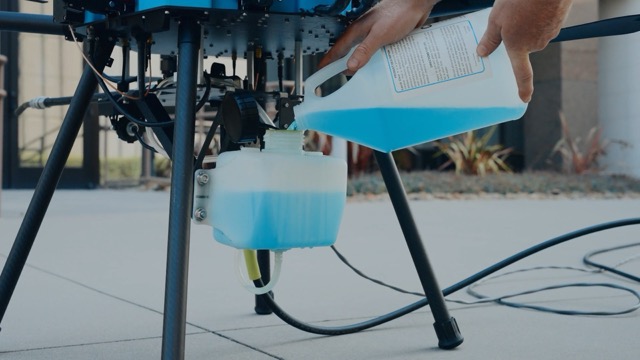
Connect the water source and verify pressure and flow. Set up the chemical mixing station using the dilution ratios calculated the night before. Connect and pressure test all hose connections before the drone is in the air. Prime the pump system and verify spray patterns are correct. Position hose routing guides and weights along the planned path.
Drone Preparation (5 Minutes)
Inspect the drone for any damage or loose connections from transport. Install a fully charged battery and verify all systems. Calibrate the controller and confirm communication link. Attach the cleaning payload and test spray operation on the ground. Complete pre-flight safety checks.
Safety Zone Establishment (5 Minutes)
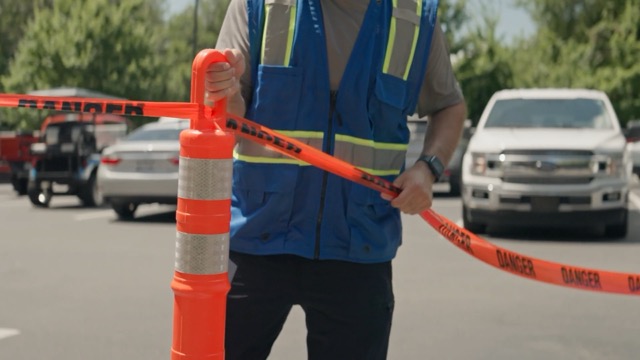
Mark the operational area with cones and tape in a perimeter that keeps uninvolved people clear of the flight path and the chemical application zone. Brief any bystanders on safety procedures. Confirm emergency contacts are accessible. Verify weather conditions are within operational limits. Make the explicit go or no-go decision before any aircraft leaves the ground.
Phase 3: Real-Time Operations
During operations, professional operators are tracking four categories simultaneously. Safety means monitoring bystander positions, watching chemical drift patterns as wind conditions shift, and maintaining emergency readiness throughout the job. Efficiency means tracking time per section against the estimate, monitoring battery consumption against coverage progress, and adjusting hose management to minimize transition time between sections. Quality means watching surface response to confirm chemistry is performing at the expected rate, verifying even coverage across each section, and assessing rinse effectiveness before moving to the next area. Data means annotating times and observations as you go rather than reconstructing from memory after the job.
The most important habit in real-time operations is asking questions rather than assuming. Is the chemistry working at the expected speed? Is coverage even? Is drift increasing? Are we on pace? Is the hose management adding time? Operators who ask these questions during the job adjust in real time. Operators who do not ask them discover the answers during the customer walkthrough, when it is more complicated to fix.
Phase 4: Customer Walkthrough Before Teardown
The walkthrough must happen before equipment is broken down. This is not optional. Once the equipment is packed and the drone is in the vehicle, your ability to address any quality concerns immediately is gone. While the equipment is still deployed, walk every cleaned surface with the customer present. Review the results together. Address any areas that need additional attention right then, while you can still respond to them. Document customer satisfaction and capture any sign-off on the completed work. This is also the best moment to collect a testimonial quote, when the result is visible, the client is satisfied, and the goodwill is at its highest point.
Phase 5: System Cleanup and Equipment Care
System cleanup is not an afterthought. It is equipment maintenance that directly affects the reliability of the next job. Flush the pump and hose system with clean water and continue flushing until the water runs completely clear. Run water through the entire payload system. Operate the diverter valve multiple times to clear any chemical residue from the lines. Empty the system and allow it to air dry rather than sealing residual moisture inside.
Post-flight drone care takes about three minutes and is worth every second. Spray the aircraft down with clean water, paying particular attention to the front motors and any areas with direct chemical exposure. Wipe down all surfaces. Check for any new damage or wear points that appeared during the job. Inspect all connection points. Document anything that needs attention before the next deployment.
Before departing the site, pack all equipment using the checklist rather than from memory. Remove all cones, tape, and safety signage. Confirm no chemical residue or debris has been left on the property. Complete any final customer communication and confirm the next scheduling touchpoint. Process the invoice or payment.
Phase 6: Follow-Up Within 24 Hours
The follow-up phase is where single jobs become recurring relationships. Within 24 hours of job completion, send the customer a completion notification that includes before-and-after photos from the job. This is both a quality confirmation and a marketing asset that demonstrates your documentation discipline. Request feedback and a testimonial if the customer has not already provided one. Schedule a follow-up check-in within the week to confirm satisfaction and address any post-job questions.
Use the follow-up conversation to discuss ongoing maintenance scheduling. A customer who just saw a dramatic before-and-after result is in the best possible frame of mind to commit to a recurring maintenance plan. Propose one directly rather than waiting for them to ask. A building that gets cleaned once and then deteriorates back to its previous condition over the next year is a missed opportunity. A building on a regular maintenance cycle is a recurring revenue relationship.
Phase 7: Continuous Improvement
The workflow improves through deliberate review, not just through repetition. Every week, analyze completed jobs for efficiency opportunities, review any customer feedback, update checklists based on field experience, and plan upcoming equipment maintenance. Every month, compare actual job times and costs against estimates, review customer satisfaction patterns, evaluate pricing against real operational data, and plan for capacity or equipment needs.
The operators who build this review habit into their weekly and monthly routines are not just getting better at individual jobs. They are building an operation that compounds: better estimates, better pricing, better training material for new crew members, and a documented track record that supports the kind of growth that requires bringing other people into the process.
The Big Takeaway
A repeatable job-day workflow does not just prevent problems. It makes the business scalable. When operations are standardized, quality becomes predictable, training becomes straightforward, and customers feel confident hiring you again without needing to re-evaluate the decision each time. Build the workflow. Run it consistently. Let the system produce the results that your reputation gets built on.
.jpg)